Are Tips and Gratuities Taxable in Canada?

If you work in a restaurant, drive for a ride-share service, deliver food, work at a hotel, or do any job where customers leave you extra money as a thank-you, that money counts as income in Canada. Tips and gratuities are taxable, and you are required to report them.
Many workers are not aware of this obligation, or they assume that cash tips do not need to be declared. This guide explains what the rules are, how tips are categorized, and what both employees and employers need to do.
Are Tips Taxable in Canada?
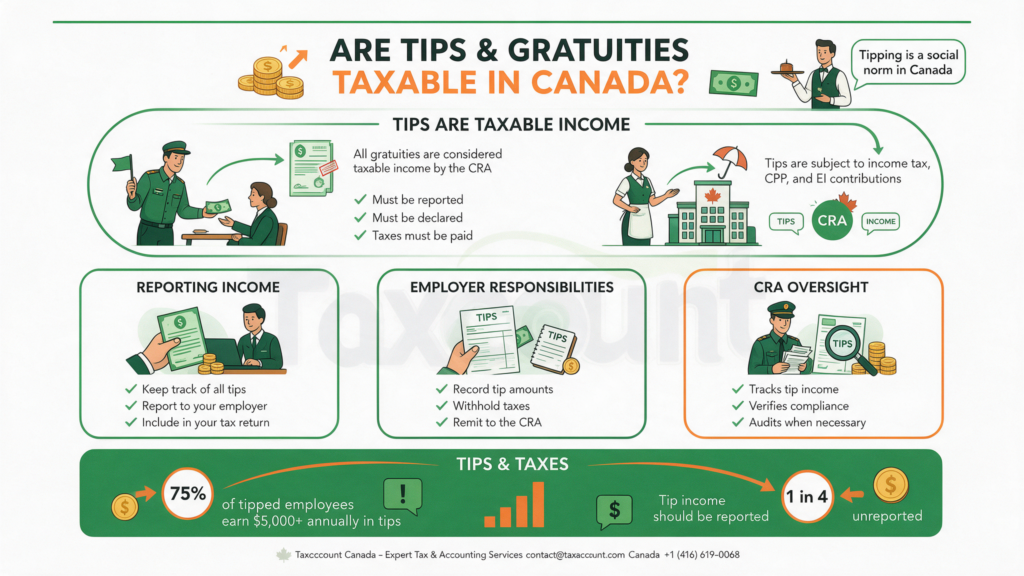
Yes. Tips and gratuities are considered employment income or self-employment income in Canada and must be included on your tax return. The Canada Revenue Agency (CRA) is clear on this point: all tips received in the course of employment are taxable.
Book a free consultation
☎️ Get HelpThis includes:
- Cash tips left on a table
- Tips added to a debit or credit card payment
- Tips pooled and distributed among staff
- Gratuities added automatically to a restaurant bill
- Tips received by delivery drivers or service workers
Types of Tips: Controlled vs. Direct
The CRA distinguishes between two types of tips:
1. Controlled Tips
Controlled tips are amounts that your employer has some influence over. The employer collects the tip, then distributes it to employees. An example is when a restaurant adds a mandatory service charge and then distributes it among the staff.
Because the employer controls these tips, they are treated like regular wages. The employer must:
- Include the controlled tips on the employee’s T4 slip (in Box 14, employment income)
- Withhold income tax on them
- Deduct CPP contributions
- Deduct EI premiums
2. Direct Tips
Direct tips are amounts customers give directly to the employee, without the employer’s involvement. A server receiving a cash tip from a customer is the most common example. Tips left on a card that the employer passes through to the employee at face value are also generally treated as direct tips.
For direct tips, the employer is not involved in the transaction and has no legal obligation to report or remit taxes on them. However, the employee must report direct tips as income on their personal tax return.
Employer Obligations for Controlled Tips
If tips pass through the employer’s hands:
- They must be included in the employee’s T4 in the year they were distributed
- All mandatory payroll deductions apply (income tax, CPP, EI)
- The employer remits these to the CRA just like regular payroll
This means tipped employees receiving controlled tips will see them on their T4 and they are automatically captured in their tax return.
Employee Obligations for Direct Tips
For direct tips, employees are responsible for tracking and reporting them. Here is what to do:
1. Keep a record of the tips you receive
Maintain a daily or weekly log of your tip income. Write down the date, amount received, and any relevant details. This is your documentation in case the CRA ever asks.
2. Report the total on your tax return
Add your total direct tips to your other employment income. You report this on Line 10400 (Other employment income) of your T1 return.
3. Include tips when calculating your net income
Tips are part of your total income, which affects your eligibility for benefits, RRSP room, and other income-tested programs.
What Counts as Insurable Earnings for EI?
Controlled tips are insurable earnings and subject to EI premiums (both employee and employer portions).
Direct tips are generally not insurable earnings because the employer is not paying them — the customer is. This means EI premiums do not apply to direct tips. However, this also means direct tips do not count toward your insurable hours for EI purposes.
CPP Contributions on Tips
CPP contributions apply to controlled tips since they are treated as employment income by the employer.
For direct tips, CPP generally does not apply through the payroll system since the employer is not the payer. However, if tips are treated as self-employment income (which is uncommon but possible in certain situations), the individual would be responsible for CPP as a self-employed person.
What Happens If Tips Are Not Reported?
Not reporting tips is a form of tax evasion. If the CRA discovers unreported tip income, it will:
- Reassess your tax return and add the income
- Charge interest on the taxes owed
- Apply gross negligence penalties if the unreported amount is significant
The CRA uses various tools to identify unreported tip income, including comparisons between your reported income and your lifestyle, data from payment processors, and industry benchmarks for businesses like restaurants.
Table of Summary
| Tips and Gratuities Topic | Key Information |
|---|---|
| Are Tips Taxable in Canada? | Yes. Tips and gratuities are taxable income and must be reported on your tax return, whether received in cash, by card, through a tip pool, or as an automatic service charge. |
| Types of Tips | The CRA distinguishes between controlled tips, which employers influence or distribute, and direct tips, which customers give to employees without employer involvement. |
| Controlled Tips | Tips collected and distributed by an employer are treated like regular wages and are subject to applicable payroll deductions. |
| Direct Tips | Tips received directly from customers are generally not processed through employer payroll. Employees are responsible for tracking and reporting these amounts as income. |
| Employer Reporting Responsibilities | Employers must include controlled tips on employees’ T4 slips, withhold applicable income tax, CPP contributions, and EI premiums, and remit the deductions to the CRA. |
| T4 Reporting | Controlled tips are included in employment income in Box 14 of the T4 slip for the year they are distributed. |
| Reporting Direct Tips | Employees must keep records of direct tips and report the total on Line 10400 (Other employment income) of their T1 tax return, as explained in the article. |
| Cash Tips | Cash tips are taxable even if the employer does not record or process them. Employees must track and declare this income. |
| Credit and Debit Card Tips | Tips added to card payments are taxable. Their classification depends on whether the employer controls or distributes the amounts. |
| Pooled Tips | If the employer controls the tip pool and distributes the money, the tips are generally controlled tips. Employee-managed pools without employer involvement may be treated as direct tips, requiring each employee to report their share. |
| EI on Controlled Tips | Controlled tips are generally insurable earnings and subject to EI premiums for both the employee and employer. |
| EI on Direct Tips | Direct tips are generally not insurable earnings because the employer does not pay them. They generally do not count toward insurable hours for EI purposes. |
| CPP on Controlled Tips | CPP contributions apply to controlled tips because they are treated as employment income processed through payroll. |
| CPP on Direct Tips | Direct tips generally do not have CPP deducted through payroll. If tips are treated as self-employment income in certain circumstances, the individual may be responsible for CPP as a self-employed person. |
| Ride-Share and Delivery Tips | Tips received through ride-share or delivery platforms are taxable. Workers treated as self-employed generally report these amounts as business income. |
| Impact on Benefits and RRSP Room | Reported tips contribute to total income and can affect eligibility for income-tested benefits and RRSP contribution room. |
| Consequences of Not Reporting Tips | The CRA may reassess a return, add unreported income, charge interest on unpaid taxes, and apply gross negligence penalties in significant cases. |
| CRA Tip Income Reviews | The CRA may compare reported income with industry benchmarks, lifestyle information, and payment processor data to identify possible discrepancies. |
| Record-Keeping | Maintain a daily or weekly log of tips, including dates, amounts, and relevant details, to support accurate reporting and respond to CRA questions. |
| Professional Tax Assistance | A tax professional can help determine how tips should be reported, understand payroll obligations, and reduce the risk of errors or CRA penalties. |
Frequently Asked Questions
I only receive cash tips. Do I still have to report them?
Yes. Cash tips are still taxable. You are required to keep a record and include them in your income for the year.
What if my employer pools tips and gives me a share? Who reports it?
If the employer controls the pool and distributes it, those are controlled tips and the employer includes them on your T4. If a tip pool is organized by employees themselves without employer involvement, it may still count as direct tips, and each employee must report their share individually.
I work for a ride-share company. Are my tips taxable?
Yes. Tips from passengers through apps like Uber or Lyft are taxable income. Since you are typically treated as self-employed for ride-share work, you report all income including tips as business income on your return.
How does the CRA know how much I earned in tips?
In some cases they may not know exactly. However, the CRA can compare your reported income to industry standards, your lifestyle, or data from payment processors. If there is a significant discrepancy, your return may be flagged for review.
Conclusion
Tips and gratuities are fully taxable in Canada. Whether you receive them in cash or through a payment system, you are responsible for reporting them. Controlled tips handled by the employer are automatically captured on your T4. Direct tips are your personal responsibility to track and declare.
Good record-keeping makes this straightforward. Keep a daily log of what you receive, and make sure to include your tip income when you file your return each year.
How Taxccount Canada Can Help
Reporting tip income correctly is important for employees and business owners, particularly when a workplace uses tip pools or employer-managed gratuities.
Taxccount Canada can help individuals understand how to report employment income, review T4 information, and prepare personal tax returns. We also support businesses with payroll compliance, bookkeeping, and tax reporting.
Contact Taxccount Canada to book a free consultation and discuss your tax or payroll questions.
Book a free consultation with Taxccount today
☎️ Get HelpThis is general information only and not professional advice. Consult a professional before acting.
 Written and fact-checked by Udit Gupta
 Written and fact-checked by
Ex Big4, Ernst & Young, Deloitte | International & Cross-Border Tax Specialist | CPA Canada In Depth Tax Training | Licensed Chartered Accountant from ICAI & MIA
Udit Gupta has over 15 years of experience helping corporations & business owners with corporate structuring, corporate tax filing, bookkeeping, payroll, GST/HST, cross-border tax and CRA representation. Big 4 trained at Ernst & Young and Deloitte, and qualified as a Chartered Accountant in India and Malaysia, he founded accounting firm in 2014 to serve entrepreneurs, startups and non-resident business owners across Canada. View Full Member Bio.
Indian Institute of Chartered Accountant Member No. (521458) | Malaysian Institute of Accountants Membership number (CA 44667) | Ex Big4,Ex Ernst & Young (EY), Ex-Deloitte | CPA Canada In-Depth Tax Training 19 Dec 2023, 12 Jul 2022, 5 Jul 2023
Editorial policy. Every article is researched against primary sources — the Income Tax Act, CRA publications and CPA Canada.