Payroll Deductions in Canada: A Guide for Employers and Employees

Every time you receive a paycheque in Canada, you will notice deductions taken before you get your take-home pay. These are called payroll deductions. They are required by law, and employers are responsible for calculating and remitting them to the Canada Revenue Agency (CRA).
This guide explains what payroll deductions are, what must be withheld, and what employers and employees both need to know.
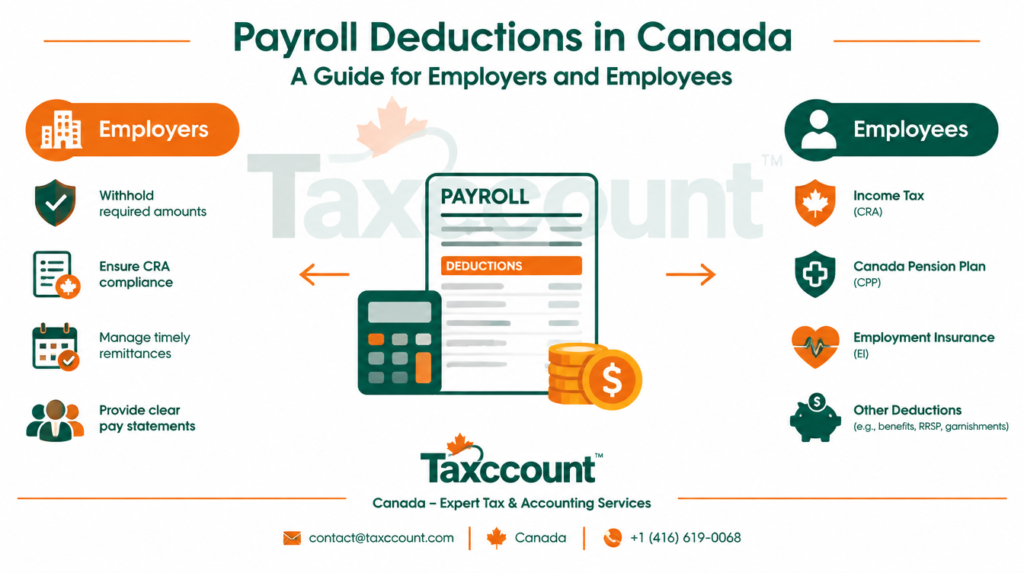
What Are Payroll Deductions?
Payroll deductions are amounts withheld from an employee’s pay by the employer on behalf of the government. The money is sent directly to the CRA (and in Quebec, Revenu Quebec) instead of being paid to the employee.
Think of it as the government collecting taxes gradually throughout the year, rather than in one large payment when you file your return.
Book a free consultation
☎️ Get HelpThe Three Mandatory Deductions
There are three main deductions that employers must withhold from employee pay:
1. Federal and provincial income tax
2. Canada Pension Plan (CPP) contributions
3. Employment Insurance (EI) premiums
These are statutory deductions. Employers have no choice but to make them. Failing to do so can result in serious penalties.
Income Tax Withholding
Employers withhold federal and provincial income tax from each employee’s pay based on:
- The employee’s expected annual income
- The claims the employee has made on their TD1 form (Personal Tax Credits Return)
- The pay frequency (weekly, bi-weekly, monthly, etc.)
The TD1 form is filled out by employees when they start a job and whenever their personal situation changes. It tells the employer which personal tax credits to apply when calculating how much income tax to withhold.
The more credits an employee claims, the less tax is withheld each period. If too little is withheld, the employee will owe a balance when they file their return.
Canada Pension Plan (CPP) Contributions
CPP is Canada’s retirement pension program. Both employees and employers contribute to CPP on each paycheque.
Key facts about CPP contributions:
- Contributions apply to earnings above the basic exemption (currently $3,500 per year)
- There is a maximum annual contribution limit set each year
- Employees contribute a percentage of their pensionable earnings
- Employers match the employee’s contribution dollar for dollar
- Self-employed individuals pay both the employee and employer portions themselves
CPP2 was introduced as a second, enhanced CPP contribution on earnings above the first ceiling. Both employees and employers also match CPP2 contributions on the eligible portion.
Employment Insurance (EI) Premiums
EI provides temporary income support for workers who lose their jobs, take parental leave, or cannot work due to illness or caregiving responsibilities.
Key facts about EI premiums:
- Employees pay a premium based on their insurable earnings
- Employers pay 1.4 times the employee’s premium (the employer premium rate is higher)
- There is a maximum insurable earnings amount set each year
- Earnings above that ceiling are not subject to EI premiums
Some workers are exempt from EI, such as incorporated business owners who control more than 40% of the voting shares and certain family members of the employer in a non-arm’s-length situation.
Employer Responsibilities
Employers have several important obligations:
1. Obtain a payroll account with the CRA (a business number with an RP suffix)
2. Collect completed TD1 forms from each new employee
3. Calculate deductions correctly for each pay period
4. Withhold and remit deductions to the CRA on schedule
5. Issue T4 slips to employees by the last day of February following the tax year
6. File the T4 Summary with the CRA at the same time
If an employer fails to withhold, remit, or report properly, the CRA can hold the employer personally liable. Directors of a corporation can also be personally liable for unremitted payroll deductions.
How to Calculate Payroll Deductions
The CRA provides a free online calculator called the Payroll Deductions Online Calculator (PDOC). Employers can enter an employee’s pay information and the tool calculates the exact amounts to withhold.
Alternatively, employers can use the CRA’s paper tax tables (Payroll Deductions Tables, also called T4032) or payroll software to handle the calculations automatically.
Remittance to the CRA
Employers must send the deductions they collect to the CRA by specific due dates. The frequency depends on the size of the employer:
- Regular remitters: Remit by the 15th of the month following the payroll period
- Quarterly remitters: Small employers (typically with average monthly remittances under a threshold) can remit quarterly
- Accelerated remitters: Large employers must remit more frequently — some as often as the next banking day after payroll
Missing a remittance deadline results in penalties ranging from 3% to 10% of the amount owing, depending on how late the payment is. Repeated failures attract higher penalties.
Table of Summary
| Payroll Deductions Topic | Key Information |
|---|---|
| What Are Payroll Deductions? | Amounts withheld from an employee’s pay by the employer and remitted to the CRA or, in Quebec, Revenu Québec. These payments help cover taxes and government contributions throughout the year. |
| Three Mandatory Deductions | The three main statutory deductions are federal and provincial income tax, Canada Pension Plan (CPP) contributions, and Employment Insurance (EI) premiums. |
| Income Tax Withholding | Employers calculate income tax deductions based on the employee’s expected annual income, TD1 tax credit claims, and pay frequency. |
| TD1 Form | Employees complete the Personal Tax Credits Return when starting a job and when their personal circumstances change. The information helps employers determine how much income tax to withhold. |
| CPP Contributions | Employees and employers contribute to CPP based on eligible pensionable earnings. Contributions apply above the basic annual exemption, stated in the article as $3,500, subject to annual limits. |
| Employer CPP Contributions | Employers generally match the employee’s CPP contribution dollar for dollar. |
| CPP2 Contributions | CPP2 provides additional pension contributions on eligible earnings above the first earnings ceiling. Both employees and employers contribute to CPP2. |
| Self-Employed CPP Contributions | Self-employed individuals generally pay both the employee and employer portions of CPP contributions. |
| Employment Insurance (EI) | EI provides temporary income support for eligible workers who lose their jobs or cannot work because of illness, parental leave, or caregiving responsibilities. |
| EI Premiums | Employees pay EI premiums on insurable earnings, while employers generally contribute 1.4 times the employee’s premium. Annual maximum insurable earnings limits apply. |
| EI Exemptions | Certain workers may be exempt from EI, including some incorporated business owners who control more than 40% of voting shares and certain family members in non-arm’s-length employment situations. |
| CRA Payroll Account | Employers must establish a CRA payroll account, identified by a business number with an RP suffix, to manage payroll deductions and remittances. |
| Employer Responsibilities | Employers must collect TD1 forms, calculate deductions correctly, remit amounts on time, issue T4 slips by the end of February following the tax year, and file the T4 Summary. |
| Calculating Payroll Deductions | Employers can use the CRA Payroll Deductions Online Calculator (PDOC), official payroll deduction tables (T4032), or payroll software. |
| Regular Remittance Schedule | Regular remitters generally send payroll deductions to the CRA by the 15th of the month following the payroll period. |
| Quarterly Remitters | Eligible small employers may be permitted to remit payroll deductions quarterly, subject to CRA requirements. |
| Accelerated Remitters | Larger employers may have to remit more frequently, with some payments due as soon as the next banking day after payroll. |
| Late Remittance Penalties | Missing remittance deadlines can result in penalties ranging from 3% to 10% of the amount owing, depending on how late the payment is. Repeated failures may attract higher penalties. |
| Other Payroll Deductions | Employers may deduct items such as group benefit premiums, union dues, or pension contributions when applicable. Voluntary deductions generally require the employee’s written consent. |
| Part-Time Employees | Payroll deduction rules also apply to part-time employees, subject to the relevant income thresholds, contribution limits, and exemptions. |
| Failure to Remit Deductions | Employers may face penalties and interest for failing to remit withheld amounts. Corporate directors may also be held personally liable for unremitted payroll deductions. |
| Professional Payroll Assistance | Tax and accounting professionals can help businesses calculate deductions, manage remittances, issue payroll slips, and maintain CRA compliance. |
Frequently Asked Questions
What is a TD1 form and when does an employee need to fill one out?
A TD1 is a Personal Tax Credits Return that employees complete to indicate their personal tax credit amounts. Employees fill it out when they start a new job, move to a new province, or when their personal situation changes (such as getting married, having a child, or turning 65).
Can an employer deduct other things from an employee’s pay?
Beyond the three statutory deductions, employers can withhold amounts the employee has agreed to, such as group benefit plan premiums, union dues, or pension plan contributions. But any voluntary deductions require the employee’s written consent.
What happens if an employer does not remit payroll deductions to the CRA?
The CRA takes unremitted payroll deductions very seriously. The employer faces penalties and interest. In cases of intentional or repeated non-compliance, directors of the corporation can be held personally responsible for the entire amount owed.
Do employers have to deduct taxes for part-time employees?
Yes. The same deduction rules apply to part-time employees. The amounts may be smaller due to lower earnings, but income tax, CPP, and EI still apply (subject to their respective thresholds and exemptions).
Conclusion
Payroll deductions are a shared responsibility between employers and employees. Employees need to understand what is being taken from their pay and why. Employers need to handle the calculations and remittances correctly to avoid penalties.
If you are an employer setting up payroll for the first time, or an employee who wants to understand your paycheque better, the CRA’s online tools and a tax professional can both be valuable resources.
How Taxccount Canada Can Help
Payroll rules can be complicated, especially when your business hires its first employee, offers taxable benefits, or needs to correct a payroll filing.
Taxccount Canada supports businesses with payroll calculations, source deduction tracking, remittance preparation, bookkeeping, and tax compliance. Our team can help you understand your responsibilities and organize payroll records so you can focus on running your business.
Contact Taxccount Canada to book a free consultation and discuss your payroll and accounting needs.
Book your free consultation today
☎️ Get HelpThis is general information only and not professional advice. Consult a professional before acting.
 Written and fact-checked by Udit Gupta
 Written and fact-checked by
Ex Big4, Ernst & Young, Deloitte | International & Cross-Border Tax Specialist | CPA Canada In Depth Tax Training | Licensed Chartered Accountant from ICAI & MIA
Udit Gupta has over 15 years of experience helping corporations & business owners with corporate structuring, corporate tax filing, bookkeeping, payroll, GST/HST, cross-border tax and CRA representation. Big 4 trained at Ernst & Young and Deloitte, and qualified as a Chartered Accountant in India and Malaysia, he founded accounting firm in 2014 to serve entrepreneurs, startups and non-resident business owners across Canada. View Full Member Bio.
Indian Institute of Chartered Accountant Member No. (521458) | Malaysian Institute of Accountants Membership number (CA 44667) | Ex Big4,Ex Ernst & Young (EY), Ex-Deloitte | CPA Canada In-Depth Tax Training 19 Dec 2023, 12 Jul 2022, 5 Jul 2023
Editorial policy. Every article is researched against primary sources — the Income Tax Act, CRA publications and CPA Canada.