How Are Dividends Taxed in Canada?

Dividends are a common form of investment income in Canada. Their tax treatment differs from employment income because Canadian dividends may benefit from the dividend gross-up and dividend tax credit system. Understanding these rules can make tax filing easier and help investors and business owners plan their income more effectively.
What Are Dividends?
A dividend is a payment made by a corporation to its shareholders from corporate profits. If you receive taxable dividends from a Canadian corporation, the income generally needs to be reported on your T1 personal income tax return.
An accountant for taxes or professional tax return filing services can help ensure dividend income and available tax credits are properly reported.
Get Dividend Tax Help
☎️ Get HelpHow Dividend Taxation Works in Canada
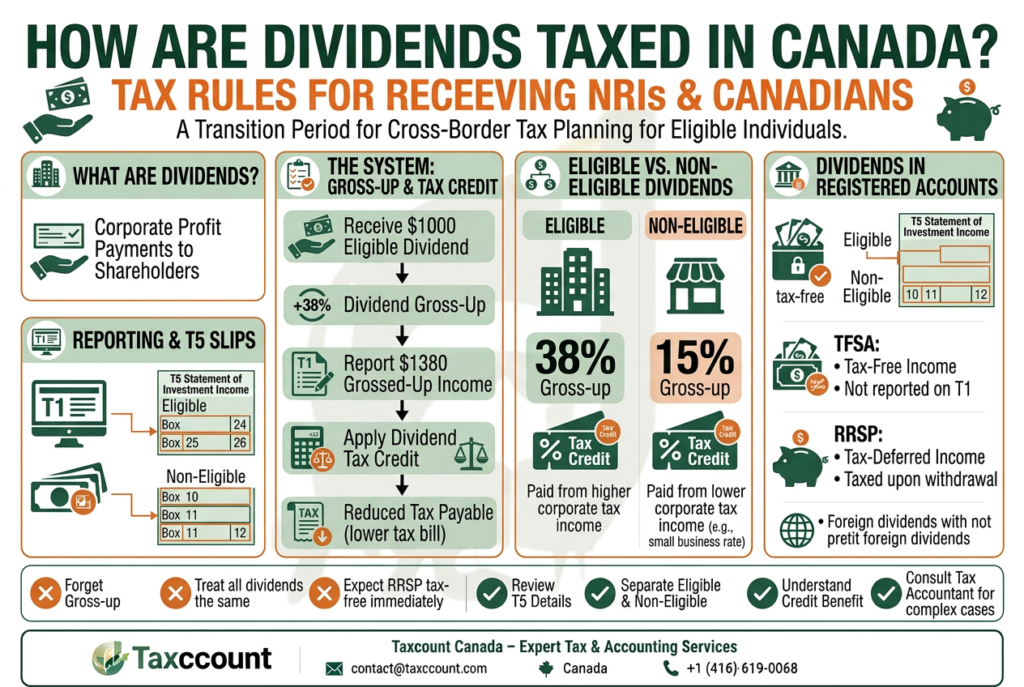
Canada uses a dividend gross-up and tax credit system designed to recognize corporate income tax already paid before profits are distributed to shareholders.
For example, if you receive a $1,000 eligible dividend:
- The dividend is grossed up by 38%.
- $1,380 is included as taxable dividend income.
- The applicable dividend tax credit is calculated.
- The credit reduces federal and provincial tax otherwise payable.
Your final tax rate depends on factors such as your total taxable income, province or territory of residence and the type of dividend received.
Eligible vs. Non-Eligible Dividends
Canadian dividends are generally classified as eligible or non-eligible dividends.
Eligible dividends are generally paid from corporate income taxed at higher corporate tax rates. They receive a 38% gross-up and a higher dividend tax credit.
Non-eligible dividends are commonly paid by Canadian-controlled private corporations from income benefiting from lower corporate tax rates, such as the small business rate. They generally receive a 15% gross-up and a lower dividend tax credit.
This distinction is particularly relevant for incorporated business owners considering salary and dividend compensation.
How to Report Dividends on Your Tax Return
Dividend information is generally reported using the amounts shown on your tax slips. Eligible and non-eligible dividends are reported separately on the T1 return.
Tax software generally calculates the applicable taxable amount and dividend tax credit based on the information entered from your slips.
If you have several investments or receive dividends from your corporation, professional tax and accounting services can help with accurate tax filing.
T5 Slips and Dividends
Canadian dividend income is commonly reported on a T5 Statement of Investment Income. Important boxes can include:
- Box 24: Actual amount of eligible dividends
- Box 25: Taxable amount of eligible dividends
- Box 26: Dividend tax credit for eligible dividends
- Box 10: Actual amount of other than eligible dividends
- Box 11: Taxable amount of other than eligible dividends
- Box 12: Dividend tax credit for other than eligible dividends
Keep your T5 slips with your tax records when preparing your return.
Dividends in a TFSA or RRSP
Canadian dividends earned inside a TFSA are generally tax-free and are not reported as taxable income on your personal return.
Income earned inside an RRSP is generally tax-deferred. Tax is normally payable when funds are withdrawn from the RRSP.
Special rules can apply to foreign dividends held in registered accounts, so the type and source of an investment should also be considered.
Table of Summary
| Section | Easy Information |
|---|---|
| 1. Topic | The article explains how dividends are taxed in Canada, including the dividend gross-up, dividend tax credit, and reporting requirements. |
| 2. How Dividend Taxation Works | Canadian dividends may receive special tax treatment through the gross-up and dividend tax credit system, which recognizes corporate tax already paid before profits are distributed. |
| 3. Eligible Dividends | Eligible dividends generally receive a 38% gross-up and a higher dividend tax credit. The final tax depends on your income and province or territory of residence. |
| 4. Non-Eligible Dividends | Non-eligible dividends generally receive a 15% gross-up and a lower dividend tax credit. They are commonly paid by Canadian-controlled private corporations from income taxed at lower corporate rates. |
| 5. Reporting Dividends | Taxable Canadian dividends are generally reported on your T1 personal income tax return using amounts shown on your tax slips. Eligible and non-eligible dividends are reported separately. |
| 6. T5 Slip | Dividend information is commonly reported on a T5 Statement of Investment Income. Important boxes include 10, 11, 12, 24, 25 and 26 for actual dividends, taxable amounts and dividend tax credits. |
| 7. Dividends in a TFSA | Canadian dividends earned inside a TFSA are generally tax-free and are not reported as taxable income on your personal tax return. |
| 8. Dividends in an RRSP | Investment income earned within an RRSP is generally tax-deferred. Tax is normally payable when money is withdrawn from the RRSP. |
| 9. Dividend Tax Credit | The dividend tax credit helps reduce double taxation by recognizing corporate income tax already paid on profits before they are distributed to shareholders. |
| 10. Key Takeaway | Dividend taxation depends on the type of dividend, total taxable income, province or territory, and the account holding the investment. Proper reporting can help ensure available dividend tax credits are claimed. |
Frequently Asked Questions
Are dividends taxable in Canada?
Yes. Taxable dividends received outside registered plans generally need to be reported on your income tax return.
Are eligible dividends taxed differently?
Yes. Eligible dividends generally receive a higher gross-up and dividend tax credit than non-eligible dividends.
Do I report dividends from a TFSA?
Canadian dividend income earned within a TFSA is generally not reported as taxable income.
What is the dividend tax credit?
The dividend tax credit recognizes corporate income tax already paid and helps reduce double taxation of Canadian corporate profits distributed to shareholders.
Where can I find my dividend income?
Dividend information from Canadian investments is commonly reported on a T5 slip provided by the payer or financial institution.
Are RRSP dividends taxable immediately?
Generally, no. Investment income earned within an RRSP is tax-deferred, while withdrawals are generally included in taxable income.
Do I need a tax accountant for dividend income?
Simple dividend reporting may be straightforward, but tax accountants can be useful when you have multiple investments, corporate dividends or more complex tax circumstances.
Receive Investment Income? Let Taxccount Canada Help
Taxccount Canada provides tax and accounting services and tax return filing services for investors, individuals and business owners. We can help accurately report dividend income, review applicable dividend tax credits and complete your Canadian tax filing.
Need help with dividend income or your personal tax return? Contact Taxccount Canada for professional tax assistance.
Talk to a Tax Expert
☎️ Get HelpThis is general information only and not professional advice. Consult a professional before acting.
 Written and fact-checked by Udit Gupta
 Written and fact-checked by
 Ex Big4, Ernst & Young, Deloitte | International & Cross-Border Tax Specialist | CPA Canada In Depth Tax Training | Licensed Chartered Accountant from ICAI & MIA
Udit Gupta has over 15 years of experience helping corporations & business owners with corporate structuring, corporate tax filing, bookkeeping, payroll, GST/HST, cross-border tax and CRA representation. Big 4 trained at Ernst & Young and Deloitte, and qualified as a Chartered Accountant in India and Malaysia, he founded accounting firm in 2014 to serve entrepreneurs, startups and non-resident business owners across Canada. View Full Member Bio.
Indian Institute of Chartered Accountant Member No. (521458) | Malaysian Institute of Accountants Membership number (CA 44667) | Ex Big4,Ex Ernst & Young (EY), Ex-Deloitte | CPA Canada In-Depth Tax Training 19 Dec 2023, 12 Jul 2022, 5 Jul 2023
Editorial policy. Every article is researched against primary sources — the Income Tax Act, CRA publications and CPA Canada.