Tax Deductions for Nurses in Canada: What You Can Claim

Nurses across Canada work incredibly hard, and many spend their own money on work-related expenses. The good news is that Canadian tax law allows employees — including nurses — to deduct certain work-related costs from their income, as long as the right conditions are met.
This guide covers the most common tax deductions available to nurses working in Canada, whether you are a registered nurse (RN), registered practical nurse (RPN), nurse practitioner (NP), or another nursing professional.
Employment Expenses vs. Self-Employment Expenses
First, it is important to know your working situation:
- If you are an employee (receiving a T4), you can claim certain employment expenses using Form T777 (Statement of Employment Expenses). Your employer must sign a T2200 form confirming that you are required to pay for certain expenses as part of your employment.
- If you are self-employed or an agency nurse who is treated as self-employed, you file business income and can deduct a broader range of expenses on your self-employment schedule.
Most hospital-based nurses are employees. However, agency nurses may be treated as self-employed depending on their work arrangement.
Let Taxccount help you file correctly and save money
☎️ Get HelpLicensing and Professional Fees
Nurses are required to pay annual registration or licensing fees to a regulatory body to maintain their licence. For example, in Ontario, nurses pay fees to the College of Nurses of Ontario (CNO).
These fees are deductible on Line 21200 of your T1 return as professional membership dues. This applies as long as the fees are required to maintain your professional standing and your ability to work.
Continuing Education and Training
Nurses often take training courses, attend workshops, or complete certifications to keep their skills current. Whether these are deductible depends on the circumstances.
For employed nurses:
If your employer requires you to take specific training as a condition of your employment, those costs may be deductible as a T777 expense — but only if your T2200 confirms it.
In other cases, continuing education may qualify as a tuition tax credit if the institution is a qualifying educational institution. Costs like textbooks may also be eligible.
For self-employed nurses:
Courses directly related to your nursing practice and needed to earn your income are generally deductible as business expenses.
Uniforms and Footwear
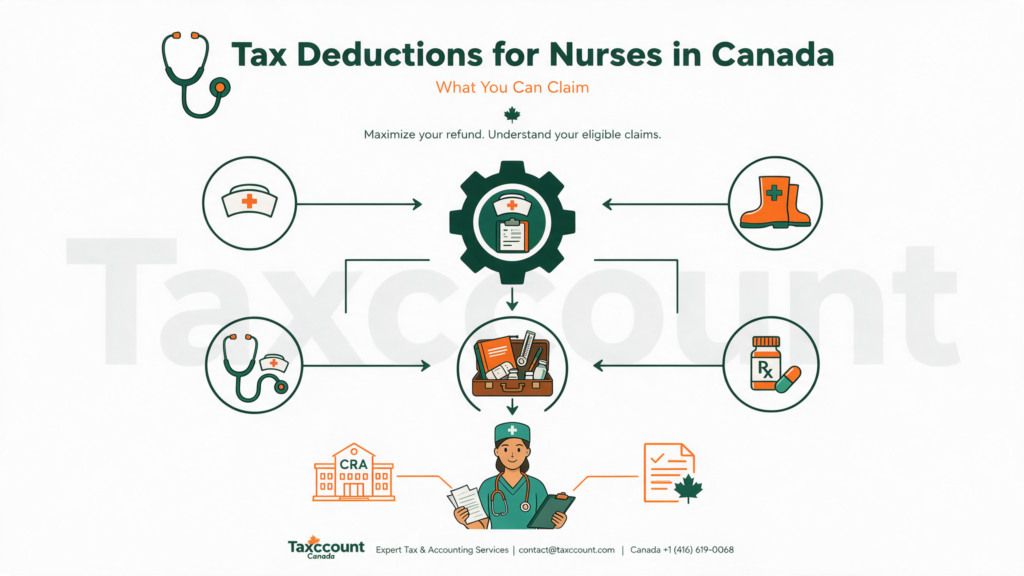
Special clothing required for work — like scrubs or non-slip footwear that can only be used at work — may be deductible as a T777 employment expense if your employer requires you to provide it yourself and your T2200 confirms this.
However, general clothing that could be worn outside of work is not deductible, even if you only wear it for work.
Tools and Supplies
Some nurses buy their own tools, such as a stethoscope, medical equipment, or specific devices needed for patient care. If your employer requires you to provide these at your own cost, they may be deductible as employment expenses on Form T777.
Keep all receipts and make sure the T2200 from your employer confirms the requirement.
Home Office Expenses
Nurses who work primarily from a home office — which is less common but relevant for some nurse practitioners, clinical educators, or those doing administrative nursing work — may be able to claim home office expenses.
To qualify:
- The home office must be your primary place of work, OR
- You must use the space exclusively to meet patients or clients on a regular and ongoing basis
- Your employer must confirm this on the T2200
Eligible home office expenses include a portion of rent, electricity, heating, and internet costs, based on the percentage of your home used for work.
Vehicle Expenses for Nurses
If you are required to travel between different work locations (such as between a hospital and a clinic, or between patient homes in a home care nursing role), you may be able to claim vehicle expenses.
You cannot claim the commute from your home to your main workplace. But travel between job sites during your working day is generally deductible.
You must keep a vehicle log showing dates, destinations, and distances traveled for work.
Eligible vehicle expenses include:
- Fuel
- Insurance
- Maintenance and repairs
- Licence and registration
- Depreciation (Capital Cost Allowance)
You deduct a proportion based on the percentage of your total kilometers driven that were for work.
Union Dues
Many nurses belong to nursing unions like the Ontario Nurses’ Association or CUPE. Union dues paid in the year are deductible on Line 21200 of your T1 return, just like professional licensing fees.
Check your T4 slip, as union dues may already be reported in Box 44 and automatically available for deduction.
Other Common Deductions
- Malpractice insurance: Premiums paid for liability or malpractice insurance as part of your nursing practice may be deductible if required by your employer.
- Professional publications: Nursing journals or reference materials required for your work may be deductible if you are self-employed.
- Parking at work: Generally not deductible as an employment expense unless it is required to travel between different work locations.
Table of Summary
| Tax Deduction Topic | Key Information |
|---|---|
| Tax Deductions for Nurses in Canada | Nurses may claim eligible work-related expenses depending on their employment status and applicable tax requirements. |
| Eligible Nursing Professionals | Registered nurses (RNs), registered practical nurses (RPNs), nurse practitioners (NPs), and other nursing professionals may qualify. |
| Employees vs. Self-Employed Nurses | Employees receiving a T4 may claim eligible employment expenses using Form T777, while self-employed nurses may deduct eligible business expenses. |
| Form T2200 | Employees generally need their employer to complete and sign Form T2200 to confirm required employment expenses. |
| Form T777 | Used by employees to report eligible employment expenses when the applicable conditions are met. |
| Professional Licensing Fees | Required annual registration and licensing fees paid to regulatory bodies, such as the College of Nurses of Ontario (CNO), may be deductible. |
| Line 21200: Professional Dues | Eligible professional membership fees and union dues are claimed on Line 21200 of the T1 tax return. |
| Continuing Education and Training | Employer-required training may qualify as an employment expense when supported by the T2200. Other eligible education costs may qualify for tuition tax credits. |
| Training for Self-Employed Nurses | Courses directly related to nursing practice and needed to earn income are generally deductible as business expenses. |
| Uniforms and Footwear | Required scrubs or specialized non-slip footwear may qualify if nurses must purchase them personally and the T2200 confirms the requirement. |
| General Clothing | Ordinary clothing that can be worn outside work is not deductible, even if used mainly for work. |
| Tools and Medical Supplies | Stethoscopes, medical equipment, and patient-care devices may qualify when employees must provide them at their own cost and the T2200 supports the claim. |
| Home Office Expenses | Some nurse practitioners, clinical educators, and nurses performing administrative work from home may qualify if the workspace meets the stated conditions and the employer confirms them on Form T2200. |
| Eligible Home Office Costs | A work-related portion of rent, electricity, heating, and internet may qualify, based on the percentage of the home used for work. |
| Vehicle Expenses | Nurses required to travel between work locations or patient homes may claim eligible vehicle expenses based on the work-related proportion of total kilometres driven. |
| Non-Deductible Commuting | Travel between home and the main workplace cannot be claimed as a vehicle employment expense. |
| Eligible Vehicle Costs | Potential deductions include fuel, insurance, maintenance, repairs, licence and registration fees, and Capital Cost Allowance (CCA). |
| Vehicle Mileage Log | Nurses should record work-related travel dates, destinations, and distances to support vehicle expense claims. |
| Union Dues | Eligible union dues paid during the year may be deducted on Line 21200. They may already appear in Box 44 of the T4 slip. |
| Malpractice Insurance | Liability or malpractice insurance premiums may qualify when they meet the applicable employment or business expense requirements. |
| Professional Publications | Nursing journals and reference materials required for work may be deductible for self-employed nurses, according to the article. |
| Workplace Parking | Parking is generally not deductible as an employment expense unless it is required for travel between different work locations. |
| Agency Nurses | Agency nurses may be employees or self-employed depending on their work arrangements. Their tax obligations and eligible expenses differ accordingly. |
| Employer-Provided Equipment | Employees cannot claim the cost of equipment provided by their employer. |
| Required Documentation | Keep receipts, maintain mileage records where applicable, and obtain Form T2200 when required to support employment expense claims. |
| Key Takeaway | Nurses should understand their employment status, identify eligible expenses, maintain supporting records, and seek professional advice to avoid missing deductions they may qualify for. |
Frequently Asked Questions
Do I need a T2200 to claim employment expenses as a nurse?
Yes. If you are claiming expenses as an employee, your employer must complete and sign Form T2200 (Declaration of Conditions of Employment) confirming that you are required to pay those expenses as part of your job.
Can I claim my stethoscope as a tax deduction?
If your employer requires you to provide your own stethoscope and your T2200 confirms this, yes. Keep your receipt. However, if your employer provides equipment, you cannot claim it.
I work for multiple hospitals through an agency. Am I an employee or self-employed?
It depends on the specific arrangement. Some agency nurses are treated as employees; others are treated as self-employed. Your tax obligations differ significantly between the two. Review your contracts and consult a tax professional if you are unsure.
Are scrubs I buy myself tax deductible?
Only if your employer requires you to supply them yourself (not if the hospital provides them) and your T2200 confirms this. Generic scrubs that could be worn casually outside of work may not qualify.
Conclusion
Nurses in Canada have access to several meaningful tax deductions, from professional licensing fees and union dues to vehicle expenses and uniforms. The key is knowing which deductions you qualify for based on your employment arrangement and ensuring your employer has completed the T2200 form where required.
Keep your receipts organized throughout the year and work with a tax professional to make sure you are claiming everything you are entitled to.
How Taxccount Canada Can Help Nurses
Nurses may have a combination of employment income, professional dues, eligible expenses, investment income, or self-employment income. Identifying the correct tax treatment can help avoid unsupported claims and missed tax benefits.
Taxccount Canada provides tax and accounting services for individuals, healthcare professionals, and business owners across Canada. Our team can help review your income documents, assess potentially eligible expenses, and prepare your return in accordance with applicable CRA requirements.
Contact Taxccount Canada to book a free consultation and get help with your Canadian tax filing.
Book a free consultation with Taxccount today
☎️ Get HelpThis is general information only and not professional advice. Consult a professional before acting.
 Written and fact-checked by Udit Gupta
 Written and fact-checked by
Ex Big4, Ernst & Young, Deloitte | International & Cross-Border Tax Specialist | CPA Canada In Depth Tax Training | Licensed Chartered Accountant from ICAI & MIA
Udit Gupta has over 15 years of experience helping corporations & business owners with corporate structuring, corporate tax filing, bookkeeping, payroll, GST/HST, cross-border tax and CRA representation. Big 4 trained at Ernst & Young and Deloitte, and qualified as a Chartered Accountant in India and Malaysia, he founded accounting firm in 2014 to serve entrepreneurs, startups and non-resident business owners across Canada. View Full Member Bio.
Indian Institute of Chartered Accountant Member No. (521458) | Malaysian Institute of Accountants Membership number (CA 44667) | Ex Big4,Ex Ernst & Young (EY), Ex-Deloitte | CPA Canada In-Depth Tax Training 19 Dec 2023, 12 Jul 2022, 5 Jul 2023
Editorial policy. Every article is researched against primary sources — the Income Tax Act, CRA publications and CPA Canada.