Old Age Security (OAS) in Canada: What It Is and How It Works

Old Age Security (OAS) is an important source of retirement income for many Canadians. Unlike the Canada Pension Plan (CPP), OAS eligibility is generally based on age and Canadian residence rather than employment history or contributions.
Understanding OAS eligibility, taxation, the recovery tax and the option to delay payments can help you plan your retirement income more effectively.
What Is Old Age Security (OAS)?
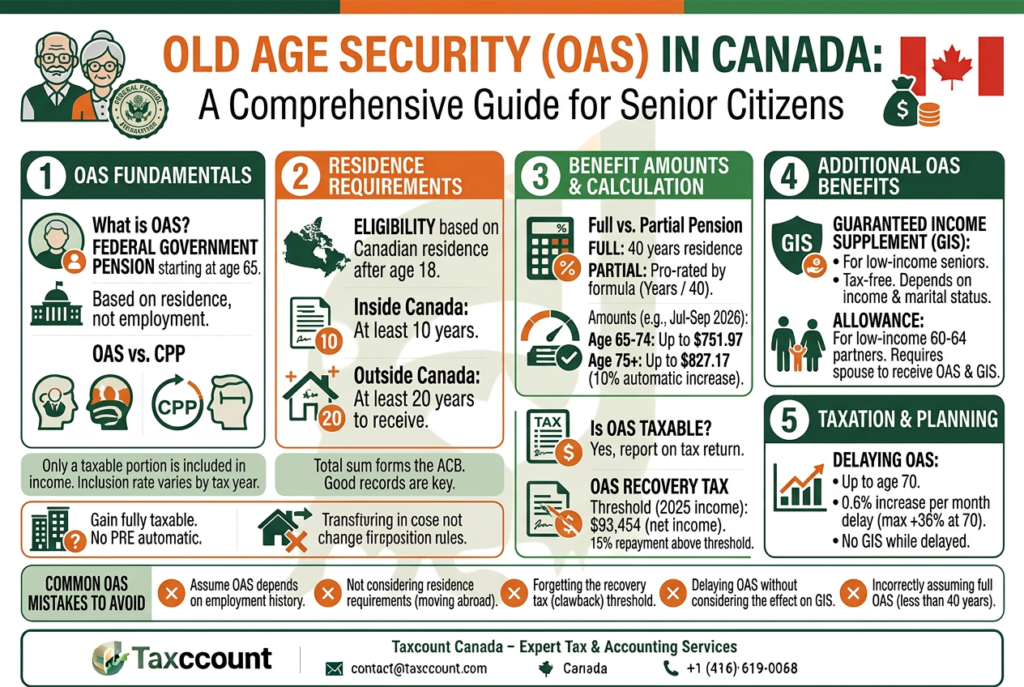
OAS is a federal government pension available to eligible individuals starting at age 65.
You do not need to have worked in Canada or contributed to OAS through payroll deductions to qualify. Instead, eligibility and the amount you receive are largely determined by how long you have lived in Canada after age 18. Canada
Get OAS Tax Help
☎️ Get HelpWho Qualifies for OAS?
If you are living in Canada when applying, you generally need to:
- Be at least 65 years old
- Be a Canadian citizen or legal resident when your OAS application is approved
- Have lived in Canada for at least 10 years after age 18
Different rules apply if you live outside Canada. Generally, at least 20 years of Canadian residence after age 18 is required to receive OAS while living abroad, although Canada’s international social security agreements may affect eligibility. Canada
Full vs. Partial OAS Pension
Generally, 40 years of Canadian residence after age 18 is required to receive a full OAS pension.
If you have fewer than 40 years, you may qualify for a partial pension. The calculation is generally:
Years of Canadian residence after age 18 ÷ 40
For example, someone with 20 qualifying years of Canadian residence would generally receive 20/40, or 50%, of the full OAS pension. Canada
How Much Is the OAS Payment?
OAS payment amounts are reviewed four times a year—in January, April, July and October—to reflect increases in the cost of living.
For July to September 2026, the maximum monthly OAS amounts are:
- Age 65 to 74: up to $751.97
- Age 75 and older: up to $827.17
The actual amount can depend on age, income and years of Canadian residence. OAS also increases automatically by 10% beginning the month after a recipient turns 75. Canada
Is OAS Taxable in Canada?
Yes. OAS pension payments are taxable income.
Canadian residents generally report OAS pension income on their personal income tax return. The amount received is reported on the applicable OAS information slip.
Depending on your overall income, OAS can increase your income tax payable and may also be subject to the OAS recovery tax.
Professional tax return filing services can help ensure retirement benefits and related deductions are correctly reported.
What Is the OAS Clawback?
The OAS clawback is officially called the OAS pension recovery tax.
If your net income exceeds the applicable annual threshold, you may have to repay part or all of your OAS.
For the 2025 income year, which determines recovery tax for the July 2026 to June 2027 period, the minimum recovery threshold is $93,454. The repayment is generally 15% of income above the threshold, up to the amount of OAS subject to recovery. Canada
For example, if applicable income exceeded the threshold by $10,000:
$10,000 × 15% = $1,500
The thresholds are indexed, so the applicable amount should be checked for each tax year.
Can You Delay Your OAS?
Yes. You can delay starting OAS after age 65, up to age 70.
For every month you delay, your pension increases by 0.6%. This equals:
- 7.2% for a one-year delay
- 14.4% for two years
- 21.6% for three years
- 28.8% for four years
- 36% for five years
There is no additional increase for delaying OAS beyond age 70. Canada
Whether delaying OAS makes sense depends on factors such as your current income, other retirement income, financial needs and expected retirement circumstances.
How Does Delaying OAS Affect GIS?
This is an important consideration for lower-income seniors.
If you delay your OAS pension, you cannot receive the Guaranteed Income Supplement during the period in which OAS is delayed. If applicable, your spouse or common-law partner may also be unable to receive the Allowance during that period. Canada
What Is the Guaranteed Income Supplement?
The Guaranteed Income Supplement (GIS) is an additional benefit for qualifying low-income OAS recipients.
To qualify, you generally need to:
- Be 65 or older
- Receive OAS
- Live in Canada
- Meet applicable income requirements
- Satisfy the other eligibility conditions
Unlike OAS, GIS is generally a tax-free benefit. Eligibility and payment amounts depend on income and marital status. Canada
Filing your income tax return each year is important because income information is used to determine ongoing eligibility and payment amounts.
What Is the Allowance?
The Allowance is another benefit under the OAS program intended for certain lower-income individuals aged 60 to 64.
Among other requirements, the individual’s spouse or common-law partner must receive OAS and be eligible for GIS. Residence and combined-income requirements also apply. Canada
OAS vs. CPP: What Is the Difference?
OAS and CPP are separate retirement programs.
OAS is primarily based on age and Canadian residence. CPP is generally based on contributions made from employment or self-employment earnings during your working years.
You may qualify for both programs, and both can form part of your overall retirement income.
Common OAS Mistakes to Avoid
Common issues include:
- Assuming OAS depends on employment history
- Confusing OAS with CPP
- Not considering the OAS recovery tax when planning retirement income
- Assuming everyone receives the full OAS amount
- Delaying OAS without considering the effect on GIS
- Failing to consider residence requirements when moving outside Canada
- Not reporting taxable OAS income correctly
Tax and accounting services can help retirees understand how OAS interacts with CPP, RRSP/RRIF withdrawals, investment income and other sources of taxable income.
Table of Summary
| Section | Easy Information |
|---|---|
| 1. Topic | The article explains Old Age Security (OAS) in Canada, including eligibility, payment amounts, taxation, the OAS recovery tax, delaying OAS and related benefits. |
| 2. What Is OAS? | OAS is a federal government pension generally available from age 65. Unlike CPP, eligibility is mainly based on age and Canadian residence rather than employment contributions. |
| 3. Who Qualifies? | If living in Canada, you generally need to be 65 or older, a Canadian citizen or legal resident when approved, and have lived in Canada for at least 10 years after age 18. Different rules apply when living outside Canada. |
| 4. Full vs. Partial OAS | Generally, 40 years of Canadian residence after age 18 is required for a full OAS pension. Fewer qualifying years may result in a partial pension. |
| 5. OAS Payment Amount | For July–September 2026, the maximum monthly amount is $751.97 for ages 65–74 and $827.17 for age 75+. OAS payments are reviewed quarterly for cost-of-living increases. |
| 6. Is OAS Taxable? | Yes. OAS is taxable income and generally needs to be reported on your Canadian personal income tax return. |
| 7. OAS Clawback | The OAS pension recovery tax may require higher-income recipients to repay some or all of their OAS. For the 2025 income year, the minimum recovery threshold stated in the article is $93,454. |
| 8. Delaying OAS | OAS can be delayed from age 65 to 70. The pension increases by 0.6% for each month delayed, up to a maximum increase of 36% at age 70. |
| 9. GIS & Allowance | The Guaranteed Income Supplement (GIS) provides additional generally tax-free benefits to qualifying low-income OAS recipients. The Allowance may be available to certain eligible individuals aged 60–64. |
| 10. Key Takeaway | OAS planning should consider Canadian residence history, taxable income, recovery tax, GIS eligibility and the timing of when benefits begin. OAS and CPP are separate programs and a person may qualify for both. |
Frequently Asked Questions
At what age can I receive OAS?
OAS can generally begin at age 65. You can choose to delay it until as late as age 70. Canada
Do I need to have worked in Canada to receive OAS?
No. OAS eligibility does not depend on employment or CPP contribution history. Canadian residence requirements are generally more important. Canada
Is OAS taxable?
Yes. OAS pension payments are generally taxable income.
How many years do I need to live in Canada to receive full OAS?
Generally, 40 years of Canadian residence after age 18 are required for a full OAS pension. A partial pension may be available with fewer qualifying years. Canada
What is the OAS clawback?
The OAS recovery tax requires higher-income recipients to repay part or potentially all of their OAS once income exceeds the applicable annual threshold. Canada
Does OAS increase after age 75?
Yes. OAS automatically increases by 10% beginning the month after the recipient turns 75. Canada
Can I receive both OAS and CPP?
Yes. They are separate programs, and an eligible individual may receive both.
Need Help With OAS and Retirement Tax Planning?
Taxccount Canada provides tax and accounting services and tax return filing services for retirees and seniors across Canada.
Our tax accountants can help you understand how OAS, CPP, RRSP/RRIF withdrawals, investment income and the OAS recovery tax affect your Canadian income tax return.
Contact Taxccount Canada for professional assistance with retirement-related tax filing and planning.
Plan Your OAS Better
☎️ Get HelpThis is general information only and not professional advice. Consult a professional before acting.
 Written and fact-checked by Udit Gupta
 Written and fact-checked by
 Ex Big4, Ernst & Young, Deloitte | International & Cross-Border Tax Specialist | CPA Canada In Depth Tax Training | Licensed Chartered Accountant from ICAI & MIA
Udit Gupta has over 15 years of experience helping corporations & business owners with corporate structuring, corporate tax filing, bookkeeping, payroll, GST/HST, cross-border tax and CRA representation. Big 4 trained at Ernst & Young and Deloitte, and qualified as a Chartered Accountant in India and Malaysia, he founded accounting firm in 2014 to serve entrepreneurs, startups and non-resident business owners across Canada. View Full Member Bio.
Indian Institute of Chartered Accountant Member No. (521458) | Malaysian Institute of Accountants Membership number (CA 44667) | Ex Big4,Ex Ernst & Young (EY), Ex-Deloitte | CPA Canada In-Depth Tax Training 19 Dec 2023, 12 Jul 2022, 5 Jul 2023
Editorial policy. Every article is researched against primary sources — the Income Tax Act, CRA publications and CPA Canada.