How Early Can You File Taxes in Canada?
Every year, Canadians ask the same question: when can I start filing my taxes? The answer depends on the method you use and whether you are waiting for all your income slips. This guide explains the earliest date you can file your Canadian tax return, when the CRA starts accepting returns, and why filing early is almost always the right move.
When Does the CRA Open Tax Filing Each Year?
Canadian personal income tax returns are filed for the previous calendar year (January 1 to December 31). The CRA typically opens the tax season in late February — usually the third week of the month. This is when the NETFILE electronic filing system becomes available and you can submit your completed return through CRA-certified tax software.
Although you can prepare your return before NETFILE opens, you cannot submit it electronically until the service goes live. Once it opens, your return can be submitted immediately.
File Taxes Early
☎️ Get HelpWhen Can You File a Paper Tax Return?
For paper returns mailed to the CRA, you can technically send them at any time. However, the CRA does not begin processing paper returns until after the tax season opens. Mailing a paper return in early January does not speed up processing — it simply sits until the CRA is ready.
When Do You Need All Your Tax Slips?
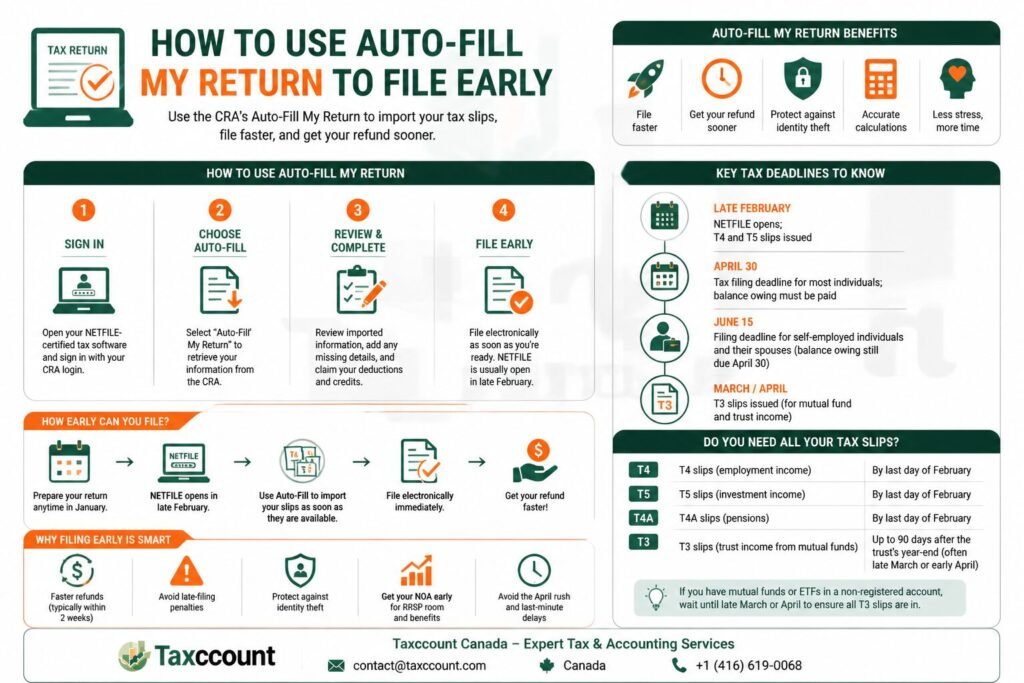
Before you can file a complete and accurate return, you need all your income slips. Key deadlines for slip issuance are:
- T4 slips (employment income): Employers must issue by the last day of February
- T5 slips (investment income): Issuers must provide by the last day of February
- T4A slips (pensions, commissions, other income): Last day of February
- T3 slips (trust income from mutual funds, ETFs): Up to 90 days after the trust’s year-end, often in late March or early April
If you hold mutual funds or ETFs in a non-registered account, you may want to wait until late March or April to ensure all T3 slips have arrived before filing.
When Do Most Canadians File?
The filing deadline for most Canadians is April 30. The majority of Canadians file between March and April 30. However, filing earlier — as soon as all your slips are in hand — is always advisable.
Key Tax Deadlines to Know
- February (late): NETFILE opens; T4 and T5 slips issued
- April 30: Tax filing deadline for most individuals; balance owing must be paid
- June 15: Filing deadline for self-employed individuals and their spouses (but any balance owing is still due April 30)
- March/April: T3 slips issued (for mutual fund and trust income)
Why Filing Early Is Smart
- Faster refunds: Electronic returns are typically processed within 2 weeks. The earlier you file, the sooner you receive your refund
- Avoid late-filing penalties: If you owe money and file late, the CRA charges a 5% penalty on the balance owing, plus 1% per month after the deadline
- Protect against identity theft: Filing early prevents fraudsters from filing a return under your SIN before you do
- RRSP and benefit calculations: Your NOA confirms your RRSP room and benefit entitlements for the next year; getting it early helps you plan
- Less stress: Avoiding the April rush means fewer delays and more time to gather missing documents
How to Use Auto-Fill My Return to File Early
The CRA’s Auto-Fill My Return feature, available through NETFILE-certified software, automatically imports your tax slips and other information directly from the CRA once they are available. This means you can start preparing your return immediately after NETFILE opens without waiting to receive physical slips in the mail.
Table of Summary
Here is the blog information in 6 easy rows for quick understanding:
| Section | Easy Information |
|---|---|
| 1. Topic | The blog explains how early you can file taxes in Canada and when CRA starts accepting returns. |
| 2. CRA Opening Time | CRA typically opens tax filing in late February (NETFILE season). You can prepare earlier but cannot submit electronically until it opens. |
| 3. Paper Filing | Paper returns can be mailed anytime, but CRA only processes them after tax season opens, so early mailing does not speed it up. |
| 4. Tax Slip Timing | Key slips arrive by: T4/T5/T4A (end of Feb), T3 (March–April). Waiting ensures all income is included before filing. |
| 5. Key Deadlines | April 30: filing & payment deadline (most Canadians). June 15: self-employed filing deadline (tax owing still due April 30). |
| 6. Why File Early | Faster refunds (≈2 weeks), avoid penalties, reduce fraud risk, and get quicker access to benefits and RRSP/NOA updates. |
Frequently Asked Questions
Can I file my taxes before I receive my T4?
You should wait until your T4 is available. Employers are required to issue T4 slips by the last day of February. You can access your T4 early through CRA My Account using the Auto-Fill My Return feature, which imports slips as soon as they are filed by your employer.
What if I file before all my slips arrive?
Filing an incomplete return can result in a CRA reassessment, which means additional processing and potential interest if you underpay. It is best to wait until all slips are in hand or available through CRA My Account before submitting.
Is there a penalty for filing too early?
No. There is no penalty for filing before April 30, as long as your information is complete and accurate. Filing early is encouraged.
When does NETFILE open for 2025 taxes (2024 tax year)?
NETFILE for the 2024 tax year is expected to open in the third week of February 2025, following the same pattern as prior years. Check the CRA website for the exact date each year.
Start Filing Today
☎️ Get HelpThis is general information only and not professional advice. Consult a professional before acting.
 Written and fact-checked by Udit Gupta
 Written and fact-checked by
 Ex Big4, Ernst & Young, Deloitte | International & Cross-Border Tax Specialist | CPA Canada In Depth Tax Training | Licensed Chartered Accountant from ICAI & MIA
Udit Gupta has over 15 years of experience helping corporations & business owners with corporate structuring, corporate tax filing, bookkeeping, payroll, GST/HST, cross-border tax and CRA representation. Big 4 trained at Ernst & Young and Deloitte, and qualified as a Chartered Accountant in India and Malaysia, he founded accounting firm in 2014 to serve entrepreneurs, startups and non-resident business owners across Canada. View Full Member Bio.
Indian Institute of Chartered Accountant Member No. (521458) | Malaysian Institute of Accountants Membership number (CA 44667) | Ex Big4,Ex Ernst & Young (EY), Ex-Deloitte | CPA Canada In-Depth Tax Training 19 Dec 2023, 12 Jul 2022, 5 Jul 2023
Editorial policy. Every article is researched against primary sources — the Income Tax Act, CRA publications and CPA Canada.