Canada Pension Plan (CPP): How It Works and What Benefits You Get

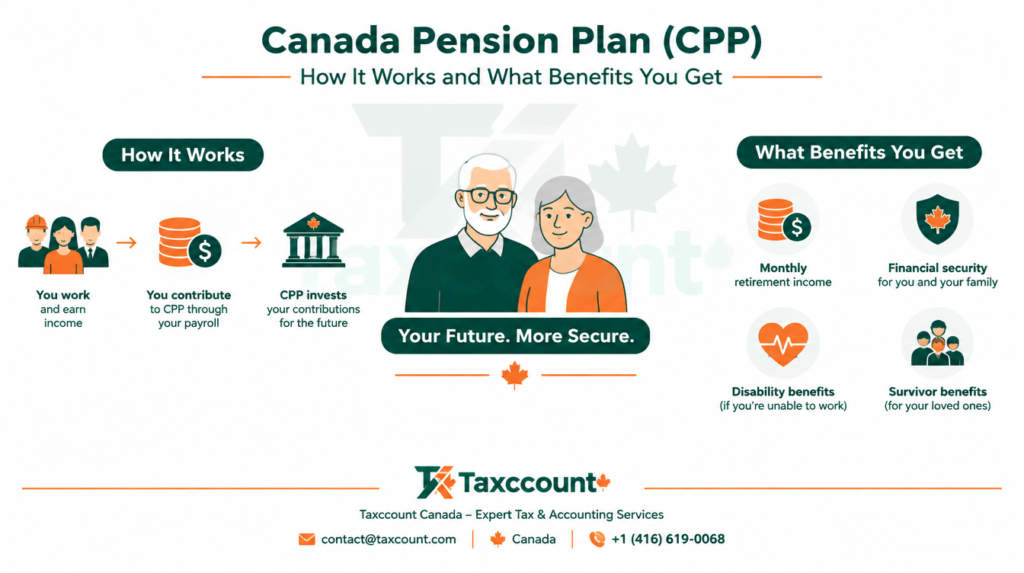
The Canada Pension Plan (CPP) is a federal government program that provides income to eligible workers and their families when they retire, become disabled, or die. If you work in Canada outside Quebec, you generally contribute to CPP through deductions from your employment income. Self-employed individuals generally pay both the employee and employer portions.
Your CPP contributions help determine the benefits you may receive later in life. This guide explains how CPP works, who contributes, when you can start receiving benefits, and the different benefits available.
Canada Pension Plan (CPP): How It Works and What Benefits You Get
The Canada Pension Plan (CPP) is a national pension program that provides income to Canadians in retirement, as well as to those who become disabled or to families of those who pass away. If you have worked in Canada and paid into CPP, you are building benefits for your future.
This guide explains the CPP program in clear, straightforward terms.
Plan My CPP and Retirement Income
☎️ Get HelpWhat Is the Canada Pension Plan?
CPP is a mandatory contributory program. If you are employed in Canada (except in Quebec, which has its own plan called QPP), both you and your employer contribute a percentage of your earnings to CPP each year. Self-employed individuals pay both the employee and employer share.
The contributions go into a fund managed by the CPP Investment Board, and your eventual benefits are based on how much you contributed and for how long.
Who Contributes to CPP?
You contribute to CPP if you:
- Are employed in Canada (outside Quebec)
- Are between the ages of 18 and 70
- Earn more than the Year’s Basic Exemption ($3,500 per year)
Contributions are calculated on your earnings between the Year’s Basic Exemption and the Year’s Maximum Pensionable Earnings (YMPE). Earnings above the YMPE are not subject to CPP contributions.
Both employees and employers pay a contribution rate set each year by the federal government. Self-employed people pay the combined employee and employer rate.
What CPP Benefits Are Available?
CPP offers several types of benefits:
1. CPP Retirement Pension
The main benefit – a monthly payment for life starting as early as age 60 or as late as age 70.
2. CPP Disability Benefit
A monthly payment for contributors who become severely disabled and cannot work regularly. To qualify, you must have contributed to CPP for at least four of the last six years (or three of the last six years if you have 25 or more years of contributions).
3. CPP Post-Retirement Benefit
If you are already receiving CPP and continue to work and contribute, you earn additional small pension increments called the Post-Retirement Benefit.
4. CPP Survivor’s Pension
A monthly benefit paid to the surviving spouse or common-law partner of a deceased CPP contributor.
5. CPP Children’s Benefit
A flat monthly payment for dependent children of disabled or deceased CPP contributors.
6. CPP Death Benefit
A one-time lump sum payment of up to $2,500 paid to the estate of a deceased contributor.
How Is Your CPP Retirement Pension Calculated?
Your CPP retirement pension is based on:
- How much you contributed
- How long you contributed
- Your average earnings during your contributory period
The maximum CPP retirement pension (at age 65) is updated each year. Few people receive the full maximum – the average payout is significantly lower because most Canadians do not contribute the maximum every year for their full working life.
Years with low or zero income (such as years raising children or on disability) can be excluded from the calculation through dropout provisions, which helps protect your benefit amount.
When Can You Start CPP?
You can start CPP as early as age 60 or delay it until age 70:
- Starting before 65: Your benefit is reduced by 0.6% for each month before your 65th birthday. Starting at 60 = a 36% reduction.
- Starting at 65: You receive your standard calculated amount.
- Delaying past 65: Your benefit increases by 0.7% per month, up to age 70. Delaying to 70 = a 42% increase over your age 65 amount.
Whether to take CPP early or late depends on your health, other income sources, and financial needs.
How Is CPP Taxed?
CPP retirement pension payments are fully taxable. You report them as income on your T1 return each year. Service Canada issues a T4A(P) slip showing the amount received.
Federal and provincial taxes may be withheld at source. You can request additional tax withholding to avoid owing a large amount at tax time.
You can also split up to 50% of your eligible CPP pension income with your spouse or common-law partner if you are both at least 60 years old and both receiving CPP. This can reduce your household’s overall tax bill.
CPP for Self-Employed Individuals
Self-employed people pay the combined employee and employer CPP contribution rate on their net self-employment income. This is calculated on Schedule 8 of your T1 return.
Half of your CPP contributions as a self-employed person (the employer portion) is deductible as a business expense, which reduces your net income. The other half (the employee portion) qualifies for a tax credit.
CPP Enhancement: What Changed?
In recent years, the federal government introduced CPP Enhancement, which increases both contributions and future benefits in two phases. Workers who contribute under the enhanced CPP will receive higher retirement benefits in the future compared to those who only contributed under the base CPP.
The enhancement is funded by additional contributions on earnings up to the YMPE and, in a second phase, on earnings above the YMPE (up to a new additional maximum). This affects all employees and self-employed individuals.
Table of Summary
| CPP Topic | Key Information |
|---|---|
| What Is CPP? | A contributory pension program that provides retirement, disability, survivor, children’s, and death benefits |
| Who Contributes? | Employees and self-employed individuals in Canada outside Quebec, generally from age 18 to 70 when earnings exceed the Year’s Basic Exemption |
| Employee Contributions | Employees contribute based on pensionable earnings between the Year’s Basic Exemption and the applicable YMPE |
| Employer Contributions | Employers generally match the employee’s CPP contributions |
| Self-Employed Contributions | Self-employed individuals generally pay both the employee and employer portions |
| CPP Retirement Pension | Monthly lifetime benefit that can generally begin between ages 60 and 70 |
| Starting CPP Before 65 | The pension is reduced by 0.6% for each month it begins before age 65 |
| Starting CPP at 65 | You receive your calculated standard CPP retirement pension |
| Delaying CPP After 65 | The pension increases by 0.7% for each month it is delayed, up to age 70 |
| CPP Disability Benefit | Monthly benefit for eligible contributors who become severely disabled and meet contribution requirements |
| CPP Survivor’s Pension | Monthly benefit that may be available to an eligible surviving spouse or common-law partner |
| CPP Children’s Benefit | Monthly benefit that may be available to dependent children of eligible disabled or deceased contributors |
| CPP Death Benefit | One-time payment of up to $2,500 to the estate of an eligible contributor |
| Post-Retirement Benefit | Additional CPP benefit earned by eligible people who continue working and contributing while receiving CPP |
| CPP Taxation | CPP retirement pension payments are generally fully taxable and reported as income on the T1 return |
| CPP Pension Splitting | Up to 50% of eligible CPP pension income may be shared with a spouse or common-law partner, subject to applicable rules |
| CPP Enhancement | Enhanced CPP increases contributions and can provide higher future retirement benefits |
| Quebec | Quebec residents generally contribute to the Quebec Pension Plan (QPP) instead of CPP |
| CPP Tax Slip | Service Canada generally issues a T4A(P) showing CPP benefits received |
Frequently Asked Questions
Can I receive CPP and still work?
Yes. You can collect CPP and continue working at the same time. If you are under 70 and still working while collecting CPP, you and your employer must continue to make contributions, which will add to your Post-Retirement Benefit.
Will I lose CPP if I die before collecting?
Your estate may qualify for the Death Benefit. Your surviving spouse may qualify for the Survivor’s Pension. Your dependent children may qualify for the Children’s Benefit.
Is CPP different in Quebec?
Yes. Quebec residents contribute to the Quebec Pension Plan (QPP) instead. QPP is similar to CPP and provides equivalent benefits, but is administered separately by Retraite Quebec.
Conclusion
CPP is one of the most important financial programs available to working Canadians. Understanding how your contributions build benefits, when to take your pension, and how CPP is taxed can make a real difference in your retirement planning.
A tax professional or financial planner can help you decide the optimal time to start your CPP payments and how to integrate it with other retirement income sources.
Need Help With Canadian tax and Retirement Tax Planning?
Need help with Canadian tax and retirement planning? Taxccount can help you understand the tax implications of CPP, OAS, RRSP withdrawals, and other sources of retirement income. Book a free consultation today.
Get Expert Retirement Tax Advice
☎️ Get HelpThis is general information only and not professional advice. Consult a professional before acting.
 Written and fact-checked by Udit Gupta
 Written and fact-checked by
 Ex Big4, Ernst & Young, Deloitte | International & Cross-Border Tax Specialist | CPA Canada In Depth Tax Training | Licensed Chartered Accountant from ICAI & MIA
Udit Gupta has over 15 years of experience helping corporations & business owners with corporate structuring, corporate tax filing, bookkeeping, payroll, GST/HST, cross-border tax and CRA representation. Big 4 trained at Ernst & Young and Deloitte, and qualified as a Chartered Accountant in India and Malaysia, he founded accounting firm in 2014 to serve entrepreneurs, startups and non-resident business owners across Canada. View Full Member Bio.
Indian Institute of Chartered Accountant Member No. (521458) | Malaysian Institute of Accountants Membership number (CA 44667) | Ex Big4,Ex Ernst & Young (EY), Ex-Deloitte | CPA Canada In-Depth Tax Training 19 Dec 2023, 12 Jul 2022, 5 Jul 2023
Editorial policy. Every article is researched against primary sources — the Income Tax Act, CRA publications and CPA Canada.