RRSP Contribution Limit in Canada: How It Works and How to Maximize It
Your RRSP contribution limit determines how much you can contribute to your Registered Retirement Savings Plan (RRSP) and claim as a deduction on your Canadian tax return. Understanding how RRSP room is calculated can help you avoid over-contributions while making the most of your available tax deductions.
RRSP Contribution Limit in Canada: How It Works and How to Maximize It
The Registered Retirement Savings Plan (RRSP) is one of the most effective ways to save for retirement and reduce your income taxes at the same time. Understanding your contribution limit is essential – contributing too much triggers penalties, and contributing too little means missed tax savings.
This guide explains how the RRSP contribution limit works and how to use it wisely.
Maximize My RRSP Contributions
☎️ Get HelpWhat Is an RRSP?
An RRSP is a registered savings plan that allows Canadians to contribute pre-tax money toward retirement savings. Contributions reduce your taxable income in the year you make them (or carry them forward to a future year), and the investments inside the plan grow tax-deferred until withdrawn.
When you withdraw from an RRSP, the amount is added to your income and taxed at your marginal rate. The strategy is to contribute when your income is high (and you get a big tax deduction) and withdraw when your income is lower (like in retirement).
How Is the RRSP Contribution Limit Calculated?
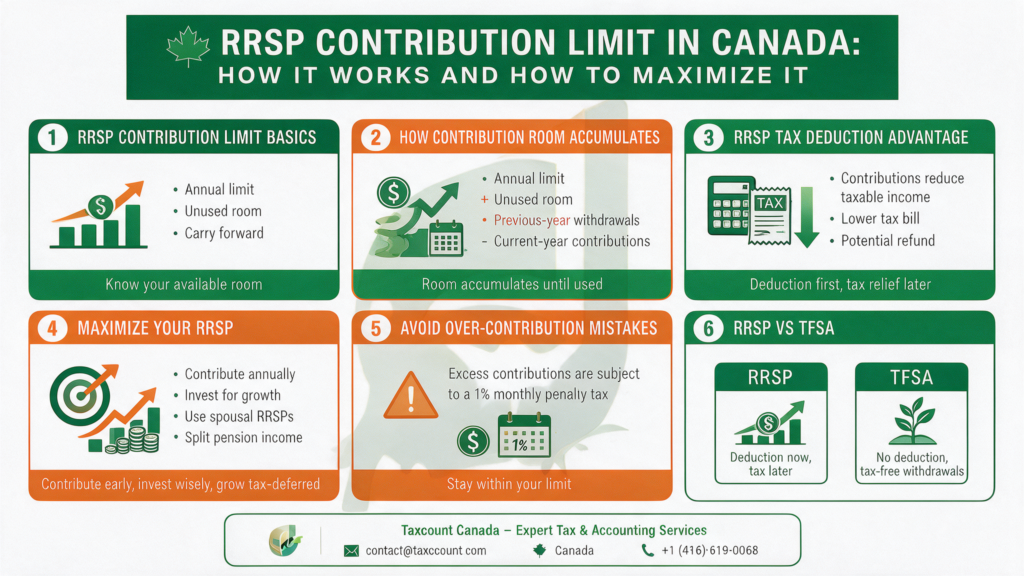
Your RRSP contribution room for any given year is:
- 18% of your previous year’s earned income, up to the annual maximum, PLUS
- Any unused contribution room carried forward from previous years, MINUS
- A Pension Adjustment (PA) if you belong to an employer pension plan
Earned income for RRSP purposes includes:
- Employment income (salaries, wages)
- Self-employment income (net business income)
- Rental income (net)
- Royalties
- Research grants
It does NOT include investment income, pension income, or capital gains.
The annual RRSP deduction limit (the maximum 18% amount) changes each year and is updated for inflation. Check the CRA website for the current year’s maximum.
Where to Find Your RRSP Room
The easiest way to find your exact RRSP contribution room is:
- Log in to CRA My Account at canada.ca
- Check your most recent Notice of Assessment (NOA)
- Call CRA at 1-800-959-8281
Your Notice of Assessment will show your RRSP deduction limit for the following year.
RRSP Contribution Deadline
Contributions made in the first 60 days of a calendar year can be claimed on either that year’s return or the previous year’s return. The exact date changes each year but generally falls in late February or early March.
Contributions made after the first 60 days of the year can only be deducted on that tax year’s return.
Important: You do not have to deduct RRSP contributions in the year you make them. You can make a contribution now and carry the deduction forward to a year when you have higher income and would benefit from a bigger tax break.
What Happens If You Over-Contribute?
CRA allows a lifetime over-contribution buffer of $2,000 without penalty. However, if you exceed your limit by more than $2,000, you face a 1% per month penalty tax on the excess amount.
To resolve an over-contribution, you generally need to withdraw the excess (and may owe income tax on it) or wait for future room to become available.
Spousal RRSPs
A spousal RRSP allows you to contribute to your spouse’s or common-law partner’s RRSP using your own contribution room. The money goes into their account and eventually gets taxed as their income when withdrawn.
This is a useful income-splitting tool. If one spouse expects to have a significantly higher income in retirement, contributing to a spousal RRSP can help equalize retirement income and reduce the household’s overall tax bill.
Note: Withdrawals from a spousal RRSP within three years of the last spousal contribution may be attributed back to the contributor’s income (not the spouse’s). This is the attribution rule for spousal RRSPs.
RRSP Withdrawals: Home Buyers Plan and Lifelong Learning Plan
You can withdraw from your RRSP before retirement in two special programs without immediate tax consequences:
Home Buyers Plan (HBP)
- Withdraw up to $35,000 (per person, so $70,000 for a couple) to buy or build a qualifying first home
- You must repay the amount to your RRSP within 15 years (with a 2-year grace period)
- If you do not repay in a given year, that year’s required repayment amount is added to your income
Lifelong Learning Plan (LLP)
- Withdraw up to $10,000 per year (maximum $20,000 total) to finance full-time education or training for you or your spouse
- Must be repaid within 10 years (repayments start 2 years after the last eligible withdrawal)
When Does an RRSP End?
You must close your RRSP by December 31 of the year you turn 71. At that point, you have three options:
1. Convert to a Registered Retirement Income Fund (RRIF)
2. Purchase an annuity
3. Withdraw the full amount as cash (fully taxable in that year)
Most Canadians convert to a RRIF, which requires minimum withdrawals each year starting in the year after conversion.
Table of Summary
| RRSP Topic | Key Information |
|---|---|
| RRSP Contribution Room | Generally 18% of the previous year’s earned income, up to the annual maximum, plus unused room carried forward |
| Pension Adjustment (PA) | May reduce RRSP contribution room if you participate in an employer pension plan |
| Where to Check RRSP Room | CRA My Account or your latest Notice of Assessment (NOA) |
| RRSP Contribution Deadline | Contributions made during the first 60 days of the year may generally be claimed for the previous tax year |
| Unused Contribution Room | Unused RRSP room can generally be carried forward |
| Over-Contribution | A $2,000 lifetime buffer generally applies; excess amounts above the permitted limit may be subject to a 1% monthly tax |
| Spousal RRSP | Contributions use the contributor’s RRSP room but are made to the spouse’s RRSP |
| Home Buyers’ Plan (HBP) | Allows eligible individuals to withdraw funds from an RRSP for a qualifying first home, subject to applicable rules |
| Lifelong Learning Plan (LLP) | Allows eligible RRSP withdrawals for qualifying education or training |
| RRSP Age Limit | An RRSP generally must be converted or otherwise dealt with by December 31 of the year the holder turns 71 |
| RRSP Withdrawals | Generally included in taxable income when withdrawn, except where specific rules or programs provide different treatment |
| Investment Growth | Investments inside an RRSP generally grow tax-deferred until amounts are withdrawn |
Frequently Asked Questions
Can I contribute to my RRSP if I have no earned income?
If you had no earned income in the prior year, you would have no new RRSP room (since room is based on prior year’s earned income). However, you may still have accumulated room from previous years.
Is there a maximum age to contribute to an RRSP?
Yes. You can contribute to your own RRSP only until December 31 of the year you turn 71. You may still contribute to a spousal RRSP if your spouse is younger than 71.
Do pension contributions reduce my RRSP room?
Yes. If you are a member of a Registered Pension Plan (RPP) or Deferred Profit Sharing Plan (DPSP), a Pension Adjustment (PA) reduces your RRSP room. This ensures the tax benefits of all registered plans are roughly equal across Canadians.
Conclusion
Your RRSP is one of the most valuable tax tools you have as a Canadian. Knowing your contribution limit, meeting deadlines, and using strategies like spousal contributions and deduction timing can significantly reduce your lifetime tax bill.
If you are unsure how to use your RRSP room most effectively, a tax professional can help you build a retirement savings plan that works for your income and goals.
Need Help with RRSP and tax planning?
Need help with RRSP and tax planning? Taxccount can help you understand your available deductions, RRSP contribution room, and Canadian tax-planning options. Book a free consultation today.
Get Retirement Tax Planning Help
☎️ Get HelpThis is general information only and not professional advice. Consult a professional before acting.
 Written and fact-checked by Udit Gupta
 Written and fact-checked by
 Ex Big4, Ernst & Young, Deloitte | International & Cross-Border Tax Specialist | CPA Canada In Depth Tax Training | Licensed Chartered Accountant from ICAI & MIA
Udit Gupta has over 15 years of experience helping corporations & business owners with corporate structuring, corporate tax filing, bookkeeping, payroll, GST/HST, cross-border tax and CRA representation. Big 4 trained at Ernst & Young and Deloitte, and qualified as a Chartered Accountant in India and Malaysia, he founded accounting firm in 2014 to serve entrepreneurs, startups and non-resident business owners across Canada. View Full Member Bio.
Indian Institute of Chartered Accountant Member No. (521458) | Malaysian Institute of Accountants Membership number (CA 44667) | Ex Big4,Ex Ernst & Young (EY), Ex-Deloitte | CPA Canada In-Depth Tax Training 19 Dec 2023, 12 Jul 2022, 5 Jul 2023
Editorial policy. Every article is researched against primary sources — the Income Tax Act, CRA publications and CPA Canada.