Is Employment Insurance Taxable in Canada?

If you collected Employment Insurance (EI) benefits during the year, you may be wondering whether those payments count as income on your tax return. The answer is yes — EI benefits are taxable in Canada. Here is what you need to know when you file.
Taxccount Canada helps individuals searching for tax filing near me understand how Employment Insurance benefits affect their income tax return.
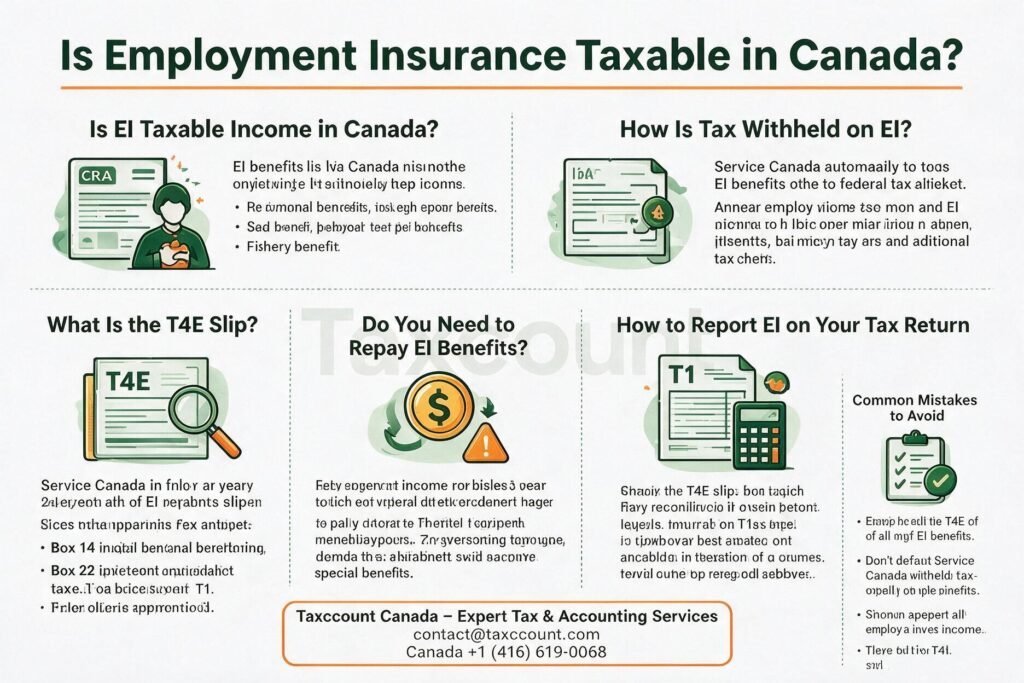
Is EI Taxable Income in Canada?
Yes. EI benefits are considered taxable income by the CRA. This applies to all types of EI payments, including:
- Regular EI benefits (after job loss)
- Maternity and parental benefits
- Sickness benefits
- Compassionate care benefits
- Fishing benefits
Professional tax return filing services can help ensure your EI benefits are reported correctly.
Report EI Benefits Properly
☎️ Get HelpHow Is Tax Withheld on EI?
Service Canada withholds federal income tax from your EI payments automatically. However, the withholding may not always equal your final tax owing. If you worked part of the year before collecting EI, your combined income could push you into a higher tax bracket, which can result in owing additional tax when you file your return.
An accountant for taxes can estimate your overall tax liability if you received both employment income and EI benefits during the year.
What Is the T4E Slip?
Service Canada issues a T4E slip (Statement of Employment Insurance and Other Benefits) to all EI recipients by the end of February. The T4E shows:
- Box 14: Total EI benefits paid to you
- Box 22: Income tax deducted at source
You must include this information when completing your T1 personal income tax return.
Tax and accounting services can help you report your T4E correctly if you have multiple sources of income.
Do You Need to Repay EI Benefits?
Yes, there is an EI repayment rule. If your net income for the year exceeds a threshold set by the federal government (updated annually), you may have to repay part of your regular EI benefits.
Generally, the repayment is equal to 30% of the lesser of:
- Your net income above the annual repayment threshold, or
- The total regular EI benefits you received
This repayment is calculated automatically when your income tax return is assessed.
If you are a first-time EI claimant, you may qualify for an exemption from the repayment rule in certain circumstances. Special benefits such as maternity and parental benefits are generally not subject to EI repayment.
How to Report EI on Your Tax Return
When you file your T1 personal income tax return, enter the amounts shown on your T4E slip in the appropriate lines of your return.
The EI benefits you received are included in your total income, while the tax withheld at source is applied as a credit against your total tax payable. Your tax software or tax preparer will automatically calculate whether you are entitled to a refund or have a balance owing.
Income tax preparation near me services can help ensure your EI income is reported accurately.
Common Mistakes When Reporting EI Benefits
To avoid delays or reassessments:
- Report all EI benefits shown on your T4E slip.
- Do not assume the tax withheld by Service Canada covers your total tax liability.
- Include all employment and investment income along with your EI benefits.
- Keep your T4E slip with your tax records for future reference.
Tax accountants can review your return if you are unsure how EI benefits affect your taxes.
Table of Summary
Here is the blog information in 6 easy rows for quick understanding:
| Section | Easy Information |
|---|---|
| 1. Topic | The blog explains whether life insurance can be claimed on taxes in Canada and under what circumstances. |
| 2. General Rule | Personal life insurance premiums are not tax deductible, including term, whole, and universal life policies. |
| 3. Exceptions | Premiums may be deductible if the policy is collateral for a business loan (Net Cost of Pure Insurance applies). |
| 4. Employer-Paid Insurance | Group life insurance premiums paid by an employer are included as a taxable benefit on your T4. |
| 5. Charitable Donations | Donating a life insurance policy to a registered charity may qualify for a charitable donation tax credit, depending on the policy’s value. |
| 6. Corporate Life Insurance | Corporate-owned policies: premiums generally not deductible, death benefits usually tax-free, key person insurance may only be deductible if used as loan collateral. Professional guidance is recommended. |
FAQs
Are Employment Insurance Benefits Taxable?
Yes. All regular Employment Insurance benefits are considered taxable income and must be reported on your Canadian income tax return.
Will I Receive a Tax Slip for EI Benefits?
Yes. Service Canada issues a T4E slip showing the total EI benefits paid and the income tax withheld during the year.
Can I Owe More Tax Even If Tax Was Deducted From My EI?
Yes. The tax withheld from EI benefits may not fully cover your total tax liability, especially if you had other income during the year.
Do Maternity and Parental EI Benefits Count as Taxable Income?
Yes. Maternity and parental Employment Insurance benefits are generally taxable and must be reported on your tax return, although they are generally not subject to the EI repayment rule.
Do I Need Professional Help to Report EI Benefits?
If you received multiple sources of income, self-employment earnings, or other taxable benefits during the year, a tax accountant near me can help ensure your return is completed accurately.
Get EI Tax Help
☎️ Get HelpThis is general information only and not professional advice. Consult a professional before acting.
 Written and fact-checked by Udit Gupta
 Written and fact-checked by
 Ex Big4, Ernst & Young, Deloitte | International & Cross-Border Tax Specialist | CPA Canada In Depth Tax Training | Licensed Chartered Accountant from ICAI & MIA
Udit Gupta has over 15 years of experience helping corporations & business owners with corporate structuring, corporate tax filing, bookkeeping, payroll, GST/HST, cross-border tax and CRA representation. Big 4 trained at Ernst & Young and Deloitte, and qualified as a Chartered Accountant in India and Malaysia, he founded accounting firm in 2014 to serve entrepreneurs, startups and non-resident business owners across Canada. View Full Member Bio.
Indian Institute of Chartered Accountant Member No. (521458) | Malaysian Institute of Accountants Membership number (CA 44667) | Ex Big4,Ex Ernst & Young (EY), Ex-Deloitte | CPA Canada In-Depth Tax Training 19 Dec 2023, 12 Jul 2022, 5 Jul 2023
Editorial policy. Every article is researched against primary sources — the Income Tax Act, CRA publications and CPA Canada.