Do You Pay Taxes When Selling Your House in Canada?

Selling your home is one of the biggest financial decisions you will make, and it raises a common question: do you owe tax on the profit? In Canada, the answer depends on how you used the property. This guide explains the tax rules clearly so you know exactly where you stand.
Taxccount Canada helps homeowners looking for tax filing near me understand how property sales are reported correctly.
Is Selling Your Home Taxable in Canada?
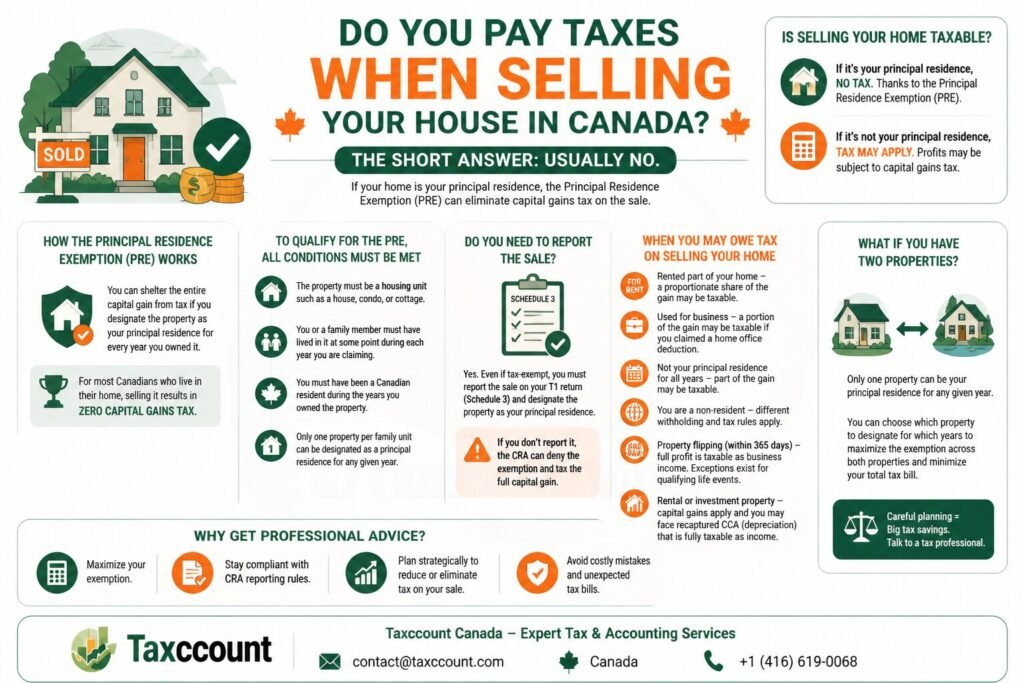
In general, if you sell property for more than you paid for it, the profit is a capital gain, and capital gains are taxable in Canada. However, there is a major exception for your primary home through the Principal Residence Exemption (PRE), which can eliminate the tax on the sale entirely.
For most Canadians who live in their home, selling it results in zero capital gains tax.
Professional tax return filing services can help ensure the sale is reported properly.
Keep Tax Records Safely
☎️ Get HelpWhat Is the Principal Residence Exemption?
The Principal Residence Exemption (PRE) allows you to shelter the capital gain from the sale of a qualifying property from tax. If you designate a property as your principal residence for every year you owned it, you owe no capital gains tax on the profit, regardless of how large the gain is.
A tax accountant near me can help review whether your property qualifies.
How to Qualify for the Principal Residence Exemption
To qualify for the PRE, all of the following conditions must be met:
- The property must be a housing unit such as a house, condo, or cottage
- You or a family member must have lived in it at some point during each year you are claiming
- You must have been a Canadian resident during the years you owned the property
- Only one property per family unit can be designated as a principal residence for any given year
Do You Still Need to Report the Sale?
Yes. Even if your home sale is fully tax-exempt, you must still report the sale on your personal income tax return using Schedule 3 of your T1 return. You must list the property, the year you acquired it, the proceeds of disposition, and designate it as your principal residence.
If you fail to report the sale, the CRA can deny the exemption and tax the full capital gain.
Working with tax and accounting services can reduce filing mistakes.
When Do You Owe Tax on Selling Your Home?
There are several situations where you may owe tax when selling your home:
Renting Out Part of Your Home
Renting out part of your home: If you rented a portion of your home, a proportionate share of the gain may be taxable.
Using Home for Business
Using home for business: If you claimed a home office deduction or used part of the home exclusively for business, a portion of the gain may be taxable.
Not Your Principal Residence for All Years
Not your principal residence for all years: If the property was not designated as your principal residence for every year you owned it, part of the gain may be subject to capital gains tax.
You Are a Non-Resident
You are a non-resident: Non-residents of Canada selling Canadian real estate face different withholding and tax rules under the Income Tax Act.
Property Flipping Within 365 Days
Property flipping (within 365 days): Under Canada’s anti-flipping rules, if you sell a residential property within 365 days of purchasing it, the full profit is taxable as business income, not as a capital gain, and the PRE cannot apply. Exceptions exist for qualifying life events such as death, disability, divorce, or job relocation.
Rental or Investment Property
Rental or investment property: Capital gains apply and you may also face recaptured CCA (depreciation) that is fully taxable as income.
A taxation accountant can help calculate the taxable portion correctly.
What If You Have Two Properties?
If you own two properties, such as a home and a cottage, only one can be your principal residence for any given year. You can strategically choose which property to designate for which years to maximize the exemption across both properties and minimize your total tax bill.
This kind of planning requires careful calculation and is best done with the help of a tax professional.
An accountant for taxes can help compare both properties before filing.
Table of Summary
Here is the blog information in 6 easy rows for quick understanding:
| Section | Easy Information |
|---|---|
| 1. Topic | The blog explains whether you pay taxes when selling your house in Canada and how capital gains are treated. |
| 2. Taxable Sale | Selling property generally triggers a capital gain, but your principal residence may be fully exempt. |
| 3. Principal Residence Exemption (PRE) | To qualify: property must be a housing unit, lived in by you/family during each year claimed, Canadian residency, and only one property per family per year. |
| 4. Reporting Requirement | Even if exempt, you must report the sale on Schedule 3 of T1, listing property, acquisition year, proceeds, and designation as principal residence. |
| 5. Situations Where Tax Applies | Tax may apply if part of home was rented, used for business, not principal residence all years, flipping within 365 days, or if seller is a non-resident. |
| 6. Multiple Properties | Only one property can be principal residence per year. Strategic designation can maximize exemption; professional advice is recommended for planning. |
Frequently Asked Questions
Can Tax Filing Near Me Services Help Report the Sale of a Home?
Yes. Tax filing near me services can help report the sale on Schedule 3, claim the Principal Residence Exemption, and avoid missed reporting requirements.
Do I Pay Tax When Selling My Principal Residence in Canada?
Usually not, if the property qualifies as your principal residence for all eligible years and you properly report and designate the sale on your tax return.
Can a Tax Accountant Near Me Help With Two Properties?
Yes. A tax accountant near me can compare the gain on your home and cottage or other property to determine which years should be designated for each property.
Do Tax Return Filing Services Help With Rental Property Sales?
Yes. Tax return filing services can calculate capital gains, recaptured CCA, eligible expenses, and the taxable portion of a rental-property sale.
Can Tax and Accounting Services Help With Property Flipping Rules?
Yes. Tax and accounting services can assess whether the 365-day residential property-flipping rule applies and whether a qualifying life-event exception is available.
When Should I Contact an Accountant for Taxes Before Selling a Home?
Contact an accountant for taxes before selling if you rented part of the property, claimed CCA, used it for business, own multiple properties, or are a non-resident.
Keep Tax Records Safely
☎️ Get HelpThis is general information only and not professional advice. Consult a professional before acting.
 Written and fact-checked by Udit Gupta
 Written and fact-checked by
 Ex Big4, Ernst & Young, Deloitte | International & Cross-Border Tax Specialist | CPA Canada In Depth Tax Training | Licensed Chartered Accountant from ICAI & MIA
Udit Gupta has over 15 years of experience helping corporations & business owners with corporate structuring, corporate tax filing, bookkeeping, payroll, GST/HST, cross-border tax and CRA representation. Big 4 trained at Ernst & Young and Deloitte, and qualified as a Chartered Accountant in India and Malaysia, he founded accounting firm in 2014 to serve entrepreneurs, startups and non-resident business owners across Canada. View Full Member Bio.
Indian Institute of Chartered Accountant Member No. (521458) | Malaysian Institute of Accountants Membership number (CA 44667) | Ex Big4,Ex Ernst & Young (EY), Ex-Deloitte | CPA Canada In-Depth Tax Training 19 Dec 2023, 12 Jul 2022, 5 Jul 2023
Editorial policy. Every article is researched against primary sources — the Income Tax Act, CRA publications and CPA Canada.