Can You Claim Life Insurance on Your Taxes in Canada?

Life insurance is an important part of financial planning, but many Canadians wonder whether the premiums they pay can be deducted on their tax return. The short answer is: in most cases, no — but there are some limited exceptions worth knowing about.
Taxccount Canada helps individuals searching for tax filing near me understand which insurance-related expenses may have tax implications under Canadian tax law.
Are Life Insurance Premiums Tax Deductible in Canada?
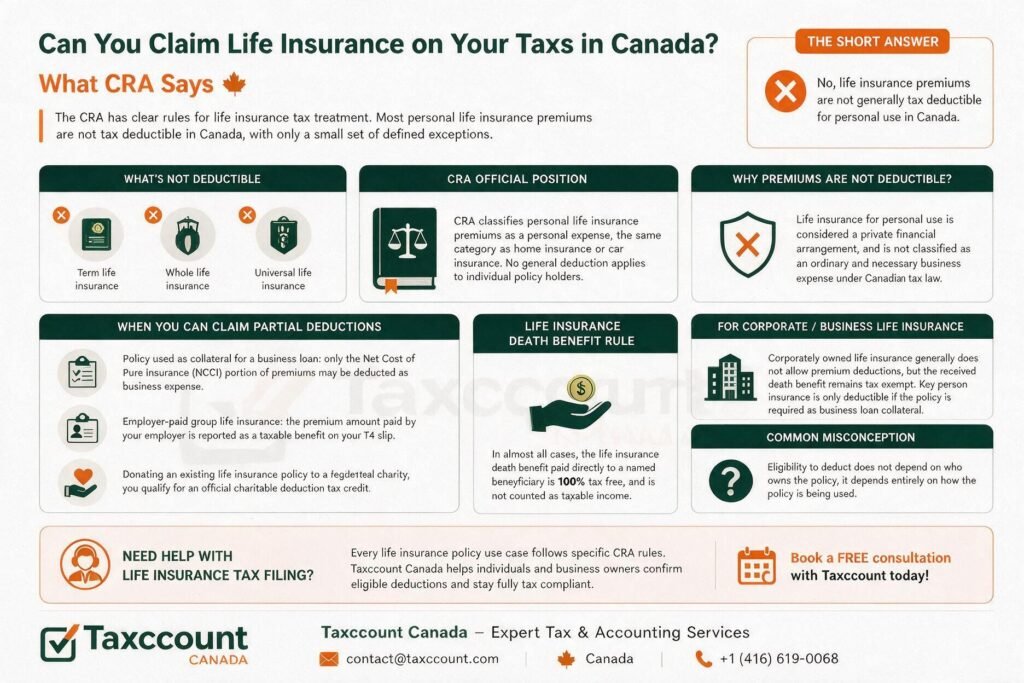
For most Canadians, life insurance premiums paid on a personal life insurance policy are not tax deductible. The CRA considers these a personal expense, similar to car insurance or home insurance. This applies to:
- Term life insurance
- Whole life insurance
- Universal life insurance
Professional tax return filing services can help determine whether any insurance-related tax rules apply to your situation.
Understand Life Insurance Taxes
☎️ Get HelpWhen Can Life Insurance Be Claimed on Your Taxes?
There are a few limited situations where life insurance may have a tax impact.
Used as Collateral for a Business Loan
If a life insurance policy is assigned as collateral for a business loan, a portion of the premiums may be deductible as a business expense. The deductible amount is based on the Net Cost of Pure Insurance (NCPI), not the full premium. This calculation is subject to specific CRA rules.
An accountant for taxes can help determine the deductible amount where this exception applies.
Employer-Paid Group Life Insurance
If your employer pays for your group life insurance coverage, the premiums paid on your behalf are generally included in your income as a taxable benefit. The taxable benefit is usually reported on your T4 slip.
Donating a Policy to Charity
If you donate a life insurance policy to a registered charity, you may be eligible for a charitable donation tax credit. The available credit depends on the value of the policy and how the donation is structured.
Tax and accounting services can help ensure charitable donations are reported correctly.
Are Life Insurance Payouts Taxable in Canada?
Generally, no. When a named beneficiary receives the death benefit from a life insurance policy, the proceeds are not considered taxable income. This tax-free treatment is one of the primary advantages of life insurance in Canada.
Life Insurance for Business Owners and Corporations
Corporate-owned life insurance follows different tax rules than personal policies.
In most cases:
- Premiums paid on a corporately owned life insurance policy are not deductible.
- The death benefit received by the corporation is generally tax-free, subject to applicable tax rules.
- Key person insurance premiums are generally not deductible unless the policy is required as collateral for a business loan.
A corporate tax accountant can help determine the tax treatment of corporate-owned life insurance policies.
Common Misconceptions About Life Insurance and Taxes
Many people assume that because life insurance is an important financial product, the premiums must be tax deductible. However, this is generally not the case for personal policies.
Whether you own an individual policy or a business policy, the tax treatment depends on how the policy is used rather than simply who owns it.
Tax accountants can help explain the specific rules that apply to your circumstances.
Table of Summary
Here is the blog information in 6 easy rows for quick understanding:
| Section | Easy Information |
|---|---|
| 1. Topic | The blog explains whether life insurance can be claimed on taxes in Canada and under what circumstances. |
| 2. General Rule | Personal life insurance premiums are not tax deductible, including term, whole, and universal life policies. |
| 3. Exceptions | Premiums may be deductible if the policy is collateral for a business loan (Net Cost of Pure Insurance applies). |
| 4. Employer-Paid Insurance | Group life insurance premiums paid by an employer are included as a taxable benefit on your T4. |
| 5. Charitable Donations | Donating a life insurance policy to a registered charity may qualify for a charitable donation tax credit, depending on the policy’s value. |
| 6. Corporate Life Insurance | Corporate-owned policies: premiums generally not deductible, death benefits usually tax-free, key person insurance may only be deductible if used as loan collateral. Professional guidance is recommended. |
FAQs
Can Tax Filing Near Me Services Help With Life Insurance Tax Questions?
Yes. Tax filing near me services can help review whether life insurance premiums, benefits, or policy-related transactions have any tax impact.
Are Life Insurance Premiums Deductible Through Tax Return Filing Services?
Usually no. Tax return filing services can help confirm that personal life insurance premiums are generally not deductible in Canada.
Can an Accountant for Taxes Claim Life Insurance Used for a Business Loan?
Yes, in limited cases. An accountant for taxes can calculate the deductible portion when a policy is assigned as collateral for a qualifying business loan.
Do Tax and Accounting Services Help With Employer-Paid Life Insurance?
Yes. Tax and accounting services can help report taxable benefits when an employer pays group life insurance premiums on your behalf.
Can a Corporate Tax Accountant Help With Corporate-Owned Life Insurance?
Yes. A corporate tax accountant can review premium deductibility, key person insurance, corporate beneficiaries, and capital dividend account planning.
Can Tax Accountants Help With Donated Life Insurance Policies?
Yes. Tax accountants can help determine whether donating a life insurance policy to a registered charity may qualify for a charitable donation tax credit.
Should I Ask a Tax Accountant Near Me Before Claiming Life Insurance?
Yes. A tax accountant near me can confirm whether your policy is personal, business-related, employer-paid, or charity-related before you claim anything.
Get Insurance Tax Advice
☎️ Get HelpThis is general information only and not professional advice. Consult a professional before acting.
 Written and fact-checked by Udit Gupta
 Written and fact-checked by
 Ex Big4, Ernst & Young, Deloitte | International & Cross-Border Tax Specialist | CPA Canada In Depth Tax Training | Licensed Chartered Accountant from ICAI & MIA
Udit Gupta has over 15 years of experience helping corporations & business owners with corporate structuring, corporate tax filing, bookkeeping, payroll, GST/HST, cross-border tax and CRA representation. Big 4 trained at Ernst & Young and Deloitte, and qualified as a Chartered Accountant in India and Malaysia, he founded accounting firm in 2014 to serve entrepreneurs, startups and non-resident business owners across Canada. View Full Member Bio.
Indian Institute of Chartered Accountant Member No. (521458) | Malaysian Institute of Accountants Membership number (CA 44667) | Ex Big4,Ex Ernst & Young (EY), Ex-Deloitte | CPA Canada In-Depth Tax Training 19 Dec 2023, 12 Jul 2022, 5 Jul 2023
Editorial policy. Every article is researched against primary sources — the Income Tax Act, CRA publications and CPA Canada.