What Is the Basic Personal Amount in Canada?

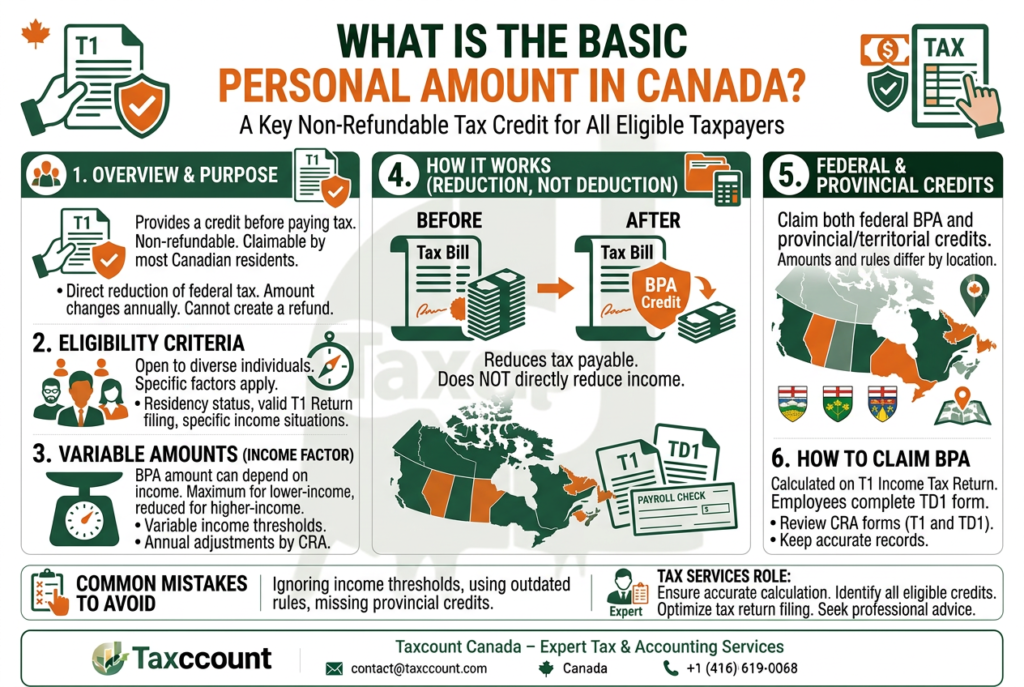
The Basic Personal Amount (BPA) is a non-refundable tax credit available to eligible Canadian taxpayers. It allows you to earn a certain amount of income before paying federal income tax. The amount can change from year to year and may also depend on your income.
Taxccount Canada helps individuals searching for tax filing near me understand tax credits, deductions, and other CRA rules that may affect their personal income tax return.
How Does the Basic Personal Amount Work?
The Basic Personal Amount does not directly reduce your taxable income. Instead, it provides a non-refundable tax credit that reduces the federal income tax you would otherwise have to pay.
The amount available to you depends on the applicable tax year and, in some cases, your net income.
Professional tax return filing services can help ensure the correct Basic Personal Amount is included when preparing your return.
Complete GST/HST Registration
☎️ Get HelpWho Can Claim the Basic Personal Amount?
Most Canadian residents filing an income tax return can claim the Basic Personal Amount.
However, the amount you are entitled to may depend on factors such as:
- Your net income
- Your residency status
- The tax year being filed
- Whether special rules apply to your situation
An accountant for taxes can help determine the amount available based on your circumstances.
Is the Basic Personal Amount the Same for Everyone?
No. The federal Basic Personal Amount can vary depending on your income.
Generally, taxpayers below the applicable income threshold can receive the maximum BPA. Higher-income taxpayers may receive a reduced amount, subject to the rules and thresholds established for that tax year.
Tax and accounting services can help taxpayers understand how income levels affect available federal tax credits.
Does the Basic Personal Amount Mean That Income Is Tax-Free?
The Basic Personal Amount can reduce federal income tax, but it does not necessarily mean that everyone earning less than the BPA will have no taxes or deductions.
Your overall tax situation can also be affected by:
- Provincial or territorial income tax
- Canada Pension Plan (CPP) contributions
- Employment Insurance (EI) premiums
- Other income
- Other deductions and tax credits
Income tax preparation near me services can help calculate your overall tax liability rather than looking at the BPA alone.
Federal and Provincial Basic Personal Amounts
In addition to the federal Basic Personal Amount, provinces and territories generally provide their own basic personal tax credits.
The provincial amount and the rules used to calculate it can differ depending on where you live.
Tax accountants can help ensure both federal and applicable provincial or territorial credits are considered when preparing your return.
How Do You Claim the Basic Personal Amount?
For most taxpayers, the Basic Personal Amount is calculated as part of preparing the T1 Income Tax and Benefit Return.
Employees in Canada may need to complete federal and provincial or territorial TD1 forms to provide their employer with information about eligible personal tax credits. Employers use the information on these forms to determine the appropriate amount of income tax to deduct from each paycheque.
Keeping your TD1 information accurate and up to date can help ensure your payroll tax deductions are calculated correctly based on your circumstances.
A tax accountant near me can help review available personal tax credits when preparing your Canadian income tax return.
Table of Summary
| Section | Easy Information |
|---|---|
| 1. Topic | The article explains the Basic Personal Amount (BPA) in Canada, a federal non-refundable tax credit that helps reduce the amount of federal income tax eligible taxpayers owe. |
| 2. What Is the Basic Personal Amount? | The Basic Personal Amount (BPA) is a non-refundable tax credit available to eligible Canadian taxpayers. It allows individuals to reduce their federal income tax payable. |
| 3. How Does BPA Work? | BPA does not reduce your taxable income directly. Instead, it reduces the federal tax you would otherwise have to pay by applying a tax credit. |
| 4. Who Can Claim BPA? | Most Canadian residents who file an income tax return can claim the Basic Personal Amount. Eligibility depends on factors such as: • Net income • Residency status • Tax year • Special CRA rules that may apply |
| 5. Is BPA the Same for Everyone? | No. The federal Basic Personal Amount can vary depending on income. |
| 6. Maximum BPA Amount | Taxpayers below the applicable income threshold may receive the maximum Basic Personal Amount. |
| 7. Higher-Income Taxpayers | Higher-income taxpayers may receive a reduced Basic Personal Amount depending on the income limits and rules for that tax year. |
| 8. Does BPA Make Income Tax-Free? | No. The BPA reduces federal income tax but does not mean all income below the BPA is completely tax-free. |
| 9. Other Factors Affecting Tax Payable | Your final tax situation may also depend on: • Provincial or territorial income tax • CPP contributions • EI premiums • Other income sources • Other deductions and credits |
| 10. Federal and Provincial BPA | Canada provides a federal Basic Personal Amount, and provinces and territories generally provide their own personal tax credits. Provincial amounts and rules may differ. |
| 11. How BPA Is Claimed | For most taxpayers, BPA is automatically calculated when preparing the T1 Income Tax and Benefit Return. |
| 12. Role of TD1 Forms | Employees provide personal tax credit information through federal and provincial/territorial TD1 forms, which help employers calculate the correct amount of tax deductions from paycheques. |
| 13. Importance of Correct Calculation | Correctly applying the BPA helps ensure taxpayers receive the tax credits they are entitled to and avoid incorrect tax calculations. |
| 14. Key Takeaway | The Basic Personal Amount is a valuable Canadian tax credit that reduces federal income tax. The available amount depends on the tax year, income level, and taxpayer circumstances. |
Frequently Asked Questions
Is the Basic Personal Amount a Tax Deduction?
No. The Basic Personal Amount is a non-refundable tax credit rather than a deduction from income.
Does Every Canadian Get the Same Basic Personal Amount?
No. The federal amount available can vary depending on income and the applicable tax year.
Do Provinces Have Their Own Basic Personal Amount?
Yes. Provinces and territories generally have their own basic personal tax credits, and the amounts can differ.
Do I Have to Apply Separately for the Basic Personal Amount?
Generally, no separate application is required. The applicable amount is calculated when completing your income tax return.
Can the Basic Personal Amount Give Me a Tax Refund?
Because it is a non-refundable tax credit, the Basic Personal Amount can reduce eligible tax payable but does not, by itself, create a refund if you otherwise have no tax payable.
Stay CRA GST Compliant
☎️ Get HelpThis is general information only and not professional advice. Consult a professional before acting.
 Written and fact-checked by Udit Gupta
 Written and fact-checked by
 Ex Big4, Ernst & Young, Deloitte | International & Cross-Border Tax Specialist | CPA Canada In Depth Tax Training | Licensed Chartered Accountant from ICAI & MIA
Udit Gupta has over 15 years of experience helping corporations & business owners with corporate structuring, corporate tax filing, bookkeeping, payroll, GST/HST, cross-border tax and CRA representation. Big 4 trained at Ernst & Young and Deloitte, and qualified as a Chartered Accountant in India and Malaysia, he founded accounting firm in 2014 to serve entrepreneurs, startups and non-resident business owners across Canada. View Full Member Bio.
Indian Institute of Chartered Accountant Member No. (521458) | Malaysian Institute of Accountants Membership number (CA 44667) | Ex Big4,Ex Ernst & Young (EY), Ex-Deloitte | CPA Canada In-Depth Tax Training 19 Dec 2023, 12 Jul 2022, 5 Jul 2023
Editorial policy. Every article is researched against primary sources — the Income Tax Act, CRA publications and CPA Canada.