How Much Taxes Do I Pay in Canada?

One of the most common questions Canadians ask each year is: how much taxes do I actually pay? The answer depends on your income, province of residence, and the credits and deductions you claim. Canada uses a progressive tax system, meaning the more you earn, the higher the rate on your top dollars — but not on every dollar.
Taxccount Canada helps individuals searching for tax filing near me understand Canadian tax rates, deductions, and filing obligations.
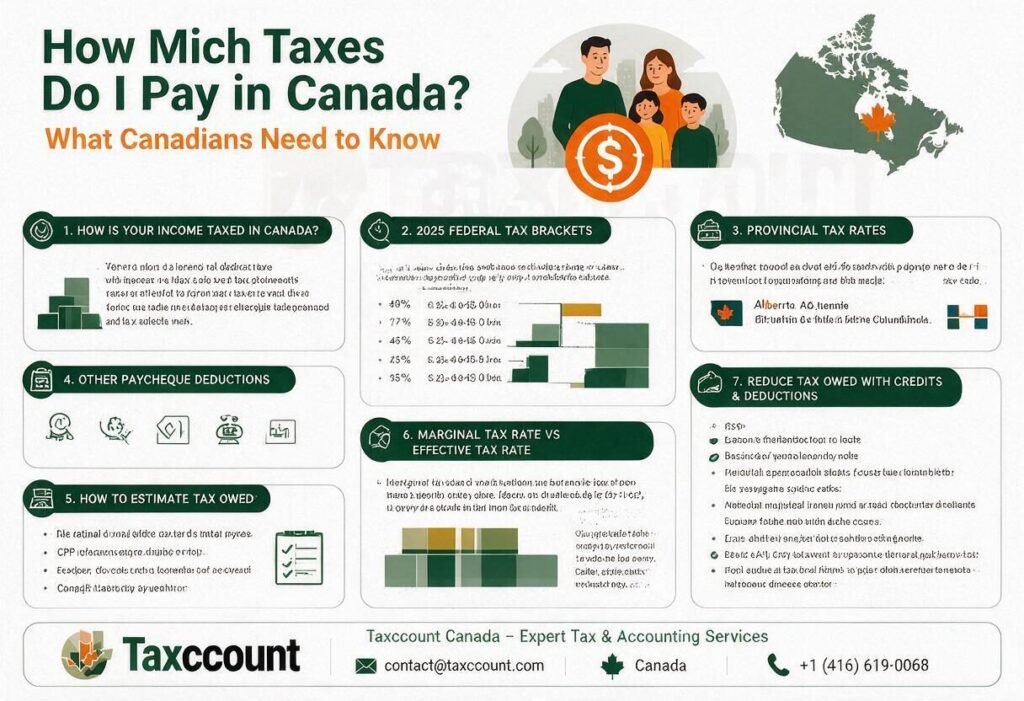
How Is Your Income Taxed in Canada?
Canada uses a marginal tax rate system. This means different portions of your income are taxed at different rates. Only the income that falls within a higher bracket is taxed at the higher rate — not your entire income.
The federal government and your province or territory calculate tax separately. Your final liability may also be reduced by deductions and tax credits.
Calculate Your Tax Owing
☎️ Get HelpFederal Tax Brackets
For the 2025 tax year, the federal government applies the following rates to taxable income:
- 14.5% on the first $57,375
- 20.5% on income over $57,375 up to $114,750
- 26% on income over $114,750 up to $177,882
- 29% on income over $177,882 up to $253,414
- 33% on income over $253,414
The lowest federal rate for 2025 is 14.5% because the rate was reduced from 15% to 14% beginning on July 1, 2025. Tax thresholds and rates can change annually, so taxpayers should confirm the applicable figures for the tax year they are filing.
Professional tax return filing services can help calculate the correct federal tax based on your taxable income.
Provincial Tax Rates
In addition to federal tax, each province and territory has its own income tax brackets and rates. Provincial or territorial tax is applied in addition to your federal income tax.
For example:
- Alberta generally has fewer provincial tax brackets than several other provinces.
- Ontario applies provincial tax rates and may also charge the Ontario surtax and Ontario Health Premium.
- Quebec residents file a separate provincial income tax return and receive a federal tax abatement.
- British Columbia uses several provincial tax brackets that increase with taxable income.
Because provincial rates and credits differ, two people earning the same income may pay different amounts depending on where they lived on December 31 of the tax year.
Tax and accounting services can help taxpayers understand how their province affects their total liability.
What Other Deductions Come Off Your Paycheque?
Beyond income tax, your employer may deduct:
- CPP contributions
- EI premiums
These amounts are separate from income tax but reduce your take-home pay. Employees may also see deductions for workplace pensions, health benefits, union dues, or other employer plans.
An accountant for taxes can review your T4 and determine whether the deductions reported by your employer have been handled correctly.
How to Estimate Your Tax Owing
Your tax owing depends on more than your salary. A proper estimate considers:
- Total income from all sources
- Federal and provincial tax brackets
- Payroll tax already deducted
- CPP and EI contributions
- Tax deductions
- Non-refundable and refundable tax credits
- Your province or territory of residence
- Your family and personal circumstances
General percentage estimates can be misleading because effective tax rates vary significantly between taxpayers and provinces.
A tax accountant near me can prepare a more reliable estimate using your actual income, deductions, and credits.
Marginal Tax Rate vs. Effective Tax Rate
Your marginal tax rate is the rate applied to your next dollar of taxable income. Your effective tax rate is your total tax payable divided by your total income.
Your effective tax rate is generally lower than your highest marginal rate because your income is divided across different tax brackets.
For example, entering the 26% federal bracket does not mean all your income is taxed federally at 26%. Only the portion within that bracket is subject to that rate.
Reduce What You Owe With Credits and Deductions
Canadians may reduce their tax bill through eligible credits and deductions, including:
- RRSP contributions
- Basic personal amount
- Medical expense tax credit
- Charitable donation tax credit
- Childcare expense deductions
- Eligible employment expenses
- Home office expenses for qualifying employees or self-employed individuals
- Tuition tax credits
- Disability-related credits
Deductions generally reduce taxable income, while tax credits reduce the tax calculated. The eligibility rules vary depending on the particular deduction or credit.
Professional income tax preparation near me services can help identify claims that apply to your circumstances.
Table of Summary
Here is the blog information in 6 easy rows for quick understanding:
| Section | Easy Information |
|---|---|
| 1. Topic | The blog explains how much tax Canadians pay and what factors affect it. |
| 2. Federal Tax | Canada uses marginal tax rates: 14.5% on first $57,375, up to 33% on income over $253,414 (2025 rates). Only the income within each bracket is taxed at that rate. |
| 3. Provincial Tax | Each province/territory has its own rates and brackets, which are added to federal tax. Quebec files a separate provincial return; others vary in brackets and surtaxes. |
| 4. Other Payroll Deductions | Employers also deduct CPP contributions, EI premiums, and sometimes pensions, health plans, and union dues, reducing take-home pay. |
| 5. Estimating Tax Owing | Proper estimates consider total income, federal & provincial brackets, deductions, credits, payroll taxes, and personal circumstances. Marginal rate applies to next dollar; effective rate is lower. |
| 6. Reducing Taxes | Canadians can reduce taxes with RRSP contributions, personal amounts, medical/charity/tuition credits, childcare, home office, employment expenses, and disability credits. Professional help ensures all eligible claims are applied. |
FAQs
Do I pay taxes on my entire income?
No. You only pay tax on your taxable income, which is your gross income minus eligible deductions. The progressive system means different portions of your income are taxed at different rates.
What is the difference between marginal and effective tax rate?
Your marginal rate is the rate applied to your highest dollar of income. Your effective rate is the average rate across your entire income. Most Canadians pay an effective rate well below their marginal rate.
When do I have to pay taxes I owe?
Any balance owing is due by April 30 of the following year. Filing your return by the deadline avoids late-filing penalties.
Get Help Calculating Your Canadian Taxes
Need help with your Canadian tax filing? Taxccount helps individuals, self-employed professionals, and corporations stay compliant with CRA rules while minimizing tax stress. Our team ensures you only pay what you owe — nothing more. Book a free consultation today.
Maximize Tax Credits
☎️ Get HelpThis is general information only and not professional advice. Consult a professional before acting.
 Written and fact-checked by Udit Gupta
 Written and fact-checked by
 Ex Big4, Ernst & Young, Deloitte | International & Cross-Border Tax Specialist | CPA Canada In Depth Tax Training | Licensed Chartered Accountant from ICAI & MIA
Udit Gupta has over 15 years of experience helping corporations & business owners with corporate structuring, corporate tax filing, bookkeeping, payroll, GST/HST, cross-border tax and CRA representation. Big 4 trained at Ernst & Young and Deloitte, and qualified as a Chartered Accountant in India and Malaysia, he founded accounting firm in 2014 to serve entrepreneurs, startups and non-resident business owners across Canada. View Full Member Bio.
Indian Institute of Chartered Accountant Member No. (521458) | Malaysian Institute of Accountants Membership number (CA 44667) | Ex Big4,Ex Ernst & Young (EY), Ex-Deloitte | CPA Canada In-Depth Tax Training 19 Dec 2023, 12 Jul 2022, 5 Jul 2023
Editorial policy. Every article is researched against primary sources — the Income Tax Act, CRA publications and CPA Canada.