Can You File Business and Personal Taxes Together in Canada?

If you run a small business or work as a freelancer, you may be wondering whether you need to file separate tax returns for your business and yourself. In Canada, the answer depends entirely on how your business is legally structured.
Taxccount Canada helps individuals searching for tax filing near me understand whether their business income should be reported on a personal or corporate tax return.
Can You File Business and Personal Taxes Together?
It depends on your business structure.
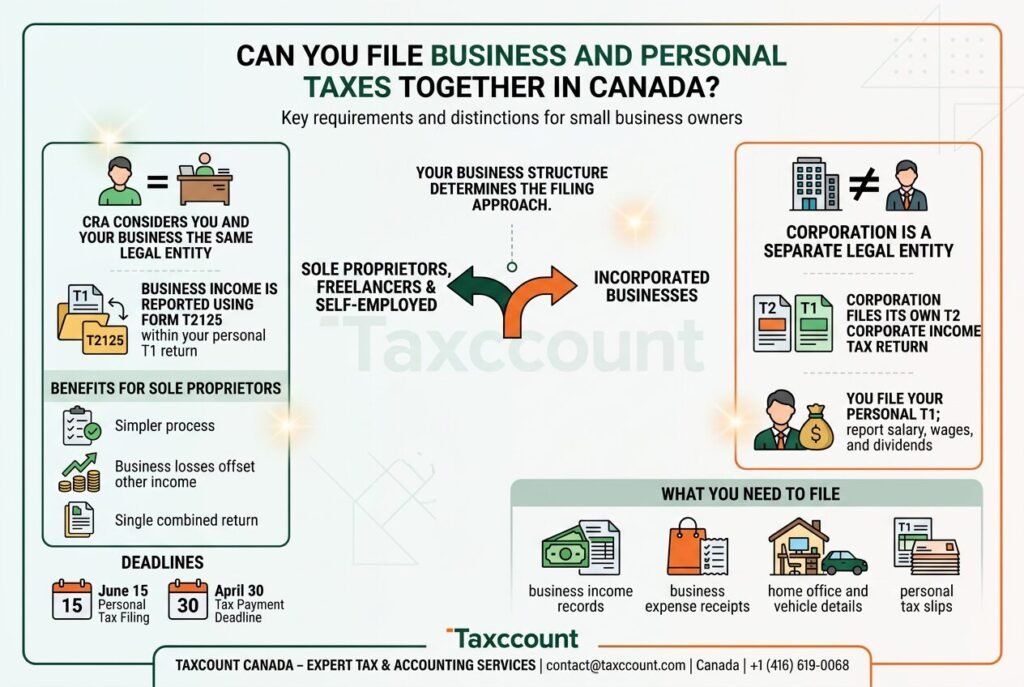
If you operate as a sole proprietor or self-employed individual, your business income is reported on your personal income tax return.
If your business is incorporated, the corporation must file its own corporate income tax return, while you continue to file your personal return separately.
Professional tax return filing services can help determine which filing requirements apply to your business.
Simplify Business Tax Filing
☎️ Get HelpSole Proprietors and Freelancers
If you are a sole proprietor, freelancer, independent contractor, or self-employed professional, your business and personal taxes are filed together.
The CRA considers you and your business to be the same legal entity.
You report your business income and expenses using Form T2125 (Statement of Business or Professional Activities), which forms part of your T1 personal income tax return.
Your net business income is then combined with any other personal income, such as employment income or investment income, to determine your total taxable income.
An accountant for taxes can help ensure your business expenses are properly claimed.
Incorporated Businesses
An incorporated business is a separate legal entity from its owner.
This means the corporation must file its own T2 Corporation Income Tax Return with the CRA.
As the shareholder or owner, you must also file your personal T1 income tax return. Any salary, wages, dividends, or other payments received from the corporation must be reported on your personal return.
Tax and accounting services can help coordinate both personal and corporate tax filings to ensure CRA compliance.
Filing Deadlines for Business Owners
If you are a sole proprietor or self-employed individual:
- Personal tax filing deadline: June 15 (for you and your spouse or common-law partner if applicable).
- Tax payment deadline: April 30 (or the applicable CRA payment deadline for the tax year).
Although self-employed individuals receive additional time to file their return, any taxes owing must generally be paid by the payment deadline to avoid interest charges.
Business tax filing becomes more complex if you operate multiple businesses or have employees.
Benefits of Filing Business and Personal Taxes Together
For sole proprietors, filing both together offers several advantages.
Simpler Filing Process
Only one personal income tax return is required, with business income reported on Form T2125.
Business Losses May Reduce Personal Tax
Eligible business losses may offset other sources of personal income, potentially reducing your overall tax liability.
One Combined Tax Return
Personal deductions, tax credits, and business expenses are reported together, making it easier to calculate your final tax position.
A Small business accountant can also help identify deductions that are commonly overlooked.
What You Need to File
Before preparing your return, gather:
- Records of all business income, invoices, and sales receipts.
- Receipts for business expenses such as advertising, office supplies, insurance, and travel.
- Home office expense records, if applicable.
- Vehicle expense records for business use.
- Personal tax slips, including T4s, T5s, RRSP receipts, and other applicable documents.
A corporate tax accountant may be beneficial if your business is incorporated or your tax affairs are more complex.
Table of Summary
Here is the blog information in 6 easy rows for quick understanding:
| Section | Easy Information |
|---|---|
| 1. Topic | The blog explains whether business and personal taxes can be filed together in Canada, depending on the legal structure of the business. |
| 2. Sole Proprietor / Freelancer | Business and personal taxes are filed together. Business income and expenses are reported using Form T2125 as part of the personal T1 tax return. |
| 3. Incorporated Business | A corporation is a separate legal entity and must file its own T2 Corporation Income Tax Return. The owner must file a separate personal T1 return for salary, dividends, or other income received. |
| 4. Filing Deadlines | Self-employed individuals generally have until June 15 to file, but any taxes owing are usually due by April 30 to avoid interest charges. |
| 5. Benefits of Combined Filing (Sole Proprietors) | Easier filing process, business losses may reduce personal taxable income, and business expenses, deductions, and credits are combined in one return. |
| 6. Documents Needed | Keep business income records, invoices, expense receipts, advertising costs, office expenses, vehicle/home office records, and personal tax slips (T4, T5, RRSP receipts). Corporate owners may need a corporate tax accountant. |
FAQs
Can Sole Proprietors File Business and Personal Taxes Together?
Yes. Sole proprietors report their business income and expenses on Form T2125, which is included with their personal T1 income tax return.
Do Incorporated Businesses File a Separate Tax Return?
Yes. A corporation must file its own T2 Corporation Income Tax Return, while the owner files a separate personal T1 return.
What Form Is Used to Report Self-Employment Income?
Self-employed individuals generally report business income and expenses using Form T2125 as part of their personal income tax return.
When Is the Filing Deadline for Self-Employed Individuals?
Self-employed individuals generally have until June 15 to file their personal income tax return, although any balance owing is generally due by the CRA payment deadline to avoid interest.
Should I Hire a Professional for Business Taxes?
If you have significant business expenses, employees, GST/HST obligations, or an incorporated business, professional assistance can help ensure your returns are accurate and compliant with CRA requirements.
Get Tax Filing Help
☎️ Get HelpThis is general information only and not professional advice. Consult a professional before acting.
 Written and fact-checked by Udit Gupta
 Written and fact-checked by
 Ex Big4, Ernst & Young, Deloitte | International & Cross-Border Tax Specialist | CPA Canada In Depth Tax Training | Licensed Chartered Accountant from ICAI & MIA
Udit Gupta has over 15 years of experience helping corporations & business owners with corporate structuring, corporate tax filing, bookkeeping, payroll, GST/HST, cross-border tax and CRA representation. Big 4 trained at Ernst & Young and Deloitte, and qualified as a Chartered Accountant in India and Malaysia, he founded accounting firm in 2014 to serve entrepreneurs, startups and non-resident business owners across Canada. View Full Member Bio.
Indian Institute of Chartered Accountant Member No. (521458) | Malaysian Institute of Accountants Membership number (CA 44667) | Ex Big4,Ex Ernst & Young (EY), Ex-Deloitte | CPA Canada In-Depth Tax Training 19 Dec 2023, 12 Jul 2022, 5 Jul 2023
Editorial policy. Every article is researched against primary sources — the Income Tax Act, CRA publications and CPA Canada.