When Do You Need to File Your Taxes in Canada? Deadlines and Key Dates
Tax season in Canada rolls around every year, but knowing exactly when you need to file can be confusing — especially if your situation has changed. Whether you are an employee, self-employed, a student, or a retiree, this guide gives you a clear answer on when your taxes are due and what happens if you miss the deadline.
Does Everyone Have to File a Tax Return in Canada?
Not everyone is legally required to file a tax return, but most Canadians should. You are required to file if:
- You owe taxes to the CRA
- You disposed of capital property (such as a rental property or investments)
- You received a taxable capital gain during the year
- The CRA has asked you to file
- You received working income tax benefit advance payments
Even if you are not required to file, there are strong reasons to do so — including claiming refunds, receiving government benefits, and building RRSP contribution room.
File Taxes On Time
☎️ Get HelpThe Standard Tax Filing Deadline in Canada
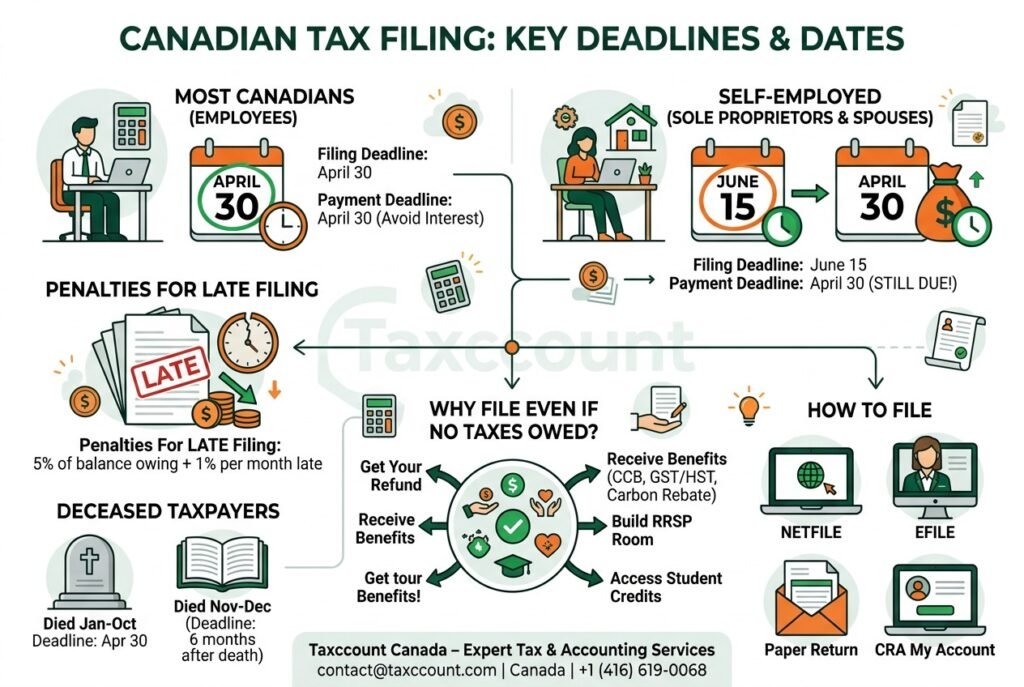
For most Canadians, the tax return must be filed by April 30 of the following year. For example, your 2024 tax return is due on April 30, 2025.
April 30 is also the deadline to pay any balance owing to the CRA. If you owe money and do not pay by this date, interest begins to accumulate starting May 1.
Filing Deadline for Self-Employed Canadians
If you are self-employed or your spouse or common-law partner is self-employed, you have until June 15 to file your tax return. This applies to sole proprietors, freelancers, independent contractors, and others with self-employment income.
Important: Even though the filing deadline is June 15, the payment deadline is still April 30. If you owe taxes, you must pay by April 30 to avoid interest charges, even if you have not yet filed your return.
What Happens If You File Late?
Filing late when you owe money is costly. The CRA applies a late-filing penalty of five percent of the balance owing, plus one percent per month for every month the return is late, up to a maximum of 12 months. This means you could owe up to 17 percent in penalties on top of your original balance.
Interest is also compounded daily on any unpaid balance and on any penalties.
If you file late but do not owe any money (for example, you expect a refund), there is no late-filing penalty. However, you will delay receiving your refund and any benefit payments that depend on your filed return.
When Should You File Even If You Do Not Owe Anything?
Filing your tax return is worthwhile even when you do not owe any taxes. Here is why:
- To get your tax refund — If your employer withheld more tax than necessary, you are owed that money back
- To receive benefit payments — GST/HST Credit, Canada Child Benefit (CCB), and the Canada Carbon Rebate are all based on your filed return
- To build RRSP contribution room — Unused room carries forward, but it only accumulates when you file
- To access student and disability credits — Many credits can only be claimed on a filed return
- To qualify for provincial benefits — Some provinces calculate benefit payments based on your federal return
Filing Deadlines for Special Situations
| Situation | Filing Deadline |
|---|---|
| Most employed Canadians | April 30 |
| Self-employed (or spouse is self-employed) | June 15 (payment still due April 30) |
| Deceased taxpayer (died Jan 1 – Oct 31) | April 30 of the following year |
| Deceased taxpayer (died Nov 1 – Dec 31) | Six months after the date of death |
| Non-residents with Canadian income | April 30 (or June 15 if self-employed) |
How to File Your Tax Return in Canada
There are several ways to file your Canadian tax return:
- NETFILE — File electronically using CRA-certified tax software (fastest and most common method)
- EFILE — Have a registered tax preparer file on your behalf
- Paper return — Download and mail your T1 General form to the CRA (allow extra processing time)
- CRA My Account — Access your tax slip information, RRSP limits, and filing history online
What You Need Before You File
- T4 slips from all employers
- T5 or T3 slips for investment income
- RRSP contribution receipts
- Tuition receipts (T2202) if applicable
- Medical expense receipts
- Charitable donation receipts
- Business income and expense records if self-employed
- Previous year’s Notice of Assessment (for RRSP room and carryforward amounts)
Tips for Filing on Time Every Year
- Set a reminder in your calendar for March 1 to begin gathering documents
- Register for CRA My Account to access your tax slips and benefit information online
- Sign up for direct deposit to receive your refund faster
- If your situation is complex (self-employed, rental income, investments), work with a tax professional to avoid errors and missed deductions
- File even if you cannot pay — this avoids the late-filing penalty while you arrange payment
Ready to File? Let Taxccount Handle It for You
Taxccount helps individuals, families, self-employed professionals, and corporations manage their Canadian tax filing requirements with accurate and timely tax return preparation. Whether you have a simple T4 income tax return or a more complex self-employment situation, our tax professionals help identify eligible tax credits, deductions, and benefits while ensuring your return is prepared in line with CRA requirements.
From personal income tax returns to self-employed and corporate tax filings, Taxccount provides reliable tax return filing services in Canada tailored to your needs. Book a free consultation with Taxccount today to discuss your tax situation.
Here is the blog information in 6 easy rows:
| Section | Easy Information |
|---|---|
| 1. Topic | The blog explains when Canadians need to file their taxes and the key CRA tax deadlines. |
| 2. Main Deadline | Most Canadians must file their tax return by April 30 of the following year. For example, the 2024 tax return was due on April 30, 2025. |
| 3. Self-Employed Deadline | Self-employed Canadians, or those with a self-employed spouse/common-law partner, can file by June 15, but any tax owing is still due by April 30. |
| 4. Late Filing Penalty | If tax is owing and the return is late, CRA may charge 5% of the balance owing + 1% per month for up to 12 months. |
| 5. Why File Even With No Tax Owing | Filing helps people receive refunds, GST/HST Credit, Canada Child Benefit, Canada Carbon Rebate, RRSP room, and provincial benefits. |
| 6. Simple Summary | File by April 30 if you are a regular taxpayer, file by June 15 if self-employed, but always pay tax owing by April 30 to avoid CRA interest and penalties. |
Frequently Asked Questions
What is the tax filing deadline in Canada for 2024?
For the 2024 tax year, most Canadians must file by April 30, 2025. Self-employed individuals have until June 15, 2025, to file, though any balance owing is still due April 30, 2025.
What if I miss the April 30 deadline?
If you owe money and file late, the CRA charges a five percent penalty on the balance owing, plus one percent per month for up to 12 months. If you are owed a refund, there is no penalty, but you will delay receiving your money.
Do I have to file a tax return if I have no income?
You are not required to file if you have no income and no balance owing, but it is usually beneficial to do so. Filing allows you to receive the GST/HST Credit, Canada Carbon Rebate, and other benefits.
Can I file my taxes after June 15 if I am self-employed?
Yes, but filing after June 15 means you are filing late. The CRA will apply a late-filing penalty if you owe any balance. It is best to file by the deadline to avoid penalties and interest.
How do I know if the CRA received my tax return?
If you file electronically using NETFILE, you will receive a confirmation number immediately. You can also check the status of your return through CRA My Account.
Get Professional Tax Help
☎️ Get HelpThis is general information only and not professional advice. Consult a professional before acting.
 Written and fact-checked by Udit Gupta
 Written and fact-checked by
 Ex Big4, Ernst & Young, Deloitte | International & Cross-Border Tax Specialist | CPA Canada In Depth Tax Training | Licensed Chartered Accountant from ICAI & MIA
Udit Gupta has over 15 years of experience helping corporations & business owners with corporate structuring, corporate tax filing, bookkeeping, payroll, GST/HST, cross-border tax and CRA representation. Big 4 trained at Ernst & Young and Deloitte, and qualified as a Chartered Accountant in India and Malaysia, he founded accounting firm in 2014 to serve entrepreneurs, startups and non-resident business owners across Canada. View Full Member Bio.
Indian Institute of Chartered Accountant Member No. (521458) | Malaysian Institute of Accountants Membership number (CA 44667) | Ex Big4,Ex Ernst & Young (EY), Ex-Deloitte | CPA Canada In-Depth Tax Training 19 Dec 2023, 12 Jul 2022, 5 Jul 2023
Editorial policy. Every article is researched against primary sources — the Income Tax Act, CRA publications and CPA Canada.