Why Is There a Carbon Tax in Canada? A Plain-Language Guide
If you have ever filled up your gas tank or paid a heating bill in Canada, you have probably noticed a carbon charge on your receipt. A lot of Canadians want to know: why is the government charging this, who actually pays it, and is any of the money coming back to you?
This guide explains the carbon tax in plain language – how it works, why Canada introduced it, who pays it, and how the Canada Carbon Rebate works to return money to households.
What Is the Carbon Tax?
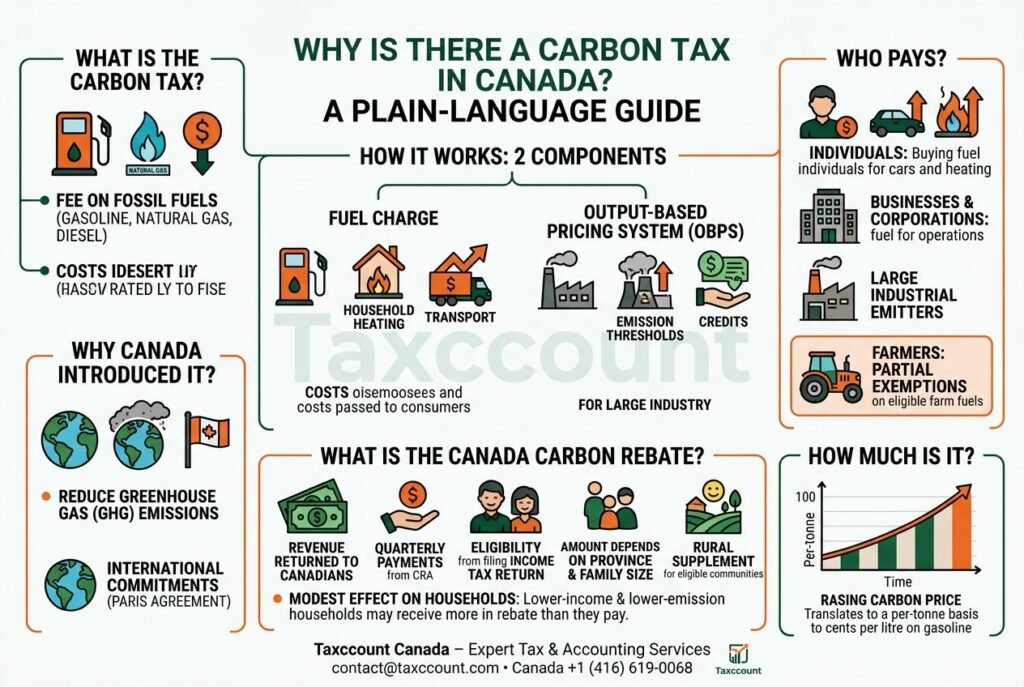
The carbon tax is a fee that the federal government of Canada charges on fossil fuels – including gasoline, diesel, and natural gas. It is applied when fossil fuels are sold to distributors and producers, and those costs are ultimately passed on to consumers and businesses.
By making fossil fuels more expensive, the government hopes that individuals and businesses will gradually shift toward cleaner energy alternatives. It is a market-based approach to reducing greenhouse gas (GHG) emissions rather than using regulation or bans.
Understand Carbon Tax Better
☎️ Get HelpWhy Did Canada Introduce a Carbon Tax?
Canada introduced carbon pricing to meet its international commitments to reduce greenhouse gas emissions under agreements like the Paris Agreement. The reasoning behind a carbon tax is straightforward economics: when something has a cost, people use less of it. By putting a price on carbon emissions, the government encourages consumers and businesses to choose lower-emission options over time.
The federal carbon pricing system also ensures that all provinces have a minimum carbon price. Provinces can use their own carbon pricing system as long as it meets federal standards. If they do not, the federal carbon tax applies automatically.
Revenue collected through the federal fuel charge is largely returned to residents of applicable provinces through the Canada Carbon Rebate – formerly known as the Climate Action Incentive Payment (CAIP).
How Does the Carbon Tax Work?
The carbon tax has two main components:
- The fuel charge: Applied to gasoline, diesel, propane, natural gas, and other fossil fuels at the point of sale. Fuel retailers collect it and pass it to consumers as part of the price. You see this as the carbon charge on your gas receipt or heating bill.
- The Output-Based Pricing System (OBPS): Applies to large industrial emitters. Companies above a certain emissions threshold pay a price on their excess emissions, while efficient companies may receive credits.
Farmers receive partial exemptions on certain fuels used for farming operations.
Who Pays the Carbon Tax?
- Individuals: Anyone who buys gasoline for their car, propane for heating, or natural gas for their home pays the carbon tax as part of the fuel price.
- Businesses and corporations: Companies that use fossil fuels for operations pay the carbon charge on those fuels.
- Large industrial emitters: Subject to the Output-Based Pricing System on emissions above their threshold.
- Farmers: Partially exempt on certain farm fuels such as marked diesel and gasoline used for eligible farming purposes.
How Much Is the Carbon Tax?
The carbon tax is set on a per-tonne basis for CO2-equivalent emissions and has been increasing over time. In practical terms, this translates to a few cents per litre of gasoline or a few dollars per gigajoule of natural gas. The exact amount varies depending on the fuel type and the volume used.
The government has committed to a specific carbon price trajectory. Annual increases are intended to gradually shift behaviour and investment decisions toward lower-emission alternatives over the longer term.
What Is the Canada Carbon Rebate?
Most of the revenue from the federal fuel charge is returned to Canadians in applicable provinces through the Canada Carbon Rebate (CCR). The rebate is issued quarterly by the Canada Revenue Agency (CRA) as a direct payment to eligible residents.
Key facts about the Canada Carbon Rebate:
- You do not apply separately – you qualify automatically by filing your annual T1 income tax return
- The amount depends on your province of residence and family size (single adult, couple, number of children)
- Residents of rural and small communities receive an additional rural supplement
- It is a tax-free payment and does not count as income
Do All Provinces Have the Carbon Tax?
Not all provinces apply the federal carbon tax directly. Provinces that have their own carbon pricing systems that meet federal standards are exempt from the federal fuel charge. Provinces like British Columbia, Quebec, and others have their own systems.
Provinces that do not have an equivalent system – or whose system does not meet the federal benchmark – have the federal fuel charge applied. Residents of those provinces receive the Canada Carbon Rebate from the federal government.
Does the Carbon Tax Actually Work?
This is a debated question. Proponents of carbon pricing argue that it is one of the most effective tools available to reduce emissions because it uses price signals rather than mandates. Research suggests that carbon pricing does reduce fuel consumption over time.
Critics argue that the cost burden on ordinary Canadians – particularly those in rural areas who have limited alternatives to driving or fossil fuel heating – outweighs the environmental benefit. Others question whether Canada’s emissions reductions are meaningful on a global scale.
The debate continues, and carbon pricing policy in Canada has evolved significantly over recent years as governments at both federal and provincial levels have adjusted their approaches.
How Does the Carbon Tax Affect Everyday Canadians?
For most households, the carbon tax adds a modest cost to gasoline, home heating, and goods and services where fuel costs are passed along. The Canada Carbon Rebate is designed so that households that use less than the average amount of fossil fuels receive more back in rebates than they pay in carbon charges.
In practice, lower-income and lower-emission households tend to come out ahead, while higher-income and higher-emission households pay more net. Rural residents receive additional support through the rural supplement to acknowledge their higher dependence on fuel.
Have Carbon Tax Questions? Talk to Taxccount
Whether you have questions about the Canada Carbon Rebate, how carbon pricing affects your tax return, or how to make sure you are receiving every benefit you are entitled to, Taxccount’s Canadian tax experts are here to help. Book a free consultation today.
| Summary Section | Easy Information |
|---|---|
| 1. Topic | The blog explains Carbon Tax in Canada and why the government charges it on fuels like gas, diesel, propane, and natural gas. |
| 2. Purpose | Canada uses carbon tax to encourage people and businesses to reduce pollution and move toward cleaner energy. |
| 3. Who Pays | Individuals, businesses, corporations, and large industries may pay it when they use fossil fuels. |
| 4. Canada Carbon Rebate | CRA gives eligible Canadians a quarterly tax-free rebate to return part of the carbon tax money. |
| 5. Main Impact | It can increase fuel and heating costs, but many households may get money back through the rebate. |
| 6. Simple Summary | Carbon tax makes pollution-related fuel use more costly, while the Canada Carbon Rebate helps return money to eligible households. |
Frequently Asked Questions
Is the carbon tax the same as the carbon rebate?
No. The carbon tax (fuel charge) is what you pay on fossil fuels. The Canada Carbon Rebate is the quarterly payment the CRA sends back to eligible households. They are related but separate – the rebate is funded by the revenue collected through the fuel charge.
Do I have to apply for the Canada Carbon Rebate?
No separate application is needed. You automatically qualify by filing your annual T1 income tax return with the CRA. The CRA calculates your rebate based on your province and family information from your return.
Which provinces have the federal carbon tax?
The federal fuel charge applies in provinces that do not have their own qualifying carbon pricing system. This has included provinces such as Alberta, Saskatchewan, Manitoba, Ontario, and certain Atlantic provinces, though the list of applicable provinces has changed over time as provincial policies evolve.
Does the carbon tax apply to groceries?
The carbon tax is not directly applied to food or grocery prices. However, because fossil fuels are used throughout the food supply chain – for farming, transportation, and processing – the carbon charge on those fuels can indirectly affect food costs.
Book a Free Tax Consultation Today
Taxccount helps individuals and families across Canada understand their tax obligations, maximize their CRA credits and rebates, and file with confidence every year. Book your free consultation with Taxccount today.
Claim Eligible CRA Rebates
☎️ Get HelpThis is general information only and not professional advice. Consult a professional before acting.
Official CRA sources:
- How to get Canada Carbon Rebate payments — CRA
- Payment timing — CRA
- Canada Carbon Rebate payment amounts — CRA
- Small and rural communities supplement — CRA
- Canada Carbon Rebate for Small Businesses — CRA
 Written and fact-checked by Udit Gupta
 Written and fact-checked by
 Ex Big4, Ernst & Young, Deloitte | International & Cross-Border Tax Specialist | CPA Canada In Depth Tax Training | Licensed Chartered Accountant from ICAI & MIA
Udit Gupta has over 15 years of experience helping corporations & business owners with corporate structuring, corporate tax filing, bookkeeping, payroll, GST/HST, cross-border tax and CRA representation. Big 4 trained at Ernst & Young and Deloitte, and qualified as a Chartered Accountant in India and Malaysia, he founded accounting firm in 2014 to serve entrepreneurs, startups and non-resident business owners across Canada. View Full Member Bio.
Indian Institute of Chartered Accountant Member No. (521458) | Malaysian Institute of Accountants Membership number (CA 44667) | Ex Big4,Ex Ernst & Young (EY), Ex-Deloitte | CPA Canada In-Depth Tax Training 19 Dec 2023, 12 Jul 2022, 5 Jul 2023
Editorial policy. Every article is researched against primary sources — the Income Tax Act, CRA publications and CPA Canada.