Tax Refund in Canada: How to Get It Faster and Maximize Your Return
For many Canadians, tax season ends with a pleasant surprise: a refund from the CRA. A refund is not a bonus from the government — it is simply the return of tax you overpaid throughout the year. But knowing how to speed up your refund and how to maximize the amount you get back are both important.
This guide explains how Canadian tax refunds work, how to get yours sooner, and what you can do to make sure you are getting back everything you are entitled to.
1. What Is a Tax Refund?
A tax refund is money the CRA sends you when you paid more tax during the year than you actually owed. This happens because:
- Tax was withheld from your paycheque at a rate that was too high
- You have credits or deductions you were not accounting for throughout the year
- You received large one-time deductions like RRSP contributions
- Your income was lower than your employer expected
The CRA calculates your actual tax owing when you file your return, and if the total tax paid (through payroll deductions or instalments) is more than what you owe, it sends you the difference.
Let Taxccount file for you today
☎️ Get Help2. Why Do Canadians Get Refunds?
The most common reasons Canadians get refunds include:
- RRSP contributions: The biggest single driver of large refunds. Every RRSP dollar reduces your taxable income.
- High withholding on bonuses or commissions: Employers often withhold more than necessary on large one-time payments.
- Unused tuition credits: Students who had credits transferred or carried forward.
- Childcare, medical, or other deductions not reflected in payroll withholding.
- Credits like the Canada Workers Benefit, disability tax credit, or others that are claimed at filing time.
3. How Long Does a Tax Refund Take?
The timing depends on how you file:
Online (NETFILE): The CRA typically processes electronically filed returns within 2 weeks. Refunds sent by direct deposit usually arrive within 8 to 10 business days of your return being assessed.
By mail (paper return): Paper returns take much longer — typically 8 weeks or more for processing.
The CRA processes returns in the order they are received. Filing early (before the April 30 deadline) means your return is assessed sooner.
4. How to Get Your Refund Faster
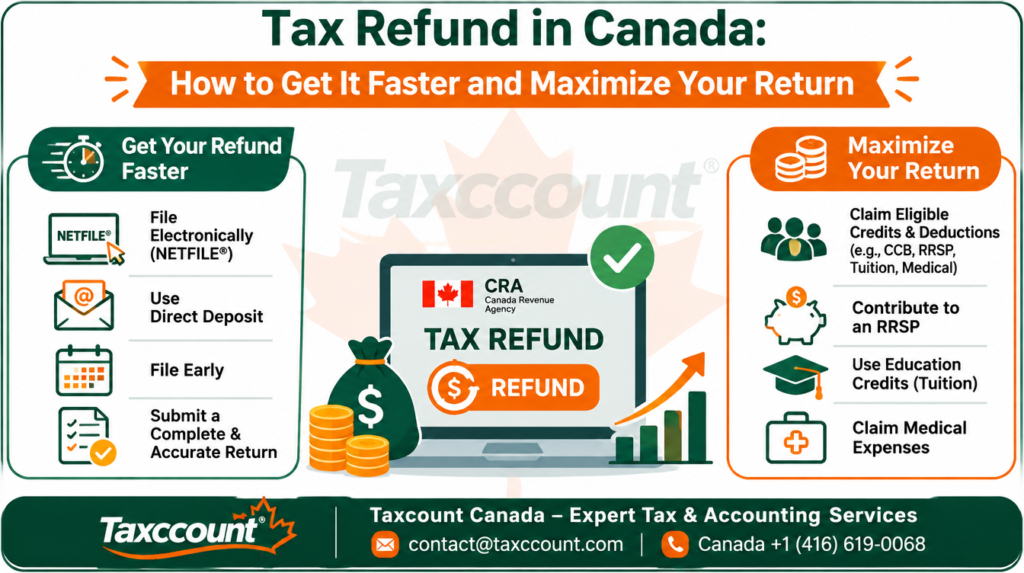
File online: Use CRA-certified tax software like TurboTax, Wealthsimple Tax, or an accountant who files electronically. Paper returns take much longer.
Sign up for direct deposit: If you have your refund deposited directly to your bank account, it arrives much faster than a cheque by mail. You can set up direct deposit through CRA My Account.
File early: The sooner you file after February (when T4 slips and other tax documents are issued), the sooner your refund arrives.
Make sure your return is complete and accurate: Returns with errors or missing information are delayed for review. Double-check all slips, amounts, and calculations before submitting.
Respond quickly to CRA requests: If the CRA needs additional information or documents, respond as soon as possible to avoid delays.
5. How Much Will You Get Back?
The amount of your refund depends on:
- How much tax was withheld from your income
- The deductions and credits you are eligible to claim
- Your total income for the year
- Whether you owe any amounts to the CRA from previous years
You can estimate your refund before you file using the CRA’s tax calculator or any certified tax software.
6. Ways to Maximize Your Tax Refund
Contribute to your RRSP: This is the most powerful way to increase your refund. Contributions reduce your taxable income dollar for dollar.
Claim all your credits: Make sure you are claiming the Basic Personal Amount, medical expenses, charitable donations, disability credits, tuition credits (if transferred), and any other credits you qualify for.
Claim home office expenses: If you worked from home and qualify, deduct your home office costs.
Report childcare expenses: Childcare costs are deductible for the lower-income parent.
Deduct RRSP contributions made in the first 60 days of the year: Contributions made between January 1 and March 1 can be applied to the previous tax year.
Carry forward or transfer student credits: If a student has unused tuition credits, they can transfer up to $5,000 to a parent or grandparent.
Claim moving expenses: If you moved for work or school, moving costs may be deductible.
7. What If Your Refund Is Less Than Expected?
If your refund is lower than expected, possible reasons include:
- The CRA applied your refund to an outstanding balance (like unpaid taxes, student loans owed to the CRA, or other government debts)
- You missed some income that the CRA added
- The CRA disallowed or reduced a deduction or credit you claimed
- A T4 or other slip was reported to the CRA that you did not include
If you disagree with the CRA’s assessment, you can file a Notice of Objection within 90 days.
8. Can the CRA Keep Your Refund?
Yes. The CRA can apply your refund to outstanding debts, including:
- Previous-year tax balances
- GST/HST amounts owing
- Other federal debt (like student loans administered by the CRA)
- Provincial debt (in some cases)
If your refund is being redirected, the CRA will send you a notice explaining where it went.
9. What to Do With Your Refund
Rather than spending your refund on day-to-day expenses, consider putting it to work:
- Contribute it to your RRSP for next year
- Put it in your TFSA for tax-free growth
- Use it to pay down high-interest debt
- Start or top up an emergency fund
- Make a lump-sum mortgage payment
Think of your refund as money you earned but were holding with the government interest-free. Using it strategically gives it more long-term value.
Table of Summary
| Topic | Key Information |
|---|---|
| What Is a Tax Refund? | A tax refund is money the CRA returns when you paid more tax during the year than you owed. This may happen because of excessive payroll deductions, unclaimed credits or deductions, RRSP contributions, or lower-than-expected income. |
| Why Do Canadians Get Refunds? | Common reasons include RRSP contributions, high tax withholding on bonuses or commissions, unused tuition credits, childcare and medical deductions, and credits such as the Canada Workers Benefit and Disability Tax Credit. |
| How Long Does an Online Tax Refund Take? | The CRA typically processes electronically filed returns within 2 weeks. Direct deposit refunds usually arrive within 8–10 business days after assessment. |
| How Long Does a Paper Tax Refund Take? | Paper returns typically take 8 weeks or more to process, making electronic filing the faster option. |
| When Should You File? | Filing early, after February when T4 slips and other tax documents are issued, can help you receive your refund sooner. The article identifies April 30 as the filing deadline. |
| File Online | Use CRA-certified tax software such as TurboTax or Wealthsimple Tax, or an accountant who files electronically. Online filing is generally faster than mailing a paper return. |
| Set Up Direct Deposit | Register for CRA direct deposit through CRA My Account so your refund goes directly into your bank account instead of arriving by cheque. |
| Submit an Accurate Return | Check all income slips, amounts, and calculations before filing. Missing information or errors can delay processing and trigger additional review. |
| Respond to CRA Requests | Provide requested information or supporting documents promptly if the CRA contacts you, helping prevent unnecessary processing delays. |
| How Much Will You Get Back? | Your refund depends on tax withheld, eligible deductions and credits, total annual income, and outstanding CRA balances from previous years. |
| Estimate Your Refund | Use the CRA tax calculator or certified tax software to estimate your refund before submitting your return. |
| Contribute to Your RRSP | RRSP contributions reduce taxable income dollar for dollar and are identified as one of the most effective ways to increase a tax refund. |
| Claim All Eligible Tax Credits | Review eligibility for the Basic Personal Amount, medical expenses, charitable donations, disability credits, tuition credits, and other available credits. |
| Claim Home Office Expenses | Employees who worked from home and meet the eligibility requirements may be able to deduct qualifying home office expenses. |
| Deduct Childcare Expenses | Eligible childcare expenses are generally deductible by the lower-income parent. |
| Claim Early-Year RRSP Contributions | RRSP contributions made between January 1 and March 1 can be applied to the previous tax year, subject to the applicable contribution rules. |
| Transfer Unused Tuition Credits | Eligible students may transfer up to $5,000 of unused tuition credits to a parent or grandparent. |
| Claim Moving Expenses | Qualifying moving costs may be deductible when relocating for work or school. |
| Why Is Your Refund Lower Than Expected? | Your refund may be reduced because of outstanding debts, unreported income added by the CRA, deductions or credits that were reduced or disallowed, or income slips missing from your original return. |
| Notice of Objection | If you disagree with the CRA’s assessment, you can file a Notice of Objection within 90 days. |
| Can the CRA Keep Your Refund? | Yes. The CRA can apply refunds toward outstanding tax balances, GST/HST debts, certain federal debts such as student loans administered by the CRA, and provincial debts in some cases. |
| Refund Applied to Outstanding Debts | If your refund is redirected to pay outstanding amounts, the CRA will send you a notice explaining where the money was applied. |
| What to Do With Your Refund | Consider contributing to an RRSP, investing in a TFSA, paying down high-interest debt, building an emergency fund, or making a lump-sum mortgage payment. |
| Is a Tax Refund Taxable? | No. A tax refund is simply the return of taxes already paid. It is not considered income and does not need to be reported on your next tax return. |
| What If You Move? | Update your address through CRA My Account or by contacting the CRA directly. This helps prevent refund cheques from being sent to an old address or getting lost. |
| How to Check Your Refund Status | Log into CRA My Account to check your account status. You can also contact the CRA Tax Information Phone Service (TIPS). |
| Does Filing Late Affect Your Refund? | Filing late does not reduce the refund itself. However, if you owe tax, late-filing penalties and interest may apply to the outstanding amount. |
| Conclusion: Get Your Refund Faster | File online early, use direct deposit, and submit a complete and accurate return to help receive your refund sooner. |
| Conclusion: Maximize Your Refund | Claim every eligible deduction and credit. A tax professional can help identify available tax benefits and ensure you do not miss potential savings. |
Frequently Asked Questions
Is a tax refund taxable income?
No. A tax refund is a return of taxes you already paid. It is not considered income and you do not report it on your next return.
What if I moved and the CRA does not have my current address?
Update your address through CRA My Account or by calling the CRA directly. Cheques sent to old addresses can get lost.
Can I check the status of my refund?
Yes. Log into CRA My Account at canada.ca and check your account status. You can also call the CRA Tax Information Phone Service (TIPS).
What if I file late? Does that affect my refund?
Filing late does not reduce your refund, but if you also owe tax, late-filing penalties and interest will apply to the amount owed.
Conclusion
A tax refund is a sign that you overpaid tax during the year — and getting it back quickly and in full matters. The fastest way to receive your refund is to file online early and set up direct deposit with the CRA.
To maximize the amount you get back, claim every deduction and credit you are entitled to. If you are unsure what you qualify for, working with a tax professional ensures you are not leaving money on the table.
Get Professional Help to Maximize Your Tax Refund
Getting the right tax refund starts with an accurate return and a careful review of eligible deductions and credits. Missing a deduction or making an incorrect claim can affect your final tax outcome.
Taxccount Canada helps individuals, families, employees, students, and self-employed professionals with Canadian tax return filing and tax planning. Our team can review your income, identify eligible tax-saving opportunities, and help you file accurately.
Contact Taxccount Canada to book a free consultation and get professional support with your tax return.
Book a consultation with Taxccount
☎️ Get HelpThis is general information only and not professional advice. Consult a professional before acting.
 Written and fact-checked by Udit Gupta
 Written and fact-checked by
Ex Big4, Ernst & Young, Deloitte | International & Cross-Border Tax Specialist | CPA Canada In Depth Tax Training | Licensed Chartered Accountant from ICAI & MIA
Udit Gupta has over 15 years of experience helping corporations & business owners with corporate structuring, corporate tax filing, bookkeeping, payroll, GST/HST, cross-border tax and CRA representation. Big 4 trained at Ernst & Young and Deloitte, and qualified as a Chartered Accountant in India and Malaysia, he founded accounting firm in 2014 to serve entrepreneurs, startups and non-resident business owners across Canada. View Full Member Bio.
Indian Institute of Chartered Accountant Member No. (521458) | Malaysian Institute of Accountants Membership number (CA 44667) | Ex Big4,Ex Ernst & Young (EY), Ex-Deloitte | CPA Canada In-Depth Tax Training 19 Dec 2023, 12 Jul 2022, 5 Jul 2023
Editorial policy. Every article is researched against primary sources — the Income Tax Act, CRA publications and CPA Canada.