Principal Residence Exemption in Canada: What You Need to Know

Selling your home in Canada can result in a capital gain if the property’s value has increased since you purchased it. Fortunately, the Principal Residence Exemption (PRE) may allow you to reduce or eliminate capital gains tax on the sale of a qualifying home.
However, simply living in a property does not mean the gain is automatically exempt or that you can ignore the sale when filing your tax return. Canada has specific rules regarding which properties qualify, how a principal residence is designated, what happens when a property is rented out, and how the sale must be reported to the Canada Revenue Agency (CRA).
Understanding the principal residence exemption in Canada can help homeowners avoid unexpected tax consequences and properly meet their reporting obligations.
What Is the Principal Residence Exemption in Canada?
The Principal Residence Exemption is a Canadian tax provision that can shelter some or all of the capital gain realized when an individual sells a property that qualifies as their principal residence.
Generally, when a capital property increases in value and is sold, the resulting capital gain may be subject to Canadian income tax. A qualifying principal residence receives special tax treatment.
If the property qualifies as your principal residence for all relevant years you owned it, the Principal Residence Exemption may eliminate the taxable capital gain.
However, eligibility depends on your individual circumstances and how the property was owned and used.
Get PRE Tax Help
☎️ Get HelpWhat Qualifies as a Principal Residence?
A property generally needs to meet specific requirements before it can be designated as a principal residence.
Eligible properties can include:
- A house
- Condominium
- Cottage
- Apartment
- Unit in a duplex
- Trailer or mobile home
- Houseboat
- Certain leasehold interests
The property must generally be owned by you, alone or jointly with another person, and ordinarily inhabited during the year by you, your spouse or common-law partner, former spouse or common-law partner, or child.
You do not necessarily have to live in the property throughout the entire year for it to potentially qualify.
Do You Have to Live in the Property All Year?
Not necessarily.
The CRA’s principal residence rules generally focus on whether the property was ordinarily inhabited during the year rather than requiring the owner to occupy it every day.
This can be relevant when someone owns a cottage, moves during the year, travels for extended periods, or owns another residential property.
Simply owning a residential property, however, does not automatically make it your principal residence.
Can You Have More Than One Principal Residence?
You may own multiple residential properties, but special rules limit how many properties a family unit can designate as its principal residence for the same year.
For example, a family might own:
- A primary home in Toronto
- A cottage in Ontario
- A vacation property elsewhere
If more than one property has increased substantially in value, deciding which property to designate for particular years can have significant tax consequences.
Proper tax planning can help determine how the available Principal Residence Exemption should be allocated.
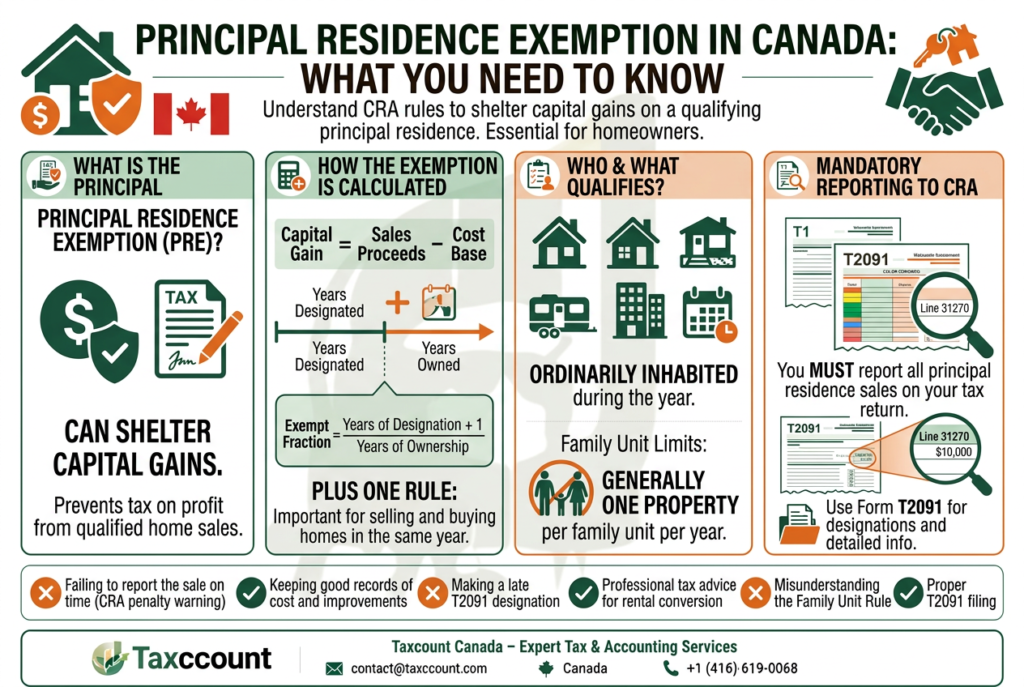
How Does the Principal Residence Exemption Work?
When you sell a property for more than its adjusted cost base, you generally realize a capital gain.
A simplified calculation is:
Capital Gain = Proceeds of Disposition − Adjusted Cost Base − Selling Costs
If the property qualifies as your principal residence, the Principal Residence Exemption may shelter some or all of the gain.
Where a property was not your principal residence for every year of ownership, only part of the gain may qualify for the exemption.
The calculation generally considers:
- The capital gain on the property
- Number of years the property was designated as a principal residence
- Number of years the property was owned
- Applicable principal residence exemption rules
Maintaining accurate ownership, purchase and improvement records is therefore important.
What Is the Plus One Rule?
The principal residence exemption formula generally includes a plus one when determining the exempt portion of a capital gain.
This rule can be particularly useful when a taxpayer sells one principal residence and purchases another during the same year.
It can help address situations where a family generally cannot designate two properties as its principal residence for the same year.
The application of this rule depends on the taxpayer’s circumstances and applicable tax provisions.
Do You Pay Capital Gains Tax When Selling Your Principal Residence?
If your home qualifies as your principal residence for all relevant years and you meet the applicable requirements, the Principal Residence Exemption may shelter the entire capital gain.
This can mean no income tax is payable on the capital gain from the sale.
However, this does not mean there is nothing to report.
The sale of a principal residence generally needs to be reported on your Canadian income tax return.
Failing to properly report the disposition may create problems even where the gain would otherwise qualify for the exemption.
Do You Have to Report the Sale of Your Principal Residence to CRA?
Yes. Canadian taxpayers generally need to report the sale of a principal residence to the CRA.
The reporting requirements generally include information such as:
- Year the property was acquired
- Proceeds of disposition
- Property address
- Principal residence designation
Depending on the circumstances, additional forms or schedules may be required as part of your tax filing.
Some homeowners mistakenly assume that a fully exempt sale does not need to appear on their tax return. Proper reporting is still important when claiming the exemption.
What Is Form T2091?
Form T2091 – Designation of a Property as a Principal Residence by an Individual (Other Than a Personal Trust) is commonly associated with claiming the Principal Residence Exemption.
The form provides information needed to designate a property as a principal residence and calculate the exemption where required.
The reporting requirements depend on the circumstances and information included with the individual’s income tax return.
Professional tax return filing services can be helpful when a property was not used exclusively as a principal residence or where multiple properties are involved.
What Happens If You Don’t Report the Sale?
Failing to report the disposition of your principal residence can create unnecessary tax complications.
Depending on the circumstances, consequences may include:
- Penalties
- Additional CRA review
- Problems claiming the Principal Residence Exemption
- Requirement to amend a previously filed return
The CRA may accept a late principal residence designation in certain circumstances, but penalties can apply.
It is therefore important to include the disposition as part of your annual tax filing rather than assuming no reporting is necessary because no tax is expected.
What If You Rent Out Your Principal Residence?
Converting your home into a rental property can significantly affect its tax treatment.
For Canadian tax purposes, changing a property from personal use to income-producing use may result in a change in use.
A change in use can, in certain circumstances, result in a deemed disposition of the property at fair market value. This means the tax rules may treat you as though you sold and immediately reacquired the property even though no actual sale occurred.
Special elections may be available in certain circumstances to defer or modify the tax consequences.
Because rental conversions can affect both capital gains and the Principal Residence Exemption, it is important to review the tax implications when the property’s use changes rather than waiting until it is eventually sold.
What If You Convert a Rental Property Into Your Home?
The opposite situation can also create a change-in-use issue.
Suppose you own a rental property and later move into it as your personal residence. The change from income-producing use to personal use can potentially result in a deemed disposition.
Depending on the circumstances, an election may be available to defer recognition of the resulting capital gain.
The treatment can become more complicated if capital cost allowance (CCA) was previously claimed on the property.
An accountant for taxes can review the property’s ownership and rental history before the tax return is prepared.
Can You Claim CCA and Still Get the Principal Residence Exemption?
Claiming CCA on a property that may later be designated as a principal residence requires careful consideration.
CCA can affect the availability of certain change-in-use elections and may also result in recapture when the property is eventually disposed of.
Before claiming CCA on a property that was previously your home, or that you expect to occupy personally in the future, it is important to consider the long-term tax consequences.
The immediate tax deduction should be considered alongside its potential impact on future tax planning.
What If Part of Your Home Is Used for Business or Rental Purposes?
Using part of your principal residence to earn income does not necessarily mean you lose the Principal Residence Exemption on the entire property.
For example, you might:
- Rent a room
- Operate a home office
- Rent a basement apartment
- Use part of your home for a business
The tax treatment depends on the circumstances, including the extent of the income-producing use, whether structural changes were made and whether CCA was claimed.
Where a significant portion of a property is used to earn income, professional tax and accounting services can help determine the appropriate reporting treatment.
Principal Residence Exemption for a Cottage
A cottage can potentially qualify as a principal residence even if it is not your primary everyday home.
This can create an important tax-planning opportunity for families that own both a city home and a cottage.
Because a family unit generally cannot designate multiple properties as its principal residence for the same year, you may need to determine which property should receive the exemption.
For example, if your cottage increased in value much faster than your primary home, automatically designating your primary home for every year may not always produce the best tax result.
The gain per year of ownership and other relevant factors should be considered before allocating the designation.
Principal Residence Exemption for Non-Residents
The rules can become more complex when a homeowner leaves Canada or becomes a non-resident.
Canadian real estate can remain subject to Canadian taxation after the owner becomes a non-resident, and additional compliance requirements may apply when Canadian property is sold.
Your Canadian residency status can also affect the calculation of the Principal Residence Exemption.
Individuals moving from Canada to another country should therefore review their property, residency status and potential capital gain as part of their departure tax planning.
Selling a Canadian Home After Leaving Canada
If you keep your Canadian home after becoming a non-resident and sell it later, additional tax rules may apply.
Non-residents disposing of taxable Canadian property can have specific CRA notification, withholding and certificate requirements.
This is particularly important for Canadians who relocate internationally but retain a home or rental property in Canada.
Before selling Canadian real estate as a non-resident, professional tax advice can help you understand the reporting and compliance requirements.
What Records Should You Keep?
Good records can make calculating the capital gain and claiming the Principal Residence Exemption significantly easier.
Consider keeping:
- Original purchase agreement
- Legal and closing documents
- Records of acquisition costs
- Receipts for qualifying capital improvements
- Renovation records
- Selling costs
- Real estate commissions
- Legal fees
- Records showing periods of personal use
- Rental records, where applicable
- Previous principal residence designations
Major capital improvements may affect the property’s adjusted cost base and therefore the amount of the capital gain.
Routine repairs and maintenance should not automatically be treated as capital improvements.
Common Principal Residence Exemption Mistakes
Homeowners should be careful to avoid common mistakes such as:
- Assuming the sale does not need to be reported because the gain is exempt
- Assuming every residential property automatically qualifies
- Ignoring years when the property was rented
- Failing to consider change-in-use rules
- Claiming CCA without considering future consequences
- Assuming a cottage cannot qualify as a principal residence
- Failing to retain renovation and acquisition records
- Ignoring non-resident tax rules after leaving Canada
- Incorrectly allocating principal residence years between multiple properties
- Waiting until the property is sold before considering the tax implications
Early planning can make the eventual tax return filing process easier and help reduce reporting errors.
Principal Residence Exemption Checklist
Before selling or reporting a property:
- [ ] Confirm the original purchase date and cost.
- [ ] Determine your adjusted cost base.
- [ ] Keep records of qualifying capital improvements.
- [ ] Determine the property’s selling costs.
- [ ] Identify each year the property was ordinarily inhabited.
- [ ] Review whether another property was designated for any of those years.
- [ ] Identify any periods when the property was rented.
- [ ] Review any change in use.
- [ ] Determine whether CCA was ever claimed.
- [ ] Review your Canadian residency history.
- [ ] Calculate the total capital gain.
- [ ] Determine the portion potentially covered by the Principal Residence Exemption.
- [ ] Report the disposition on your Canadian income tax return.
- [ ] Complete the applicable principal residence designation information.
- [ ] Keep supporting records in case the CRA requests them.
Is the Principal Residence Exemption Automatic?
Homeowners should not treat the exemption as automatic simply because the property was their home.
The property must qualify, the appropriate years must be designated, and the disposition generally needs to be properly reported.
Situations involving multiple properties, rental use, business use, non-residency or changes in use can require additional analysis.
Proper reporting is therefore an important part of claiming the exemption.
When Should You Speak With a Tax Accountant?
Professional assistance can be particularly useful when:
- You owned multiple properties
- Your home was previously rented
- A rental property became your home
- You claimed CCA
- Part of the property was used for business
- You became a non-resident of Canada
- You sold the property after leaving Canada
- You missed reporting a previous sale
- You are uncertain which years should be designated
- You need help calculating the adjusted cost base
Experienced tax accountants can review the complete history of the property rather than focusing only on the year of sale.
Principal Residence Exemption: Key Takeaways
The Principal Residence Exemption in Canada can provide significant tax savings when a qualifying home is sold, potentially eliminating some or all of the capital gains tax.
Homeowners should remember that:
- A principal residence sale generally still needs to be reported to the CRA.
- Not every residential property automatically qualifies.
- A family generally has restrictions on designating more than one property for the same year.
- Rental and business use can affect the tax treatment.
- Change-in-use rules may create deemed dispositions.
- Claiming CCA can have future tax consequences.
- Cottages can potentially qualify as principal residences.
- Non-residents may face additional Canadian tax requirements.
- Accurate purchase, renovation and sale records are important.
Understanding these rules before selling or changing the use of a property can help prevent unexpected Canadian tax consequences.
How Taxccount Canada Can Help
- Selling a home, converting a property to a rental, or determining the appropriate principal residence designation can involve more than calculating the selling price and purchase cost.
- Taxccount Canada provides professional tax and accounting services and tax return filing services to help individuals understand and meet their Canadian tax reporting obligations.
- Our team can assist with principal residence reporting, capital gains calculations, change-in-use situations, rental properties, non-resident property sales and related tax filing requirements.
- If you are looking for an accountant for taxes, experienced tax accountants, or professional assistance with your Canadian income tax return, Taxccount Canada can help you understand the reporting requirements applicable to your situation.
- Selling your principal residence or unsure how to report it? Contact Taxccount Canada for professional Canadian tax filing and accounting assistance.
- Disclaimer: This article provides general information only and should not be considered tax, legal or financial advice. The Principal Residence Exemption and related tax treatment depend on the facts of each situation. Consult a qualified tax professional regarding your specific circumstances.
Table of Summary
| Section | Easy Information |
|---|---|
| 1. Topic | The article explains the Principal Residence Exemption (PRE) in Canada, which may reduce or eliminate capital gains tax when a qualifying home is sold. |
| 2. What Qualifies as a Principal Residence? | A house, condo, cottage, apartment, duplex unit, mobile home, houseboat, or certain leasehold interests may qualify if the property meets the applicable ownership and occupancy requirements. |
| 3. How Does the PRE Work? | When a qualifying principal residence is sold at a gain, the PRE may shelter some or all of the capital gain. If the property was not designated for every year of ownership, only part of the gain may be exempt. |
| 4. Multiple Properties & Plus-One Rule | A family may own several properties, but there are restrictions on designating more than one property for the same year. The plus-one rule can help when one principal residence is sold and another is purchased in the same year. |
| 5. CRA Reporting Requirements | Even when the entire gain is exempt, the sale generally must still be reported to the CRA. Principal residence designation information and, where applicable, Form T2091 may be required. |
| 6. Rental or Business Use | Renting out your home, converting a rental property into your residence, or using part of the property to earn income can affect the PRE and may trigger change-in-use or deemed disposition rules. |
| 7. CCA Considerations | Claiming Capital Cost Allowance (CCA) on a property can affect certain change-in-use elections and may result in recapture when the property is disposed of. |
| 8. Cottages & Non-Residents | A cottage may qualify as a principal residence. Homeowners who become non-residents of Canada may face additional tax, reporting, withholding, and compliance requirements when selling Canadian property. |
| 9. Records to Keep | Keep purchase and closing documents, capital improvement receipts, renovation records, selling costs, legal fees, rental records, and previous principal residence designations to support the capital gain calculation. |
| 10. Key Takeaway | The PRE can provide significant tax savings, but it should not be treated as automatic. Proper designation, CRA reporting, and planning are especially important for multiple properties, rental use, CCA, and non-resident situations. |
FAQs
1. What is the Principal Residence Exemption in Canada?
The Principal Residence Exemption in Canada is a tax rule that may allow homeowners to reduce or eliminate capital gains tax when selling a property that qualifies as their principal residence. Eligibility depends on CRA requirements and how the property was used and designated during the years of ownership.
2. Do I have to report the sale of my principal residence to the CRA?
Yes. Even when the entire gain is covered by the principal residence exemption, the sale generally needs to be reported on your Canadian income tax return for the year of disposition. Proper reporting is important to claim the exemption.
3. How does the Principal Residence Exemption work in Canada?
When an eligible property is designated as your principal residence for qualifying years, the exemption can reduce the taxable capital gain when you sell it. The calculation depends on factors such as the years of ownership, years designated as a principal residence, and applicable CRA rules.
4. What properties can qualify as a principal residence in Canada?
A house, condominium, cottage, apartment, mobile home, or certain other housing units may qualify if the property meets the conditions for a principal residence under Canadian tax rules.
5. Can I claim the Principal Residence Exemption on a rental property?
A property used primarily to earn rental income does not automatically qualify for the full exemption. However, situations involving a change in use between a principal residence and rental property can have special tax rules. A tax accountant can help determine the appropriate treatment.
Talk to a Tax Expert
☎️ Get HelpThis is general information only and not professional advice. Consult a professional before acting.
 Written and fact-checked by Udit Gupta
 Written and fact-checked by
 Ex Big4, Ernst & Young, Deloitte | International & Cross-Border Tax Specialist | CPA Canada In Depth Tax Training | Licensed Chartered Accountant from ICAI & MIA
Udit Gupta has over 15 years of experience helping corporations & business owners with corporate structuring, corporate tax filing, bookkeeping, payroll, GST/HST, cross-border tax and CRA representation. Big 4 trained at Ernst & Young and Deloitte, and qualified as a Chartered Accountant in India and Malaysia, he founded accounting firm in 2014 to serve entrepreneurs, startups and non-resident business owners across Canada. View Full Member Bio.
Indian Institute of Chartered Accountant Member No. (521458) | Malaysian Institute of Accountants Membership number (CA 44667) | Ex Big4,Ex Ernst & Young (EY), Ex-Deloitte | CPA Canada In-Depth Tax Training 19 Dec 2023, 12 Jul 2022, 5 Jul 2023
Editorial policy. Every article is researched against primary sources — the Income Tax Act, CRA publications and CPA Canada.