Tax on Foreign Income in Canada: What Residents Need to Know

If you are a Canadian tax resident who earns income from another country — whether from a job abroad, foreign investments, rental property overseas, or business activities in another country — Canada expects you to report and pay tax on that income.
This is one of the most confusing aspects of the Canadian tax system for newcomers and international workers. This guide breaks it down clearly so you understand your obligations and how to avoid being taxed twice.
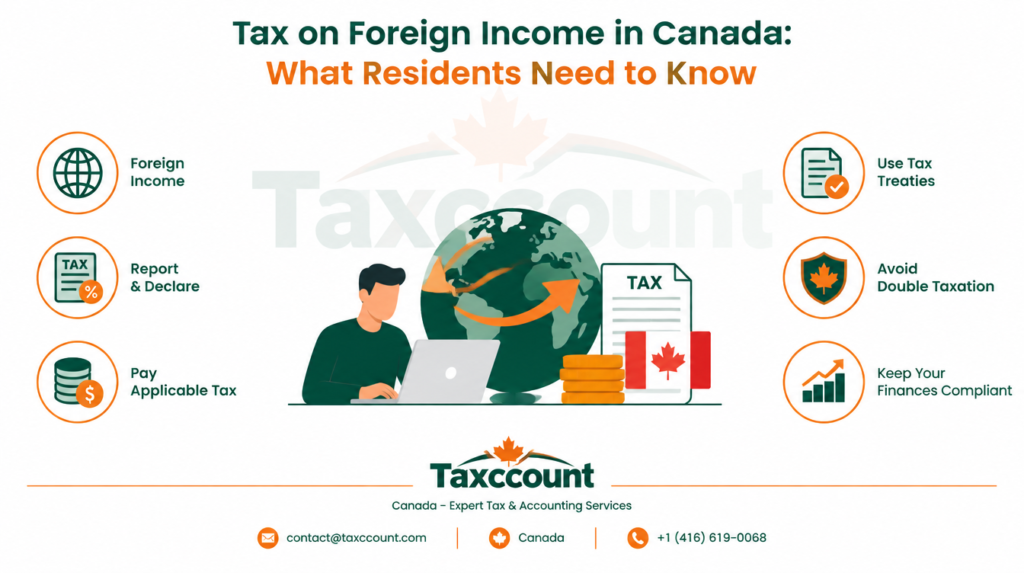
Canadian Tax Residency and World Income
Canada taxes based on residency, not citizenship. If you are a resident of Canada for tax purposes, you must report your worldwide income — that is, income from all sources inside and outside Canada.
Let Taxccount help you report it correctly
☎️ Get HelpA tax resident is generally:
- Someone who lives in Canada on a regular basis
- Someone who has significant residential ties to Canada (home, spouse, children, bank accounts)
- Someone who was physically in Canada for 183 days or more in a year
Non-residents of Canada are only taxed on income earned in Canada (like employment income from Canadian employment or rental income from Canadian property).
If you are unsure of your residency status, the CRA has guidance to help you determine it, or you can consult a tax professional.
What Is Considered Foreign Income?
Foreign income includes any income earned outside of Canada, such as:
- Employment income from a foreign employer
- Business income earned abroad
- Interest from a foreign bank account
- Dividends from foreign stocks or investments
- Rental income from property located outside Canada
- Pension payments from a foreign government or employer
- Capital gains from selling foreign property or investments
All of these must be converted to Canadian dollars (using the exchange rate at the time the income was received or the annual average rate published by the Bank of Canada) and included on your Canadian tax return.
How Is Foreign Income Taxed?
Foreign income is included in your total income and taxed at your normal marginal tax rates, the same as Canadian-source income. There is no special lower rate for foreign income.
However, the type of income matters:
- Foreign employment income: included on Line 10400 of your T1
- Foreign business income: reported as business income
- Foreign investment income (interest and dividends): reported on Schedule 4
- Foreign capital gains: reported on Schedule 3
- Foreign pension income: reported on the appropriate pension line of your return
You must also convert foreign amounts to Canadian dollars. The CRA generally accepts the average annual exchange rate or the rate on the transaction date.
The Foreign Tax Credit
The biggest concern with foreign income is double taxation — being taxed by both Canada and the foreign country on the same income. Canada addresses this through the Foreign Tax Credit (FTC).
The Foreign Tax Credit allows you to offset Canadian tax with taxes you already paid to a foreign government on the same income. This prevents you from paying full tax twice.
For example:
- You earned $20,000 from a U.S. investment and the U.S. withheld $3,000 in taxes
- On your Canadian return, you owe $7,000 in tax on that income
- You claim a Foreign Tax Credit of $3,000
- Your net Canadian tax on that income is $4,000
The credit is claimed on Schedule T2209 (Federal Foreign Tax Credits) on your T1 return. There are limits: the credit generally cannot exceed the Canadian tax that would have been payable on that income.
Provincial foreign tax credits also exist to offset provincial tax on foreign income.
Tax Treaties Canada Has with Other Countries
Canada has tax treaties with over 90 countries. These treaties help determine:
- Which country has the right to tax specific types of income
- The withholding tax rates that apply to dividends, interest, and royalties
- How to resolve situations where both countries claim a resident
For example, the Canada-U.S. tax treaty means that interest and dividends paid to Canadian residents from U.S. sources are subject to reduced U.S. withholding taxes. The treaty also affects how capital gains and pension income are treated.
If your home country and Canada both have a treaty, it can significantly reduce your overall tax burden.
Foreign Property Reporting Requirements
If you are a Canadian resident who owns foreign property with a cost of more than $100,000 CAD, you must file Form T1135 (Foreign Income Verification Statement) with your tax return.
Foreign property includes:
- Foreign bank accounts
- Shares in foreign corporations (not held in a Canadian brokerage or registered account)
- Foreign real estate (other than personal-use property)
- Interests in foreign entities
Failing to file T1135 when required can result in significant penalties — $25 per day, up to $2,500 per year, and larger penalties for intentional non-filing.
This is a separate requirement from reporting the income itself. Even if you earned no income from the foreign property, you may still need to file T1135.
Common Mistakes with Foreign Income
1. Not converting to Canadian dollars
All foreign income must be reported in CAD. Use the Bank of Canada exchange rate.
2. Forgetting foreign interest from bank accounts
Many Canadians with foreign bank accounts forget to report interest earned. Even small amounts must be included.
3. Not filing T1135
If your foreign property exceeds $100,000, not filing T1135 is a serious oversight that can result in large penalties.
4. Missing the foreign tax credit
Many taxpayers do not claim the Foreign Tax Credit and end up overpaying Canadian tax. Make sure to claim taxes paid to foreign governments.
5. Treating foreign pensions incorrectly
Foreign pension income is often taxable in Canada. Some treaties provide partial exemptions, so review the treaty rules for your specific country.
Table of Summary
| Foreign Income Tax Topic | Key Information |
|---|---|
| Tax on Foreign Income in Canada | Canadian tax residents generally must report worldwide income, including income earned from employment, investments, rental properties, pensions, and business activities outside Canada. |
| Canadian Tax Residency | Canada determines tax obligations primarily by residency status, not citizenship. Residential ties, regular living arrangements, and physical presence help determine residency. |
| Significant Residential Ties | A home, spouse, children, and other residential connections to Canada may be relevant when determining tax residency. |
| 183-Day Rule | Physical presence in Canada for 183 days or more during a year may be relevant to determining residency, depending on the circumstances. |
| Non-Residents of Canada | Non-residents are generally taxed on certain Canadian-source income, such as Canadian employment income and rental income from Canadian property. |
| Types of Foreign Income | Foreign income includes employment earnings, business profits, bank interest, investment dividends, overseas rental income, foreign pensions, and capital gains from foreign property or investments. |
| Converting Foreign Income to CAD | Foreign income must be converted into Canadian dollars using an applicable exchange rate, such as the transaction-date rate or an accepted annual average rate. |
| Foreign Employment Income | Foreign employment income is reported on Line 10400 of the T1 return, according to the article. |
| Foreign Business Income | Income earned through business activities abroad is reported as business income on the Canadian tax return. |
| Foreign Interest and Dividends | Foreign investment income, including interest and dividends, is reported on Schedule 4. |
| Foreign Capital Gains | Capital gains from selling foreign property or investments are reported on Schedule 3. |
| Foreign Pension Income | Foreign pension payments are generally taxable for Canadian residents and must be reported on the appropriate pension line, subject to applicable treaty rules. |
| Tax Rates on Foreign Income | Foreign income is generally included in total income and taxed at the applicable marginal tax rates, rather than receiving a special lower tax rate. |
| Foreign Tax Credit (FTC) | The Foreign Tax Credit can reduce Canadian tax when tax has already been paid to a foreign government on the same income, helping prevent double taxation. |
| Schedule T2209 | Eligible federal Foreign Tax Credits are calculated using Schedule T2209 and claimed on the T1 return. The credit is generally limited to the Canadian tax attributable to the foreign income. |
| Provincial Foreign Tax Credits | Provincial foreign tax credits may also be available to offset provincial tax on eligible foreign income. |
| Canada’s Tax Treaties | Canada has tax treaties with more than 90 countries. These treaties help determine taxing rights, withholding tax rates, and how certain cross-border tax situations are handled. |
| Canada–U.S. Tax Treaty | The treaty may reduce U.S. withholding taxes on certain payments to Canadian residents and affects the treatment of income such as pensions and capital gains. |
| Foreign Property Reporting: Form T1135 | Canadian residents generally must file Form T1135 if the total cost amount of specified foreign property exceeds $100,000 CAD at any time during the year, subject to applicable exceptions. |
| Types of Foreign Property | Examples include foreign bank accounts, shares in foreign corporations held outside Canadian registered accounts or Canadian brokerages, certain foreign real estate, and interests in foreign entities. |
| T1135 Is Separate from Income Reporting | Filing Form T1135 is a separate disclosure requirement. It may apply even if the foreign property generated no income during the year. |
| T1135 Penalties | The article states that penalties for failing to file when required can be $25 per day, up to $2,500 per year, with potentially larger penalties for intentional non-filing. |
| Reporting Foreign Bank Interest | Interest earned in foreign bank accounts must be reported, even when the amount is small. |
| Claiming Foreign Tax Credits | Taxpayers should review whether they qualify for foreign tax credits for taxes paid abroad to avoid paying more Canadian tax than necessary. |
| Foreign Pension Tax Treatment | Foreign pensions are generally taxable for Canadian residents, but tax treaties may provide different treatment or partial exemptions. |
| Moving to Canada During the Year | According to the article, new residents are generally taxed on income earned after becoming Canadian tax residents; income earned before that date is generally not taxable in Canada. |
| Working Abroad Temporarily | Someone who remains a Canadian tax resident generally reports foreign employment income in Canada, even if foreign taxes have already been paid, and may qualify for a Foreign Tax Credit. |
| Common Foreign Income Tax Mistakes | Common errors include failing to convert income to CAD, overlooking foreign bank interest, missing Form T1135, not claiming eligible foreign tax credits, and incorrectly reporting foreign pensions. |
| Key Takeaway | Canadian residents should report worldwide income accurately, apply eligible foreign tax credits and treaty provisions, convert amounts to CAD, and meet foreign property reporting requirements. Professional advice can help with complex cross-border situations. |
Frequently Asked Questions
I worked in the U.S. for part of the year and paid U.S. taxes. Do I still report that income in Canada?
If you were a Canadian tax resident for the full year, yes. You report the U.S. income in Canada and claim a Foreign Tax Credit for the U.S. taxes paid.
My spouse has a foreign pension. Is it taxable in Canada?
Generally yes, if your spouse is a Canadian resident. The amount and how it is taxed may depend on whether Canada has a tax treaty with the source country.
I have a foreign bank account with a small balance. Do I need to file T1135?
Only if the total cost of all your foreign property exceeds $100,000 CAD at any point during the year. A small bank account alone is unlikely to trigger the filing requirement.
I moved to Canada this year. Do I pay Canadian tax on income I earned before I moved?
No. As a new resident, you are only taxed on income earned after you became a Canadian tax resident. Income from before your arrival date is generally not taxable in Canada.
Conclusion
Canadian residents must report and pay tax on their worldwide income, but double taxation is avoided through the Foreign Tax Credit and tax treaties. Foreign income is reported in Canadian dollars, and certain foreign property holdings also require separate disclosure through Form T1135.
Given the complexity of cross-border tax situations, it is always a good idea to consult a tax professional who understands both Canadian tax law and the rules of the country where your income originates.
How Taxccount Canada Can Help
Foreign income can involve more than entering an amount on a Canadian tax return. Residency status, foreign tax credits, exchange rates, tax treaties, and foreign asset reporting may all affect your obligations.
Taxccount Canada provides tax and accounting services to individuals, self-employed professionals, investors, and businesses across Canada. Our team can help review foreign income documents, identify relevant reporting requirements, and prepare tax returns based on your circumstances.
Contact Taxccount Canada to book a free consultation and discuss your foreign income tax filing needs.
Book a free consultation with Taxccount today
☎️ Get HelpThis is general information only and not professional advice. Consult a professional before acting.
 Written and fact-checked by Udit Gupta
 Written and fact-checked by
Ex Big4, Ernst & Young, Deloitte | International & Cross-Border Tax Specialist | CPA Canada In Depth Tax Training | Licensed Chartered Accountant from ICAI & MIA
Udit Gupta has over 15 years of experience helping corporations & business owners with corporate structuring, corporate tax filing, bookkeeping, payroll, GST/HST, cross-border tax and CRA representation. Big 4 trained at Ernst & Young and Deloitte, and qualified as a Chartered Accountant in India and Malaysia, he founded accounting firm in 2014 to serve entrepreneurs, startups and non-resident business owners across Canada. View Full Member Bio.
Indian Institute of Chartered Accountant Member No. (521458) | Malaysian Institute of Accountants Membership number (CA 44667) | Ex Big4,Ex Ernst & Young (EY), Ex-Deloitte | CPA Canada In-Depth Tax Training 19 Dec 2023, 12 Jul 2022, 5 Jul 2023
Editorial policy. Every article is researched against primary sources — the Income Tax Act, CRA publications and CPA Canada.