Do I Need to File Taxes in Canada? Here Is How to Know for Sure
One of the most common questions Canadians have every spring is whether they actually need to file a tax return. Maybe you had a low-income year, or you are a student, a retiree, or a newcomer to Canada. The short answer is: sometimes you are required to file, and sometimes you are not — but you almost always should file anyway.
This guide explains who must file a tax return in Canada, who can skip it, and why filing is almost always in your best interest.
Who Is Required to File a Tax Return in Canada?
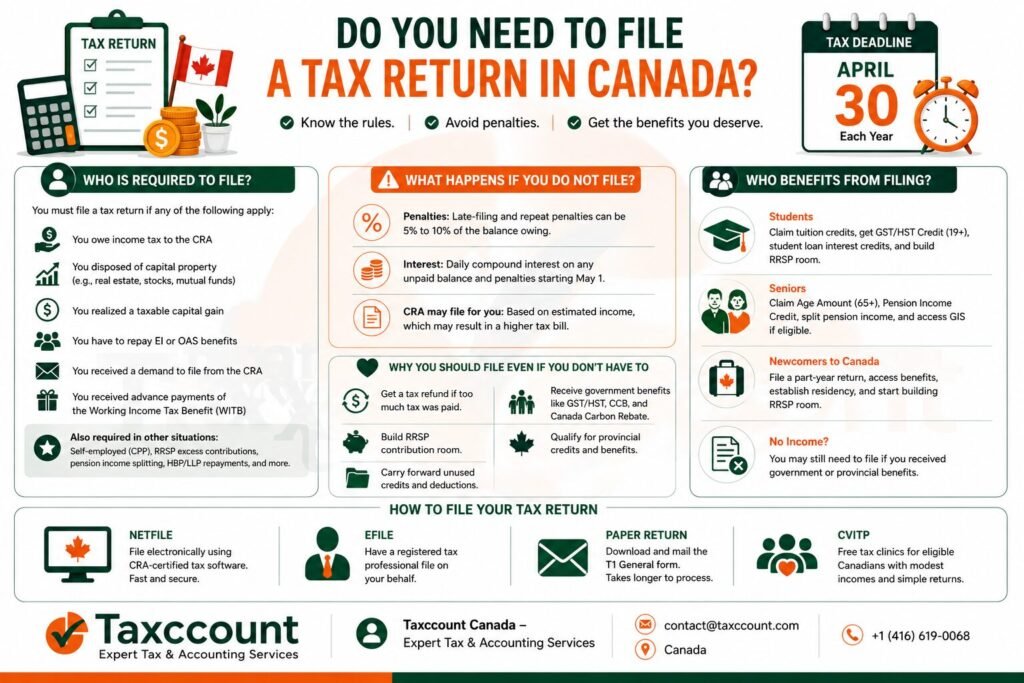
Under the Canadian Income Tax Act, you are legally required to file a tax return if any of the following apply:
- You owe income tax to the CRA for the year
- You disposed of capital property (such as real estate, stocks, or mutual funds)
- You realized a taxable capital gain
- You have to repay Employment Insurance (EI) or Old Age Security (OAS) benefits
- You received a demand to file from the CRA
- You received advance payments of the Working Income Tax Benefit (WITB)
File Taxes With Ease
☎️ Get HelpSituations Where You Must File
- You are self-employed and owe CPP contributions on net self-employment income
- You have contributed to your RRSP more than your limit and are reporting an excess contribution
- You are splitting pension income with a spouse and need to file the appropriate election
- You withdrew funds from a Home Buyers’ Plan (HBP) or Lifelong Learning Plan (LLP) and have a repayment obligation
What Happens If You Do Not File?
- Late-filing penalty — Five percent of the balance owing, plus one percent per month for up to 12 months
- Repeat late-filing penalty — Ten percent of the balance owing, plus two percent per month for up to 20 months
- Daily compound interest — Applied on any unpaid balance and penalties starting May 1
The CRA also has the authority to file a return on your behalf based on estimated income, which may not reflect your deductions or credits and could result in a higher tax bill.
Why You Should File Even If You Do Not Have To
- To get a tax refund — If your employer withheld more tax than necessary, you are owed that money back
- To receive government benefits — The GST/HST Credit, Canada Child Benefit (CCB), and the Canada Carbon Rebate are all calculated based on your filed return
- To build RRSP contribution room — Each year you file, you earn additional room based on your earned income
- To qualify for provincial credits and benefits — Many provinces use your federal return to calculate provincial benefit amounts
- To carry forward unused credits — Tuition credits, capital losses, and other carryforward amounts must be tracked through annual filings
Do Students Need to File Taxes?
Students are not always required to file, but they almost always benefit from doing so. Filing allows students to claim tuition credits (T2202 form) and carry them forward or transfer them to a supporting family member, receive the GST/HST Credit once they turn 19, access student loan interest tax credits, and build RRSP contribution room for future use.
Do Seniors Need to File Taxes?
Seniors are often required to file because they receive CPP, OAS, or other pension income. Filing also allows seniors to claim the Age Amount credit (available to Canadians 65 and older), split eligible pension income with a spouse, claim the Pension Income Credit, and receive the Guaranteed Income Supplement (GIS) if income is below certain thresholds.
Do Newcomers to Canada Need to File Taxes?
If you became a Canadian resident during the tax year, you are required to file a tax return for the portion of the year during which you were a resident. This is called a part-year return. Filing as a newcomer allows you to access government benefits like the GST/HST Credit and Canada Child Benefit, establish your tax residency status with the CRA, and begin building your RRSP contribution room.
Do You Need to File If You Have No Income?
Having no income does not necessarily mean you do not need to file. If you received government payments such as GIS, social assistance, or provincial benefits, you may still be required to file — and filing is often necessary to continue receiving those payments in subsequent years.
How to File Your Tax Return
- NETFILE — File electronically using CRA-certified tax software. Most Canadians use this method.
- EFILE — Have a registered tax professional file on your behalf.
- Paper return — Download and mail the T1 General form to the CRA. Processing takes longer.
- Community Volunteer Income Tax Program (CVITP) — Free tax clinics for eligible Canadians with modest incomes and simple tax situations.
Not Sure If You Need to File? Ask Taxccount
Taxccount provides tax support for Canadians from all walks of life, including students, newcomers, seniors, families, and self-employed individuals. We help you understand your tax responsibilities, prepare your return accurately, and meet important filing deadlines. Whether your tax situation is straightforward or more complex, our team is here to guide you through each step. Book a free consultation with Taxccount today.
Table of Summary
Here is the article information in 6 easy rows:
| Section | Easy Information |
|---|---|
| 1. Topic | The blog explains whether Canadians need to file a tax return and when filing is required. |
| 2. Who Must File | You must file if you owe tax, sold capital property, had taxable capital gains, need to repay EI/OAS, received a CRA demand to file, or have certain RRSP/HBP/LLP obligations. |
| 3. What Happens If You Do Not File | CRA may charge late-filing penalties, repeat late-filing penalties, and daily compound interest if tax is owing. CRA may also estimate and file a return for you. |
| 4. Why File Even If Not Required | Filing helps you get refunds, GST/HST Credit, Canada Child Benefit, Canada Carbon Rebate, RRSP room, provincial benefits, and carryforward credits. |
| 5. Students, Seniors & Newcomers | Students, seniors, and newcomers may not always be required to file, but filing helps them claim credits, benefits, pension-related amounts, and establish tax records. |
| 6. Simple Summary | Even if you do not owe tax, it is usually better to file your Canadian tax return because it protects your benefits, credits, refunds, and CRA record. |
Frequently Asked Questions
What happens if I do not file my taxes in Canada?
If you owe money and do not file, the CRA charges a late-filing penalty of five percent of the balance owing plus one percent per month. The CRA can also file a return on your behalf using estimated income, which may result in a higher tax bill.
Do I need to file taxes if I earned below the basic personal amount?
If your income is below the basic personal amount (approximately $15,000 for 2024), you generally do not owe any federal income tax. However, filing is still recommended so you can receive benefit payments and build RRSP contribution room.
Can I file taxes for a previous year?
Yes. The CRA allows you to file returns for previous years. If you are owed a refund, you generally have up to ten years to claim it. If you owe money, file as soon as possible to stop further interest from accumulating.
Do I need to file taxes if I only received employment income?
You are not always legally required to file if your employer withheld the correct amount of tax and you have no other income or deductions. However, filing is recommended to confirm that no tax is owed and to receive any benefits you are entitled to.
Get Tax Filing Help
☎️ Get HelpThis is general information only and not professional advice. Consult a professional before acting.
 Written and fact-checked by Udit Gupta
 Written and fact-checked by
 Ex Big4, Ernst & Young, Deloitte | International & Cross-Border Tax Specialist | CPA Canada In Depth Tax Training | Licensed Chartered Accountant from ICAI & MIA
Udit Gupta has over 15 years of experience helping corporations & business owners with corporate structuring, corporate tax filing, bookkeeping, payroll, GST/HST, cross-border tax and CRA representation. Big 4 trained at Ernst & Young and Deloitte, and qualified as a Chartered Accountant in India and Malaysia, he founded accounting firm in 2014 to serve entrepreneurs, startups and non-resident business owners across Canada. View Full Member Bio.
Indian Institute of Chartered Accountant Member No. (521458) | Malaysian Institute of Accountants Membership number (CA 44667) | Ex Big4,Ex Ernst & Young (EY), Ex-Deloitte | CPA Canada In-Depth Tax Training 19 Dec 2023, 12 Jul 2022, 5 Jul 2023
Editorial policy. Every article is researched against primary sources — the Income Tax Act, CRA publications and CPA Canada.