How Is Interest Income Taxed in Canada?

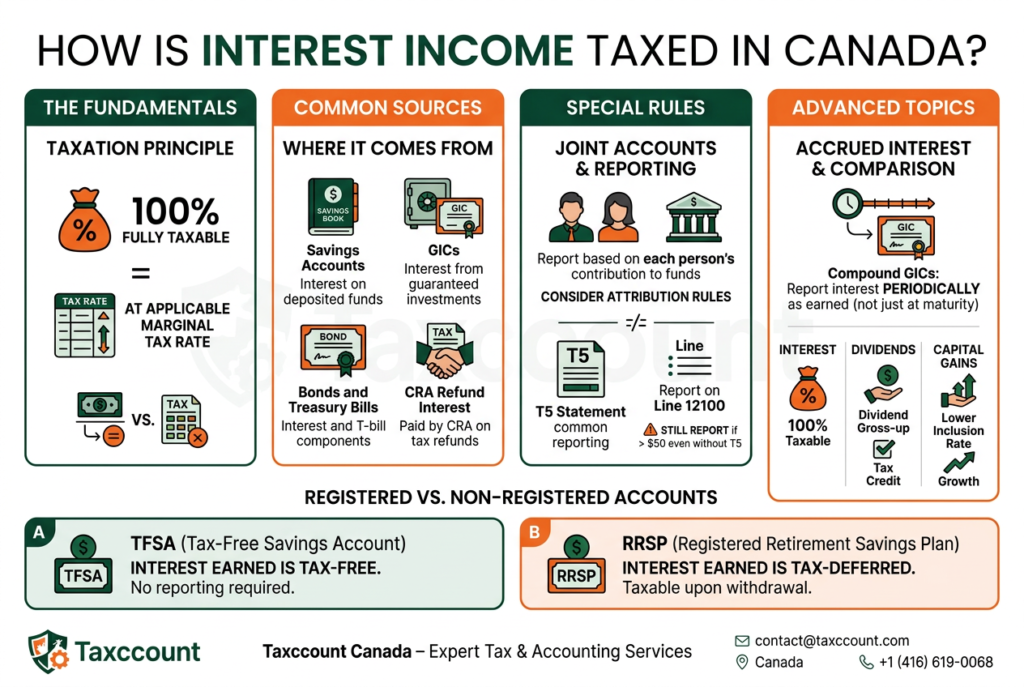
Interest income is a common type of investment income in Canada. Unlike Canadian dividends or capital gains, interest income is generally fully included in taxable income and taxed at your applicable marginal tax rate. Understanding how interest is taxed and reported can help you avoid errors during tax filing.
What Is Interest Income?
Interest income is money earned from lending or depositing funds. Common sources include:
- Savings accounts
- Guaranteed Investment Certificates (GICs)
- Bonds and treasury bills
- Corporate bonds
- Loans made to other individuals or businesses
- Interest paid by the CRA on tax refunds
Interest earned outside registered accounts generally needs to be included on your Canadian income tax return.
Get Interest Tax Help
☎️ Get HelpHow Is Interest Income Taxed in Canada?
Interest income is generally 100% included in your taxable income. There is no dividend tax credit or capital-gains treatment available simply because the income comes from an investment.
For example, if you earn $1,000 of taxable interest and your applicable marginal tax rate is 40%, the additional tax attributable to that interest would be approximately $400, ignoring other factors.
Your actual tax depends on your total taxable income and province or territory of residence.
Common Sources of Interest Income
Savings Accounts: Interest earned in a regular savings account is generally taxable.
GICs: Interest from GICs is generally taxable as it is earned according to the applicable reporting rules, even where payment occurs later.
Bonds: Coupon interest received from bonds is generally taxable as interest income.
Treasury Bills: T-bills are generally purchased at a discount. The interest component generally reflects the difference between the purchase price and amount received at maturity, subject to applicable tax rules.
CRA Refund Interest: Interest paid by the CRA on an income tax refund is generally taxable.
Interest From a Joint Account
Having a joint account does not necessarily mean each account holder reports 50% of the interest.
Generally, interest should be reported based on each person’s contribution to the funds that generated the income.
For example, if one spouse contributed all the money to a joint savings account, that spouse would generally report the resulting interest income.
Canadian attribution rules should also be considered when funds are transferred between spouses for investment purposes.
T5 Slips and Interest Income
Financial institutions commonly report taxable interest on a T5 Statement of Investment Income.
Box 13 generally shows interest from Canadian sources.
Even if you do not receive a T5 slip, taxable interest may still need to be reported. A financial institution is generally not required to issue a T5 where the amount that would otherwise be reported is less than $50.
Interest and other investment income is generally reported on line 12100 of the T1 income tax return.
Professional tax return filing services can help when you have several investment accounts or different types of investment income.
Accrued Interest on GICs
Some investments accumulate interest without paying it to you annually.
For investments such as multi-year compound GICs, you may still have to include accrued interest in income periodically even though you have not yet received the cash.
This means waiting until a multi-year GIC matures does not necessarily allow you to defer all of the taxable interest until the maturity year.
Keep annual investment statements and tax slips to support your tax filing.
Can You Deduct Interest Paid on Investments?
Interest paid on borrowed money used to earn income from a business or property may be deductible when the applicable Canadian tax requirements are satisfied.
For example, interest on money borrowed to acquire an income-producing investment may qualify.
The purpose and use of the borrowed funds are important. Keep loan agreements, investment records and evidence of interest payments in case the CRA requests support.
An accountant for taxes can help determine whether investment-related interest is deductible in your particular circumstances.
Interest Income vs. Dividends vs. Capital Gains
Different forms of investment income receive different Canadian tax treatment.
Interest income is generally fully included in taxable income.
Eligible Canadian dividends generally receive the dividend gross-up and dividend tax credit treatment.
Capital gains are subject to the capital-gains inclusion rules applicable to the relevant tax year.
Because the rules differ, investors should consider both investment objectives and tax consequences when structuring their portfolios.
Interest Income in a TFSA or RRSP
Where interest-bearing investments are held inside registered accounts, different rules can apply.
Interest earned inside a TFSA is generally tax-free and does not need to be reported as taxable income.
Interest earned inside an RRSP is generally tax-deferred while it remains in the plan. Amounts withdrawn from an RRSP are generally included in taxable income.
Holding interest-producing investments inside registered accounts can therefore produce different tax results compared with holding the same investment in a non-registered account.
Table of Summary
| Section | Easy Information |
|---|---|
| 1. Topic | The article explains how interest income is taxed in Canada, including common sources, tax treatment, reporting requirements, and registered accounts. |
| 2. How Interest Income Is Taxed | Interest income earned outside registered accounts is generally 100% included in taxable income and taxed at your applicable marginal tax rate. |
| 3. Common Sources of Interest | Taxable interest can come from savings accounts, GICs, bonds, treasury bills, private loans, and CRA refund interest. |
| 4. Joint Account Interest | Interest from a joint account is generally reported according to each person’s contribution to the funds, rather than automatically splitting the income 50/50. |
| 5. T5 Slip & Tax Reporting | Interest is commonly reported on a T5 slip, with Canadian-source interest generally shown in Box 13. Interest and other investment income is generally reported on line 12100 of the T1 return. |
| 6. Interest Without a T5 | Taxable interest may still need to be reported even if you do not receive a T5 slip. A T5 is generally not required when the reportable amount is less than $50. |
| 7. Accrued Interest on GICs | With certain multi-year or compound GICs, accrued interest may need to be reported periodically, even if the cash is not received until maturity. |
| 8. Deducting Investment Interest | Interest paid on borrowed money used to earn income from a business or property may be deductible when Canadian tax requirements are satisfied. |
| 9. TFSA & RRSP Interest | Interest earned inside a TFSA is generally tax-free, while interest earned inside an RRSP is generally tax-deferred until funds are withdrawn. |
| 10. Key Takeaway | Unlike Canadian dividends, interest does not receive a dividend tax credit and is generally fully taxable. Accurate records and reporting are important for savings, GICs, bonds and other interest-producing investments. |
Frequently Asked Questions
Is interest income taxable in Canada?
Yes. Interest earned outside tax-sheltered or tax-deferred accounts is generally fully included in taxable income.
Where do I report interest income on my tax return?
Interest and other investment income is generally reported on line 12100 of the T1 income tax return.
Do I report interest if I don’t receive a T5?
Potentially, yes. Not receiving a T5 does not automatically make the interest tax-free. You remain responsible for reporting taxable income.
Is GIC interest taxable every year?
Depending on the investment terms and applicable accrued-interest rules, interest may need to be reported periodically even if the GIC does not pay the accumulated interest until maturity.
Is savings account interest taxable?
Yes. Interest earned in an ordinary non-registered savings account is generally taxable income.
Is interest earned in a TFSA taxable?
Generally, no. Qualifying investment income earned within a TFSA is generally tax-free.
Can investment loan interest be deducted?
It may be deductible where borrowed money is used for the purpose of earning income from a business or property and the applicable requirements are satisfied.
Need Help Reporting Investment Income?
Taxccount Canada provides tax and accounting services and tax return filing services for individuals, investors and business owners.
If you have interest from savings accounts, GICs, bonds or other investments, our tax accountants can help you understand the reporting requirements and properly include your investment income in your Canadian tax return.
Talk to a Tax Expert
☎️ Get HelpThis is general information only and not professional advice. Consult a professional before acting.
 Written and fact-checked by Udit Gupta
 Written and fact-checked by
 Ex Big4, Ernst & Young, Deloitte | International & Cross-Border Tax Specialist | CPA Canada In Depth Tax Training | Licensed Chartered Accountant from ICAI & MIA
Udit Gupta has over 15 years of experience helping corporations & business owners with corporate structuring, corporate tax filing, bookkeeping, payroll, GST/HST, cross-border tax and CRA representation. Big 4 trained at Ernst & Young and Deloitte, and qualified as a Chartered Accountant in India and Malaysia, he founded accounting firm in 2014 to serve entrepreneurs, startups and non-resident business owners across Canada. View Full Member Bio.
Indian Institute of Chartered Accountant Member No. (521458) | Malaysian Institute of Accountants Membership number (CA 44667) | Ex Big4,Ex Ernst & Young (EY), Ex-Deloitte | CPA Canada In-Depth Tax Training 19 Dec 2023, 12 Jul 2022, 5 Jul 2023
Editorial policy. Every article is researched against primary sources — the Income Tax Act, CRA publications and CPA Canada.