Capital Gains Tax on Property Sales in Canada: What You Need to Know

Selling property in Canada can result in a capital gain when the property is sold for more than its adjusted cost base and related selling costs. The tax treatment depends on factors such as how the property was used, whether it qualified as your principal residence, and whether it was a rental or investment property.
Understanding these rules before completing your tax filing can help you report the sale correctly and claim available exemptions or deductions.
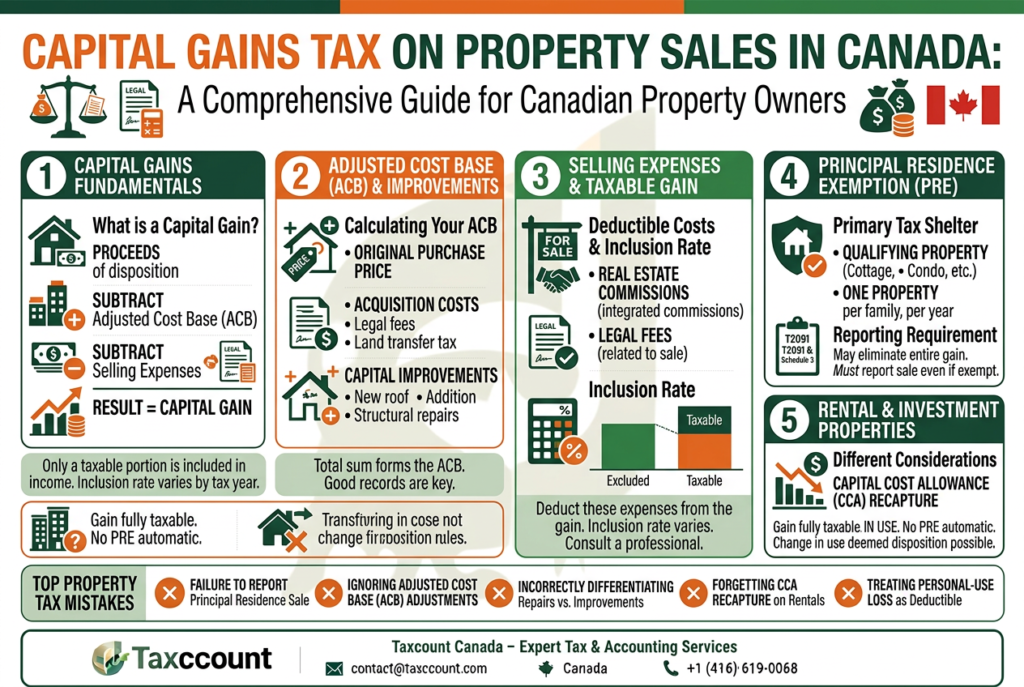
What Is a Capital Gain?
A capital gain generally occurs when you dispose of a capital property for more than its adjusted cost base (ACB) and expenses related to the disposition.
The basic calculation is:
Capital Gain = Proceeds of Disposition – Adjusted Cost Base – Selling Expenses
Only the taxable portion of the resulting capital gain is included in income according to the inclusion rate applicable to the relevant tax year.
Get Capital Gains Tax Help
☎️ Get HelpHow Is a Capital Gain on Property Calculated?
The adjusted cost base generally starts with what you paid for the property and can include certain acquisition costs and qualifying capital improvements.
Selling expenses can include costs directly associated with selling the property, such as real estate commissions and legal fees. CRA’s Schedule 3 calculation similarly subtracts ACB and selling outlays and expenses from proceeds of disposition. (Canada)
For example:
Purchase price: $300,000
Capital improvements: $40,000
Adjusted cost base: $340,000
Selling price: $550,000
Selling costs: $20,000
Capital gain:
$550,000 – $340,000 – $20,000 = $190,000
The taxable capital gain is then determined using the rules applicable to the year of sale.
What Is the Capital Gains Inclusion Rate?
Canada does not generally tax the entire capital gain as ordinary income. Instead, the applicable inclusion rate determines how much of the gain becomes a taxable capital gain.
Because capital gains rules and proposed changes have evolved in recent years, property owners should use the inclusion rate applicable to the specific tax year rather than relying on an older rate or threshold.
A tax accountant can help determine the correct treatment when preparing the return.
What Is the Principal Residence Exemption?
If a property qualifies as your principal residence for all the relevant years you owned it, the Principal Residence Exemption (PRE) may eliminate some or all of the capital gain.
A qualifying property can include a house, condominium, cottage or certain other housing units.
Generally, you, your spouse or common-law partner, former spouse or common-law partner, or child must have ordinarily inhabited the property during the relevant year, and designation rules apply.
Only one property per family unit can generally be designated as a principal residence for a particular year.
CRA confirms that when a property was solely a taxpayer’s principal residence for every year of ownership, the resulting gain can generally be sheltered by the exemption. (Canada)
Do You Have to Report the Sale of Your Principal Residence?
Yes. Even when the entire gain is covered by the Principal Residence Exemption, the sale generally must still be reported.
For a principal residence sale, individuals generally report the disposition on Schedule 3 and complete Form T2091(IND), Designation of a Property as a Principal Residence by an Individual (Other Than a Personal Trust). CRA has required principal-residence dispositions to be reported to obtain the exemption since the 2016 tax year. (Canada)
What About Rental and Investment Properties?
A rental or investment property does not automatically qualify for the Principal Residence Exemption simply because you own it.
When an investment property is sold, a capital gain may arise based on the difference between the proceeds, ACB and selling costs.
Rental properties can create additional tax considerations if capital cost allowance (CCA) was previously claimed. A sale may result in both a capital gain and CCA recapture, depending on the circumstances.
What If You Used Your Home as a Rental Property?
Special rules can apply when a principal residence is converted into a rental property or when only part of the home is used to earn rental or business income.
A change in use can potentially result in a deemed disposition.
CRA provides certain exceptions where income-producing use is ancillary to the property’s main residential use, no structural change is made, and no CCA is claimed. (Canada)
This is an area where professional tax and accounting services can be particularly useful.
Can Capital Losses Reduce Capital Gains?
A qualifying capital loss can generally be used against taxable capital gains.
Unused net capital losses can generally be carried back three years or carried forward indefinitely to reduce taxable capital gains in other years. (Canada)
However, losses on personal-use property are generally not deductible, so selling a personal residence at a loss does not normally create a deductible capital loss. (Canada)
What Happens With Inherited Property?
Tax treatment of inherited property requires looking at both the deceased person’s tax consequences and the beneficiary’s subsequent ownership.
In many situations, a deemed disposition can occur at death based on fair market value, although important exceptions and tax-deferred rollover rules can apply, particularly for transfers to a spouse or common-law partner.
The beneficiary’s cost for future capital gain purposes will depend on how the property was transferred and the applicable tax rules.
What Records Should You Keep?
Keep documents that support the property’s adjusted cost base and selling expenses, including:
- Original purchase agreement
- Legal fees
- Land transfer tax records
- Receipts for qualifying capital improvements
- Renovation invoices
- Real estate commissions
- Legal fees related to the sale
- Previous rental or CCA records
- Documents supporting principal residence designation
Good records can make a significant difference when calculating the gain many years after purchasing the property.
Common Property Sale Tax Mistakes
Common mistakes include:
- Not reporting the sale of a principal residence
- Using the original purchase price instead of the correct ACB
- Forgetting qualifying capital improvements
- Claiming ordinary repairs as capital improvements
- Ignoring change-in-use rules
- Forgetting previous CCA claims on rental property
- Treating a personal-use property loss as a deductible capital loss
- Using an outdated capital gains inclusion rate
Table of Summary
| Section | Easy Information |
|---|---|
| 1. Topic | The article explains capital gains tax on property sales in Canada, including how gains are calculated, the Principal Residence Exemption, rental properties and reporting requirements. |
| 2. Calculating a Capital Gain | A capital gain is generally calculated as Proceeds of Disposition − Adjusted Cost Base (ACB) − Selling Expenses. |
| 3. Capital Gains Inclusion Rate | Only the taxable portion of a capital gain is included in income. Property owners should use the inclusion rate applicable to the specific tax year rather than relying on an outdated rate or threshold. |
| 4. Adjusted Cost Base (ACB) | A property’s ACB generally includes the purchase price, certain acquisition costs and qualifying capital improvements. Proper records can help establish the correct ACB. |
| 5. Principal Residence Exemption | The Principal Residence Exemption (PRE) may shelter some or all of the capital gain when a qualifying property was designated as the taxpayer’s principal residence for the relevant years. |
| 6. Reporting a Principal Residence Sale | Even if the gain is fully exempt, the sale generally must be reported to the CRA, including on Schedule 3 and Form T2091(IND) where applicable. |
| 7. Rental & Investment Properties | Selling a rental or investment property can result in a capital gain. If CCA was previously claimed on a rental property, the sale may also result in CCA recapture. |
| 8. Change in Use | Converting a principal residence to a rental property, or using part of a home to earn income, can potentially result in a change in use and deemed disposition, subject to applicable exceptions and elections. |
| 9. Capital Losses | Qualifying net capital losses can generally be carried back 3 years or carried forward indefinitely against taxable capital gains. Losses on personal-use property are generally not deductible. |
| 10. Records & Key Takeaway | Keep purchase documents, legal fees, capital improvement receipts, selling costs, rental/CCA records and principal residence records to properly calculate and support the property’s tax treatment. |
Frequently Asked Questions
Do I pay tax when I sell my primary home in Canada?
If the property qualifies as your principal residence for all relevant years, the Principal Residence Exemption may eliminate the capital gain. The disposition must still generally be reported to the CRA. (Canada)
How do I calculate a capital gain on property?
Generally, subtract the property’s adjusted cost base and eligible selling expenses from the proceeds of disposition.
Can renovation costs reduce my capital gain?
Qualifying capital improvements may increase the property’s ACB and therefore reduce the capital gain. Ordinary repairs and maintenance are generally treated differently.
Do I pay capital gains tax when selling a rental property?
A rental property sale can result in a capital gain. If CCA was previously claimed, there may also be CCA recapture.
Can I claim a loss when I sell my home?
A loss on personal-use property is generally not deductible as a capital loss. (Canada)
Do I need to report my principal residence sale?
Yes. A principal residence disposition generally needs to be reported on Schedule 3, with Form T2091(IND) used for the designation. (Canada)
Can capital losses from previous years reduce my property capital gain?
Available net capital losses from other years may generally be used against taxable capital gains, subject to the applicable rules. Net capital losses can generally be carried back three years and forward indefinitely. (Canada)
Need Help Reporting a Property Sale?
Taxccount Canada provides tax and accounting services and tax return filing services for homeowners, landlords and real estate investors.
Our tax accountants can help calculate the adjusted cost base, review capital improvements, determine whether the Principal Residence Exemption applies, account for rental-property CCA and correctly report the property disposition on your Canadian tax return.
Contact Taxccount Canada for professional assistance with capital gains and property tax filing.
Plan Your Property Sale Tax
☎️ Get HelpThis is general information only and not professional advice. Consult a professional before acting.
 Written and fact-checked by Udit Gupta
 Written and fact-checked by
 Ex Big4, Ernst & Young, Deloitte | International & Cross-Border Tax Specialist | CPA Canada In Depth Tax Training | Licensed Chartered Accountant from ICAI & MIA
Udit Gupta has over 15 years of experience helping corporations & business owners with corporate structuring, corporate tax filing, bookkeeping, payroll, GST/HST, cross-border tax and CRA representation. Big 4 trained at Ernst & Young and Deloitte, and qualified as a Chartered Accountant in India and Malaysia, he founded accounting firm in 2014 to serve entrepreneurs, startups and non-resident business owners across Canada. View Full Member Bio.
Indian Institute of Chartered Accountant Member No. (521458) | Malaysian Institute of Accountants Membership number (CA 44667) | Ex Big4,Ex Ernst & Young (EY), Ex-Deloitte | CPA Canada In-Depth Tax Training 19 Dec 2023, 12 Jul 2022, 5 Jul 2023
Editorial policy. Every article is researched against primary sources — the Income Tax Act, CRA publications and CPA Canada.