What Is an RESP and How Does It Work in Canada?

Saving for a child’s post-secondary education can be a major financial goal for Canadian families. A Registered Education Savings Plan (RESP) can help by combining personal savings, tax-deferred investment growth and government education incentives.
Understanding RESP contributions, grants and withdrawal rules can help families make better education savings decisions.
What Is an RESP?
An RESP is a registered savings plan designed to help pay for a beneficiary’s post-secondary education.
Contributions made to an RESP are not tax-deductible. However, investment income earned inside the plan is generally not taxed while it remains in the RESP.
When an eligible student attends a qualifying post-secondary program, certain amounts can be paid to help cover education-related costs.
Get RESP Tax Help
☎️ Get HelpWho Can Open an RESP?
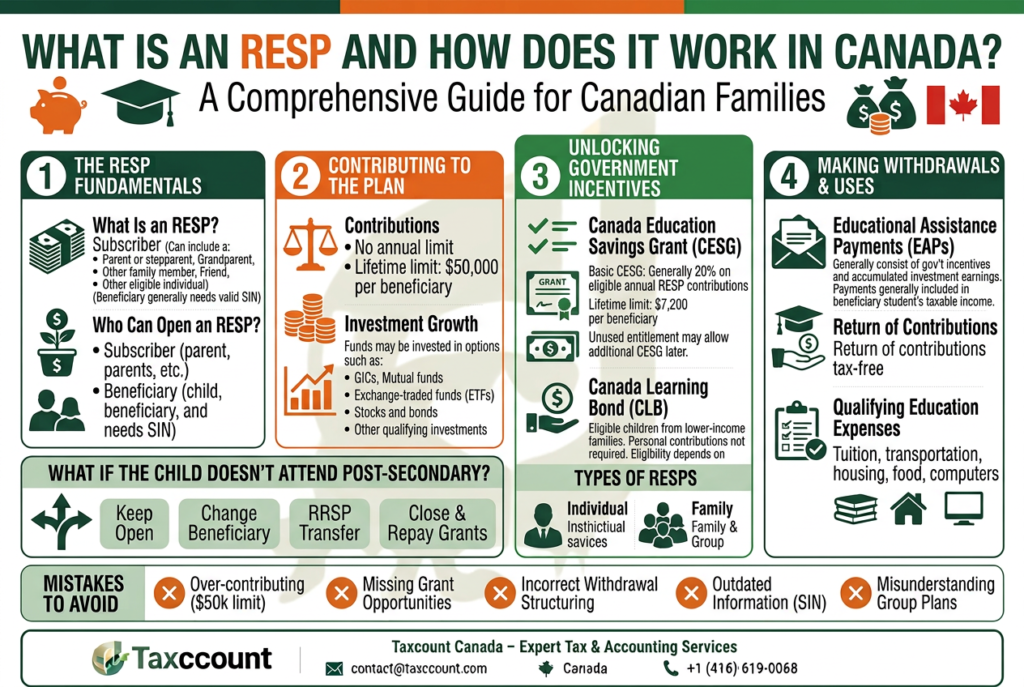
The person who opens an RESP is called the subscriber, while the person who will use the education savings is called the beneficiary.
Depending on the type of plan, a subscriber can include a:
- Parent or stepparent
- Grandparent
- Other family member
- Friend
- Other eligible individual
The beneficiary generally needs a valid Social Insurance Number (SIN) for the RESP to be registered and to access applicable government incentives.
How Much Can You Contribute to an RESP?
There is no annual RESP contribution limit, but there is a lifetime contribution limit of $50,000 per beneficiary across all RESPs established for that beneficiary.
Contributing more than the lifetime limit can result in a penalty tax on excess contributions.
RESP contributions are not deductible from your taxable income. Their main tax advantage comes from tax-deferred investment growth and access to eligible government incentives.
How Does the Canada Education Savings Grant Work?
The Canada Education Savings Grant (CESG) is one of the major benefits associated with an RESP.
The basic CESG generally provides 20% on eligible annual RESP contributions, up to applicable limits.
For example, a $2,500 eligible annual contribution can generally attract $500 of basic CESG.
The lifetime CESG limit is generally $7,200 per beneficiary.
Unused CESG entitlement from previous years may also allow families to receive additional CESG in a later year, subject to annual limits and eligibility requirements.
What Is the Additional CESG?
Some families may qualify for an additional CESG based on adjusted family income.
The additional grant is calculated on the first portion of annual RESP contributions and can increase the government assistance available to qualifying families.
Income thresholds are updated periodically, so families should review the applicable requirements for the year.
What Is the Canada Learning Bond?
The Canada Learning Bond (CLB) provides additional education savings assistance for eligible children from lower-income families.
Unlike the CESG, personal RESP contributions are not required to receive the CLB.
Eligibility depends on factors including family income and other government requirements.
How Does Money Grow Inside an RESP?
Depending on the financial institution and RESP arrangement, funds may be invested in options such as:
- GICs
- Mutual funds
- Exchange-traded funds (ETFs)
- Stocks and bonds
- Other qualifying investments
Investment income and growth generally accumulate without annual taxation while the funds remain inside the RESP.
The appropriate investment strategy may depend on how many years remain before the beneficiary expects to begin post-secondary education.
How Are RESP Withdrawals Taxed?
RESP withdrawals need to be distinguished between contributions and Educational Assistance Payments (EAPs).
Contributions
Original RESP contributions were made using after-tax money and are generally returned without additional income tax.
Educational Assistance Payments
EAPs generally consist of government education incentives and accumulated investment earnings.
These payments are generally included in the beneficiary student’s taxable income.
Because many students have relatively low taxable income and may have tuition-related tax credits, the actual tax payable on EAPs can sometimes be low.
What Can RESP Money Be Used For?
Once the beneficiary meets the applicable enrolment requirements, RESP funds can help support post-secondary education costs.
This may include costs associated with:
- Tuition
- Books and supplies
- Transportation
- Housing
- Food
- Computers and educational equipment
- Other reasonable education-related expenses
RESP providers may require enrolment documentation before making certain withdrawals.
What Happens If the Child Does Not Attend Post-Secondary School?
If the original beneficiary does not pursue qualifying post-secondary education, the RESP does not necessarily have to be closed immediately.
Depending on the plan and circumstances, options may include:
- Keeping the RESP open in case the beneficiary attends school later
- Changing the beneficiary
- Using a family RESP for another eligible beneficiary
- Transferring qualifying accumulated income to an RRSP when applicable conditions are met
- Closing the RESP
Government grants may need to be repaid when they cannot be used for an eligible beneficiary.
Accumulated investment income withdrawn by the subscriber can also be subject to regular income tax plus an additional tax, unless an available rollover or other exception applies.
What Are the Different Types of RESP?
There are three common RESP structures.
Individual RESP
An individual RESP generally has one beneficiary. Family relationships between the subscriber and beneficiary are not necessarily required.
Family RESP
A family RESP can have multiple beneficiaries, but beneficiaries generally must meet specified family relationship requirements.
This structure can provide flexibility for families with multiple children.
Group RESP
Group plans pool savings from multiple subscribers and are generally administered according to the provider’s plan rules.
Because contribution requirements, fees and withdrawal conditions can differ significantly, families should carefully review the terms before joining a group RESP.
How Long Can an RESP Stay Open?
RESPs can generally remain open for many years, subject to the applicable maximum plan duration and special rules in certain circumstances.
This provides flexibility if a beneficiary does not begin post-secondary education immediately after high school.
Tips for Getting the Most From an RESP
Families should consider a few practical strategies:
- Start contributing early to provide more time for investment growth.
- Understand available CESG and CLB benefits.
- Review unused CESG contribution room before making catch-up contributions.
- Avoid exceeding the $50,000 lifetime contribution limit.
- Review investment risk as the beneficiary approaches post-secondary education.
- Understand withdrawal rules before requesting RESP payments.
- Keep RESP and beneficiary information current.
Table of Summary
| Section | Easy Information |
|---|---|
| 1. Topic | The article explains what an RESP is and how it works in Canada, including contributions, government grants, investment growth and withdrawal rules. |
| 2. What Is an RESP? | A Registered Education Savings Plan (RESP) is a registered savings plan designed to help pay for a beneficiary’s post-secondary education. Contributions are not tax-deductible, but investment growth is generally tax-deferred while inside the plan. |
| 3. Who Can Open an RESP? | The person opening the RESP is the subscriber, while the student receiving the education savings is the beneficiary. Parents, grandparents and certain other individuals can open an RESP. |
| 4. RESP Contribution Limit | There is no annual contribution limit, but the lifetime contribution limit is $50,000 per beneficiary across all RESPs for that beneficiary. Excess contributions can result in penalty tax. |
| 5. Canada Education Savings Grant (CESG) | The basic CESG generally provides 20% of eligible contributions. A $2,500 eligible contribution can generally receive $500 of CESG, with a lifetime CESG limit of $7,200 per beneficiary. |
| 6. Additional CESG & CLB | Some families may qualify for an Additional CESG based on family income. The Canada Learning Bond (CLB) can provide education savings assistance to eligible lower-income families without requiring personal RESP contributions. |
| 7. How RESP Money Grows | RESP funds may be invested in GICs, mutual funds, ETFs, stocks, bonds and other qualifying investments. Investment income and growth generally accumulate without annual taxation inside the RESP. |
| 8. How Withdrawals Are Taxed | Original contributions are generally returned without additional income tax. Government incentives and investment earnings paid as Educational Assistance Payments (EAPs) are generally taxable to the beneficiary student. |
| 9. If the Child Doesn’t Attend School | Options may include keeping the RESP open, changing the beneficiary, using a family RESP for another eligible beneficiary, transferring qualifying accumulated income to an RRSP where permitted, or closing the plan. Grants may need to be repaid. |
| 10. Key Takeaway | Starting early can provide more time for growth and help families maximize available CESG and CLB benefits. Families should monitor the $50,000 lifetime contribution limit and understand withdrawal rules before taking money from the RESP. |
Frequently Asked Questions
Are RESP contributions tax-deductible?
No. RESP contributions do not provide an income tax deduction.
What is the RESP lifetime contribution limit?
The lifetime contribution limit is generally $50,000 per beneficiary across all RESPs established for that beneficiary.
How much CESG can a child receive?
The lifetime CESG limit is generally $7,200 per eligible beneficiary.
Is RESP investment growth taxable?
Investment growth is generally tax-deferred while it remains inside the RESP. When paid as part of an EAP, it is generally taxable to the beneficiary.
Does a family have to contribute to receive the Canada Learning Bond?
No. Eligible beneficiaries can receive the CLB without the subscriber making personal RESP contributions.
What happens if my child does not go to college or university?
Depending on the circumstances, you may keep the RESP open, change beneficiaries, transfer certain accumulated income to an RRSP if eligible, or close the plan.
Can RESP money be used for education outside Canada?
Certain qualifying educational programs outside Canada may be eligible, provided the applicable RESP requirements are satisfied.
Need Help With RESP and Education Tax Planning?
Taxccount Canada provides tax and accounting services for Canadian individuals and families. Our tax professionals can help you understand the tax treatment of RESP withdrawals, education-related tax matters and how these amounts affect your Canadian tax filing.
Contact Taxccount Canada for professional assistance with RESP-related tax planning and tax return filing services.
Plan Your RESP Right
☎️ Get HelpThis is general information only and not professional advice. Consult a professional before acting.
 Written and fact-checked by Udit Gupta
 Written and fact-checked by
 Ex Big4, Ernst & Young, Deloitte | International & Cross-Border Tax Specialist | CPA Canada In Depth Tax Training | Licensed Chartered Accountant from ICAI & MIA
Udit Gupta has over 15 years of experience helping corporations & business owners with corporate structuring, corporate tax filing, bookkeeping, payroll, GST/HST, cross-border tax and CRA representation. Big 4 trained at Ernst & Young and Deloitte, and qualified as a Chartered Accountant in India and Malaysia, he founded accounting firm in 2014 to serve entrepreneurs, startups and non-resident business owners across Canada. View Full Member Bio.
Indian Institute of Chartered Accountant Member No. (521458) | Malaysian Institute of Accountants Membership number (CA 44667) | Ex Big4,Ex Ernst & Young (EY), Ex-Deloitte | CPA Canada In-Depth Tax Training 19 Dec 2023, 12 Jul 2022, 5 Jul 2023
Editorial policy. Every article is researched against primary sources — the Income Tax Act, CRA publications and CPA Canada.