Income Tax Brackets in Canada: How the Tax System Works
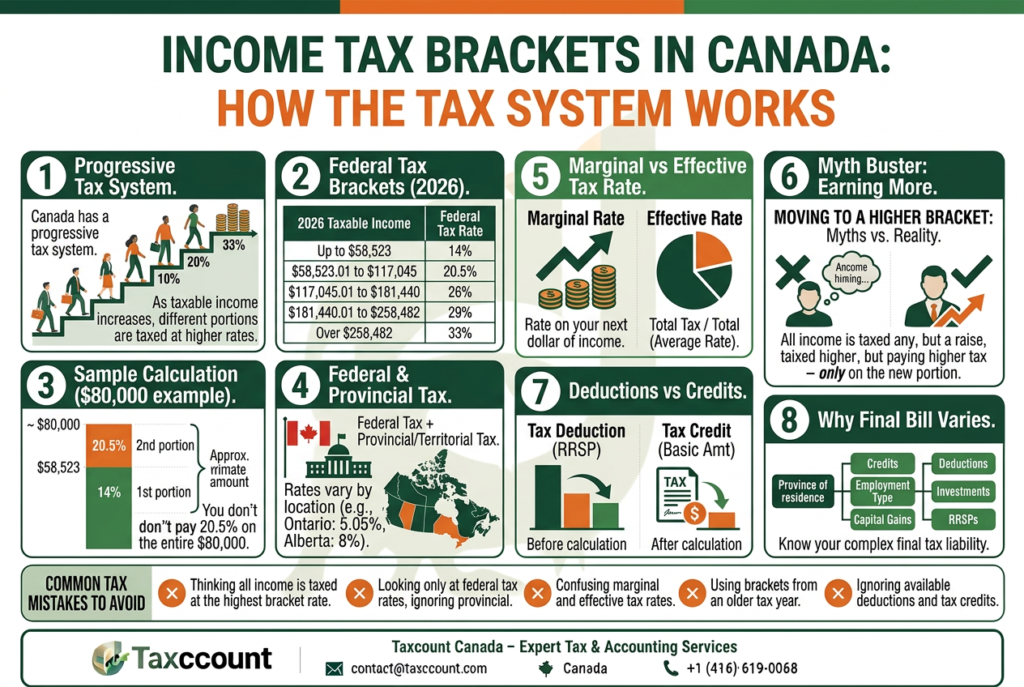
Canada uses a progressive income tax system. This means that as your taxable income increases, different portions of your income are taxed at different rates.
A common misconception is that moving into a higher tax bracket causes all of your income to be taxed at the higher rate. In reality, only the portion of taxable income within each bracket is subject to that bracket’s rate. Canada
How Does the Canadian Income Tax System Work?
For most Canadian residents, personal income tax has two main components:
- Federal income tax
- Provincial or territorial income tax
Your province or territory of residence generally determines the provincial or territorial rates that apply. Tax credits and other amounts can then reduce the tax otherwise payable.
Get Income Tax Help
☎️ Get HelpFederal Income Tax Brackets for 2026
Federal tax brackets are adjusted periodically, including through indexation for inflation.
For the 2026 tax year, the federal income tax brackets are: Canada
| 2026 Taxable Income | Federal Tax Rate |
|---|---|
| Up to $58,523 | 14% |
| $58,523.01 to $117,045 | 20.5% |
| $117,045.01 to $181,440 | 26% |
| $181,440.01 to $258,482 | 29% |
| Over $258,482 | 33% |
Each rate applies only to the taxable income falling within that particular bracket.
How Do Tax Brackets Work?
Suppose your taxable income is $80,000 in 2026.
Your federal tax before applicable credits would be calculated approximately as:
First $58,523 × 14% = $8,193.22
Remaining $21,477 × 20.5% = $4,402.79
Approximate federal tax before credits = $12,596.01
You do not pay 20.5% on the entire $80,000 simply because part of your income falls within the second tax bracket.
This progressive calculation is the key concept behind Canada’s personal income tax brackets. Canada
Provincial and Territorial Income Tax
Federal income tax is only part of your overall income tax calculation.
Each province and territory establishes its own tax brackets and rates. These rates apply in addition to federal tax.
For example, CRA lists the following 2026 starting provincial rates:
- Ontario: 5.05%
- Alberta: 8%
- British Columbia: 5.6%
- Manitoba: 10.8%
- Saskatchewan: 10.5%
Higher provincial rates apply as taxable income moves through additional brackets. Quebec administers its own provincial personal income tax system. Canada
This means two people with the same taxable income can have different overall income tax liabilities depending on where they live.
What Is Your Marginal Tax Rate?
Your marginal tax rate is generally the tax rate that applies to your next dollar of taxable income.
It can include both:
- Federal marginal tax rate
- Provincial or territorial marginal tax rate
For example, if additional income falls into a 20.5% federal bracket, that portion is subject to the 20.5% federal rate, plus the applicable provincial or territorial rate.
This does not mean all of your existing income is suddenly taxed at those rates.
What Is an Effective Tax Rate?
Your effective tax rate measures your overall tax relative to your income.
A simplified calculation is:
Effective Tax Rate = Total Income Tax ÷ Income
Because Canada uses progressive tax brackets and provides various tax credits, your effective tax rate will generally differ from your highest marginal tax rate.
Will a Raise Put All Your Income in a Higher Tax Bracket?
No.
Suppose a portion of your income moves from the 14% federal bracket into the 20.5% bracket. Only the amount above the first bracket threshold is taxed federally at 20.5%.
The income already falling within the lower bracket remains subject to the lower rate.
Therefore, earning additional income does not cause your entire income to be taxed at the next bracket’s rate. Canada
How Do Tax Credits Reduce Income Tax?
Tax credits can reduce the amount of income tax otherwise payable.
Common personal tax credits and amounts can include:
- Basic Personal Amount
- Canada employment amount
- Eligible CPP-related credits
- EI-related credits
- Disability Tax Credit
- Medical Expense Tax Credit
- Tuition amounts, where applicable
Eligibility depends on the individual’s circumstances and the particular tax year.
Tax Deduction vs. Tax Credit
Tax deductions and tax credits work differently.
A tax deduction generally reduces the income used in determining taxable income. An RRSP deduction is a common example.
A tax credit generally reduces tax otherwise payable after the applicable tax calculation.
Understanding this difference can be useful when reviewing your tax return and considering tax planning opportunities.
Why Your Tax Bracket Is Not Your Final Tax Bill
Knowing your tax bracket alone does not tell you exactly how much tax you will pay.
Your final tax liability can depend on:
- Taxable income
- Province or territory of residence
- Deductions
- Non-refundable and refundable tax credits
- Employment and self-employment income
- Investment income
- Capital gains and losses
- RRSP deductions
- Other tax circumstances
Professional tax return filing services can help calculate these amounts using the rules applicable to the particular tax year.
Common Tax Bracket Mistakes
Common misunderstandings include:
- Thinking all income is taxed at the highest applicable rate
- Looking only at federal tax rates
- Confusing marginal and effective tax rates
- Using tax brackets from an older year
- Applying tax rates to gross income instead of taxable income
- Ignoring available deductions and tax credits
Because brackets and certain tax amounts change over time, it is important to use the rates for the year being filed.
Table of Summary
| Section | Easy Information |
|---|---|
| 1. Topic | The article explains how income tax brackets work in Canada, including federal and provincial rates, marginal tax rates, effective tax rates, deductions and tax credits. |
| 2. Progressive Tax System | Canada uses a progressive income tax system. Different portions of taxable income are taxed at different rates, so moving into a higher bracket does not mean all income is taxed at the higher rate. |
| 3. Federal Tax Brackets for 2026 | The article lists 2026 federal rates ranging from 14% to 33%, depending on taxable income. Each rate applies only to income falling within that particular bracket. |
| 4. Provincial & Territorial Tax | In addition to federal tax, individuals generally pay provincial or territorial income tax based on their province or territory of residence and its applicable tax brackets. |
| 5. Marginal Tax Rate | Your marginal tax rate is generally the rate that applies to your next dollar of taxable income and can include both federal and provincial or territorial tax rates. |
| 6. Effective Tax Rate | Your effective tax rate measures your overall income tax relative to your income. It generally differs from your highest marginal tax rate because of progressive brackets and available tax credits. |
| 7. Effect of a Pay Raise | A raise does not cause all your income to be taxed at a higher rate. Only the portion of taxable income entering the higher bracket is subject to that higher rate. |
| 8. Tax Credits | Tax credits such as the Basic Personal Amount, Disability Tax Credit, Medical Expense Tax Credit and eligible tuition amounts can reduce income tax otherwise payable, subject to eligibility. |
| 9. Tax Deduction vs. Tax Credit | A tax deduction generally reduces income used to determine taxable income, while a tax credit generally reduces the amount of tax otherwise payable. |
| 10. Key Takeaway | Your final tax bill depends on more than your tax bracket, including taxable income, province or territory, deductions, credits and different types of income. Always use the tax rates and rules applicable to the year being filed. |
Frequently Asked Questions
What is the lowest federal income tax rate in Canada for 2026?
The lowest federal personal income tax rate for 2026 is 14% on taxable income up to $58,523. Canada
What is the highest federal income tax rate in Canada?
For 2026, the highest federal personal income tax rate is 33%, applying to taxable income over $258,482. Provincial or territorial income tax applies in addition. Canada
Does moving into a higher tax bracket reduce my take-home income?
Moving into a higher bracket does not cause all your income to be taxed at the higher rate. Only the portion within the higher bracket is subject to that higher rate.
Are Canadian tax brackets based on gross income?
Tax brackets apply to taxable income rather than simply your gross salary or total income.
Do provinces have different tax brackets?
Yes. Each province and territory has its own personal income tax rates and brackets, although Quebec administers its provincial income tax separately. Canada
What is a marginal tax rate?
It is generally the tax rate that applies to the next dollar of taxable income you earn.
What is an effective tax rate?
Your effective tax rate represents your overall tax relative to your income and is different from simply looking at your highest marginal tax bracket.
Need Help With Your Canadian Income Tax?
Taxccount Canada provides tax and accounting services and tax return filing services for individuals, self-employed professionals and businesses across Canada.
Our tax accountants can help calculate taxable income, identify available deductions and credits, and prepare your Canadian income tax return using the applicable federal and provincial tax rules.
Contact Taxccount Canada for professional assistance with tax filing and tax planning.
Understand Your Tax Bracket
☎️ Get HelpThis is general information only and not professional advice. Consult a professional before acting.
 Written and fact-checked by Udit Gupta
 Written and fact-checked by
 Ex Big4, Ernst & Young, Deloitte | International & Cross-Border Tax Specialist | CPA Canada In Depth Tax Training | Licensed Chartered Accountant from ICAI & MIA
Udit Gupta has over 15 years of experience helping corporations & business owners with corporate structuring, corporate tax filing, bookkeeping, payroll, GST/HST, cross-border tax and CRA representation. Big 4 trained at Ernst & Young and Deloitte, and qualified as a Chartered Accountant in India and Malaysia, he founded accounting firm in 2014 to serve entrepreneurs, startups and non-resident business owners across Canada. View Full Member Bio.
Indian Institute of Chartered Accountant Member No. (521458) | Malaysian Institute of Accountants Membership number (CA 44667) | Ex Big4,Ex Ernst & Young (EY), Ex-Deloitte | CPA Canada In-Depth Tax Training 19 Dec 2023, 12 Jul 2022, 5 Jul 2023
Editorial policy. Every article is researched against primary sources — the Income Tax Act, CRA publications and CPA Canada.