Are Travel Expenses Tax Deductible in Canada?
Travel costs can be significant, and Canadians often wonder whether those expenses can be claimed on their tax return. The answer depends on who you are and why you are travelling. Personal travel such as vacations is never deductible, but business-related travel often is. This guide explains the CRA rules clearly.
Taxccount Canada helps individuals searching for tax filing near me understand when travel expenses qualify as deductions under CRA rules.
Are Personal Travel Expenses Deductible in Canada?
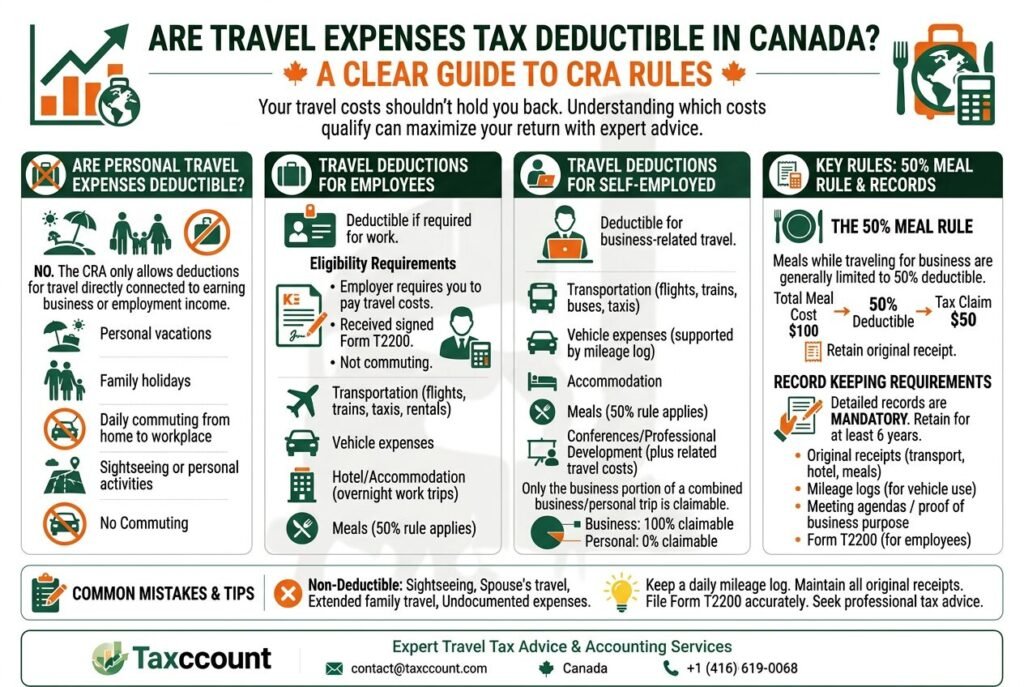
No. Personal travel expenses, including holidays, vacations, and personal trips, are not deductible in Canada. The Canada Revenue Agency (CRA) only allows travel expense deductions that are directly connected to earning business or employment income.
Professional tax return filing services can help determine whether your travel qualifies as a deductible expense.
Claim Eligible Travel Expenses
☎️ Get HelpTravel Expense Deductions for Employees
If you are an employee, you may be able to deduct travel expenses if your employer requires you to travel as part of your job. However, there are strict conditions.
Eligibility Requirements
To claim travel expenses:
- Your employer must require you to pay your own travel costs.
- You must receive a completed and signed Form T2200 (Declaration of Conditions of Employment) from your employer.
- Commuting from your home to your regular workplace is not deductible.
An accountant for taxes can help determine whether you meet the CRA’s employment expense requirements.
Eligible Travel Expenses
Eligible travel expenses for employees may include:
- Transportation, including flights, trains, taxis, and rental vehicles.
- Vehicle expenses for business travel.
- Hotel and accommodation when travelling overnight for work.
- Meals, generally limited to 50% of the actual cost while travelling for business.
Travel Expense Deductions for Self-Employed Individuals
Self-employed individuals may deduct reasonable travel expenses that are directly related to earning business income.
Eligible expenses generally include:
- Transportation costs, including flights, trains, buses, and taxis.
- Vehicle expenses based on the business-use portion supported by a mileage log.
- Hotel and accommodation for business travel.
- Meals while travelling for business.
- Conference and professional development fees, including related travel costs.
If a trip combines both business and personal purposes, only the business portion of the travel expenses may be claimed.
Business tax filing requires accurate records to support all travel-related deductions.
The 50% Meal Rule
Whether you are an employee or self-employed, meals incurred while travelling for business are generally only 50% deductible under CRA rules.
This applies to:
- Restaurant meals.
- Room service.
- Food purchased while travelling for business.
You should retain all supporting receipts for your claim.
Tax and accounting services can help ensure meal expenses are claimed correctly under the applicable CRA rules.
Record Keeping Requirements
The CRA requires detailed documentation for all travel expenses claimed.
Keep records including:
- Original receipts for transportation.
- Hotel and accommodation receipts.
- Meal receipts.
- Mileage logs for business vehicle use.
- Meeting agendas, itineraries, or other documentation supporting the business purpose of the trip.
- Form T2200 if claiming employment travel expenses.
Generally, supporting documents should be retained for at least six years after the end of the applicable tax year.
Tax accountants recommend maintaining organized records in case the CRA requests additional information.
Common Travel Expenses That Cannot Be Claimed
The following expenses are generally not deductible:
- Personal vacations.
- Family holidays.
- Daily commuting between home and your regular workplace.
- Personal sightseeing or entertainment during a business trip.
- Expenses unrelated to earning business or employment income.
Income tax preparation near me services can help distinguish between deductible and non-deductible travel costs.
Table of Summary
Here is the blog information in 6 easy rows for quick understanding:
| Section | Easy Information |
|---|---|
| 1. Topic | The blog explains whether travel expenses are tax deductible in Canada and the CRA rules for employees and self-employed individuals. |
| 2. Personal Travel Rules | Personal travel such as vacations, holidays, and personal trips cannot be claimed as tax deductions in Canada. Only travel connected to earning income may qualify. |
| 3. Employee Travel Deductions | Employees may claim travel expenses if their employer requires them to pay costs and provides a signed Form T2200. Regular commuting between home and workplace is not deductible. |
| 4. Self-Employed Travel Deductions | Self-employed individuals can deduct reasonable business-related travel costs, including transportation, accommodation, vehicle expenses, meals, and conference-related travel. Only the business portion is claimable. |
| 5. Meal Rule & Records | Business travel meals are generally 50% deductible. Keep receipts, mileage logs, hotel bills, itineraries, meeting details, and supporting documents for CRA requirements. |
| 6. Non-Deductible Expenses | Expenses that cannot be claimed include personal vacations, family trips, daily commuting, sightseeing, entertainment, and costs unrelated to earning business or employment income. |
FAQs
Are Vacation Expenses Tax Deductible?
No. Personal vacations and leisure travel are considered personal expenses and are not deductible under CRA rules.
Can Employees Claim Travel Expenses?
Yes. Employees may qualify if they are required to pay their own travel expenses, receive a signed Form T2200 from their employer, and meet the CRA’s eligibility requirements.
Can Self-Employed Individuals Deduct Business Travel?
Yes. Self-employed individuals can generally deduct reasonable travel expenses directly related to earning business income.
Can I Claim Meals While Travelling for Business?
Yes. Business travel meals are generally deductible, but only 50% of the eligible meal expenses can usually be claimed.
Should I Keep Receipts for Travel Expenses?
Yes. The CRA requires supporting documentation such as receipts, mileage logs, and records showing the business purpose of the travel. A tax accountant near me can also help review your records before filing your return.
Maximize Travel Deductions
☎️ Get HelpThis is general information only and not professional advice. Consult a professional before acting.
 Written and fact-checked by Udit Gupta
 Written and fact-checked by
 Ex Big4, Ernst & Young, Deloitte | International & Cross-Border Tax Specialist | CPA Canada In Depth Tax Training | Licensed Chartered Accountant from ICAI & MIA
Udit Gupta has over 15 years of experience helping corporations & business owners with corporate structuring, corporate tax filing, bookkeeping, payroll, GST/HST, cross-border tax and CRA representation. Big 4 trained at Ernst & Young and Deloitte, and qualified as a Chartered Accountant in India and Malaysia, he founded accounting firm in 2014 to serve entrepreneurs, startups and non-resident business owners across Canada. View Full Member Bio.
Indian Institute of Chartered Accountant Member No. (521458) | Malaysian Institute of Accountants Membership number (CA 44667) | Ex Big4,Ex Ernst & Young (EY), Ex-Deloitte | CPA Canada In-Depth Tax Training 19 Dec 2023, 12 Jul 2022, 5 Jul 2023
Editorial policy. Every article is researched against primary sources — the Income Tax Act, CRA publications and CPA Canada.