How Much Is Capital Gains Tax in Canada?

If you sell an investment, a piece of real estate (other than your principal residence), or a business asset for more than you paid for it, you have realized a capital gain. Capital gains receive preferential tax treatment in Canada, but understanding how they are taxed can help you plan ahead and avoid unexpected tax bills.
Taxccount Canada helps individuals searching for tax filing near me understand how capital gains are taxed and how to report them correctly on their income tax return.
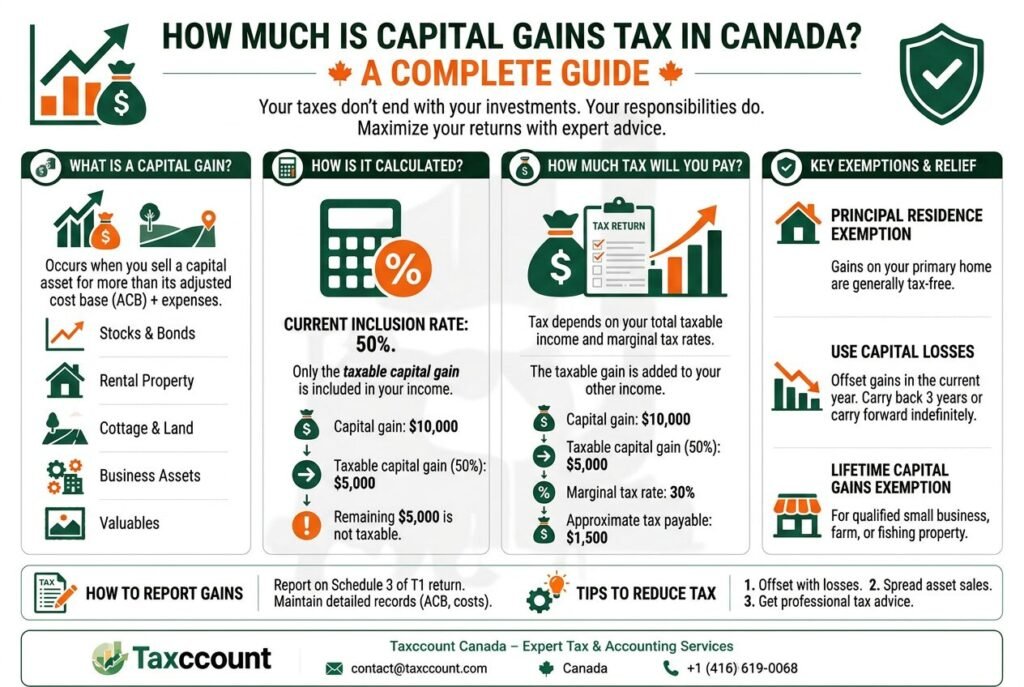
What Is a Capital Gain?
A capital gain occurs when you sell a capital asset for more than its adjusted cost base (ACB), plus any eligible selling expenses.
Common capital assets include:
- Stocks, bonds, and mutual funds
- Rental properties
- Cottages and vacant land
- Business assets
- Valuable personal property, such as artwork or collectibles
Professional tax return filing services can help calculate your capital gain accurately before filing your return.
Reduce Capital Gains Tax
☎️ Get HelpHow Is Capital Gains Tax Calculated?
In Canada, you do not pay tax on the entire capital gain. Instead, only the taxable portion of the gain, known as the taxable capital gain, is included in your income.
Current Inclusion Rate
Currently, 50% of your capital gain is included in your taxable income.
For example:
- Capital gain: $10,000
- Taxable capital gain (50%): $5,000
- The remaining $5,000 is not taxable.
The taxable capital gain is added to your other income and taxed at your applicable marginal tax rate.
An accountant for taxes can help calculate your taxable capital gain and identify available tax-saving opportunities.
How Much Tax Will You Actually Pay?
The amount of tax depends on your total taxable income and your federal and provincial marginal tax rates.
Example:
- Capital gain: $10,000
- Taxable capital gain (50%): $5,000
- Marginal tax rate: 30%
- Approximate tax payable: $1,500
Higher-income individuals generally pay more tax because the taxable capital gain is added to their other income for the year.
Tax and accounting services can estimate your tax liability before you sell an investment or property.
Capital Gains Exemptions and Relief
Several provisions may reduce or eliminate tax on capital gains.
Principal Residence Exemption
If you sell your principal residence and all CRA conditions are met, the capital gain is generally exempt from tax.
Capital Losses
If you sell a capital asset for less than its adjusted cost base, you may have a capital loss.
Allowable capital losses can generally be used to:
- Offset taxable capital gains in the current year.
- Carry losses back up to three years.
- Carry losses forward indefinitely to offset future taxable capital gains.
Lifetime Capital Gains Exemption (LCGE)
Eligible owners of qualified small business corporation shares or qualified farm or fishing property may qualify for the Lifetime Capital Gains Exemption, subject to the CRA’s eligibility rules and annual limits.
Income tax preparation near me services can help determine whether you qualify for these exemptions or loss carryovers.
How to Report Capital Gains
Capital gains are generally reported on Schedule 3 of your T1 Income Tax and Benefit Return.
You should maintain records supporting:
- Purchase price (adjusted cost base)
- Selling price
- Brokerage commissions
- Legal fees (where applicable)
- Other eligible acquisition and selling costs
Keeping accurate records will help support your calculations if the CRA requests additional information.
Tax accountants can also assist with calculating adjusted cost base for multiple investment transactions.
Tips to Reduce Capital Gains Tax
Depending on your circumstances, you may be able to reduce your tax liability by:
- Offsetting gains with available capital losses.
- Spreading asset sales across multiple tax years.
- Keeping accurate records of all acquisition and selling costs.
- Obtaining professional tax advice before selling significant investments or property.
A tax accountant near me can help develop a tax-efficient strategy before disposing of major assets.
Table of Summary
Here is the blog information in 6 easy rows for quick understanding:
| Section | Easy Information |
|---|---|
| 1. Topic | The blog explains how capital gains tax works in Canada, including calculation, reporting, exemptions, and ways to reduce tax. |
| 2. What Is a Capital Gain? | A capital gain occurs when you sell a capital asset for more than its adjusted cost base (ACB) plus eligible selling expenses. Examples include stocks, rental properties, business assets, and collectibles. |
| 3. How Capital Gains Are Taxed | Only 50% of the capital gain is included in taxable income. Example: $10,000 gain → $5,000 taxable capital gain → taxed at your marginal tax rate. |
| 4. Tax Relief Options | Capital gains tax may be reduced through the Principal Residence Exemption, capital losses, and Lifetime Capital Gains Exemption (LCGE) for qualifying assets. |
| 5. Reporting Requirements | Report capital gains on Schedule 3 of the T1 Income Tax and Benefit Return. Keep records of purchase price, selling price, commissions, legal fees, and other costs. |
| 6. Tax Reduction Strategies | Reduce capital gains tax by using capital losses, timing asset sales across years, keeping accurate records, and getting professional tax advice before major sales. |
FAQs
Do I Pay Tax on My Entire Capital Gain?
No. Generally, only 50% of a capital gain is included in your taxable income under the current rules.
Is the Sale of My Principal Residence Taxable?
In most cases, no. If your property qualifies as your principal residence and you meet the CRA requirements, the gain is generally exempt from tax.
Can Capital Losses Reduce My Taxes?
Yes. Allowable capital losses can generally offset taxable capital gains in the current year, be carried back up to three years, or carried forward indefinitely.
How Are Capital Gains Taxed?
The taxable portion of your capital gain is added to your income and taxed at your marginal income tax rate.
Should I Get Professional Advice Before Selling Investments or Property?
If you are selling rental property, investments, business assets, or other high-value capital assets, professional advice can help you calculate the gain correctly, identify available exemptions, and minimize your tax liability.
Plan Your Capital Gains
☎️ Get HelpThis is general information only and not professional advice. Consult a professional before acting.
 Written and fact-checked by Udit Gupta
 Written and fact-checked by
 Ex Big4, Ernst & Young, Deloitte | International & Cross-Border Tax Specialist | CPA Canada In Depth Tax Training | Licensed Chartered Accountant from ICAI & MIA
Udit Gupta has over 15 years of experience helping corporations & business owners with corporate structuring, corporate tax filing, bookkeeping, payroll, GST/HST, cross-border tax and CRA representation. Big 4 trained at Ernst & Young and Deloitte, and qualified as a Chartered Accountant in India and Malaysia, he founded accounting firm in 2014 to serve entrepreneurs, startups and non-resident business owners across Canada. View Full Member Bio.
Indian Institute of Chartered Accountant Member No. (521458) | Malaysian Institute of Accountants Membership number (CA 44667) | Ex Big4,Ex Ernst & Young (EY), Ex-Deloitte | CPA Canada In-Depth Tax Training 19 Dec 2023, 12 Jul 2022, 5 Jul 2023
Editorial policy. Every article is researched against primary sources — the Income Tax Act, CRA publications and CPA Canada.