Canada Carbon Rebate: What It Is and How It Affects Your Taxes

The Canada Carbon Rebate (CCR), formerly known as the Climate Action Incentive Payment (CAIP), is a government payment designed to offset the cost of the federal carbon pricing system for Canadian households. Most eligible Canadians receive this money automatically, but there is still some confusion about what it is and how it affects taxes.
This guide explains everything you need to know about the Canada Carbon Rebate.
What Is the Canada Carbon Rebate?
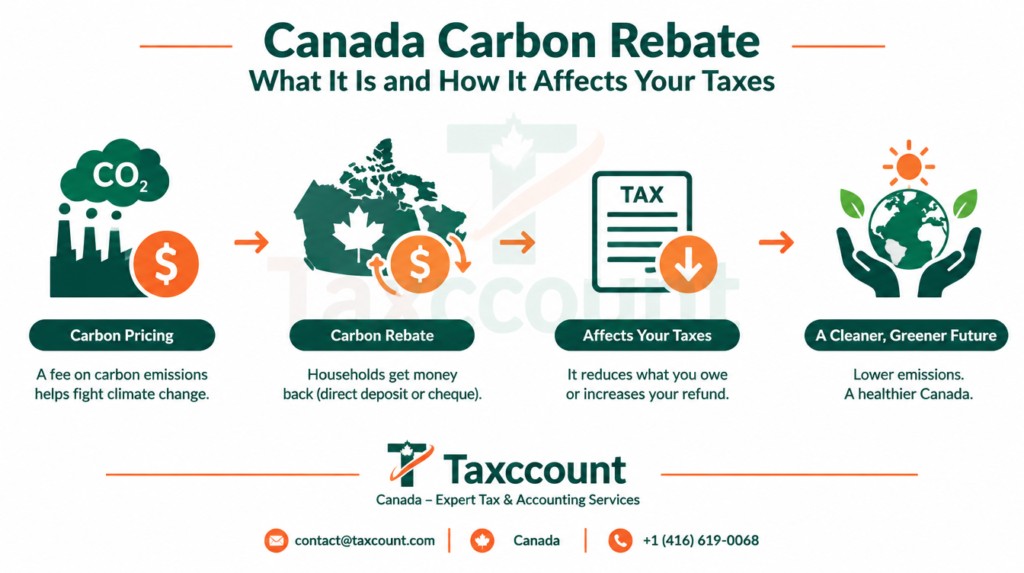
The federal carbon price adds a cost to fuels that produce greenhouse gases. To return most of the money collected to Canadians, the federal government distributes the Canada Carbon Rebate to eligible residents.
The rebate applies in provinces where the federal carbon pricing system is in effect. Provinces with their own equivalent carbon pricing systems may have their own rebate mechanisms.
Provinces currently subject to the federal carbon pricing (and eligible for the CCR) include Ontario, Manitoba, Saskatchewan, Alberta, and some others depending on changes in provincial policies. Always verify the current list with the CRA or canada.ca.
File My Return and Get My Rebate
☎️ Get HelpWho Is Eligible?
To receive the Canada Carbon Rebate, you must:
- Be a Canadian resident for tax purposes
- Be at least 19 years old (or be a parent living with a child, or have a spouse or common-law partner)
- Live in an eligible province
- File your annual income tax return
You do not need to apply for the rebate separately. Filing your tax return is all that is required for CRA to determine your eligibility and automatically send the payment.
How Much Is the Rebate?
The rebate amount depends on your province and the size of your household:
- Single adult: base amount
- Couple (married or common-law): higher combined amount
- Dependent children: additional amount per child
The amounts are set by the government and updated periodically. They are higher in provinces where the carbon price is higher. Check canada.ca for the current payment amounts by province.
Payments are issued quarterly (every three months) throughout the year.
Is the Canada Carbon Rebate Taxable?
No. The Canada Carbon Rebate is not taxable. You do not report it as income on your tax return, and receiving it does not affect your income-tested benefits, credits, or tax owing.
This is a key distinction from employment income or pension income. The CCR is a rebate, not earned income, so it has no effect on your tax bracket, OAS clawback, or other income-based calculations.
How Is the Rebate Delivered?
The CCR is paid directly to Canadians by direct deposit or cheque, quarterly throughout the year. If you are registered for direct deposit with CRA, the money goes into your bank account automatically.
The payments are sent to the person who files the tax return for the household. If both spouses file, only one receives the base plus spouse amount for the couple (typically the spouse whose return is processed first).
Who Does Not Qualify?
You do not qualify if:
- You live in a province with its own approved carbon pricing system (such as British Columbia or Quebec), as these provinces use their own rebate programs
- You are a non-resident of Canada
- You are confined to a prison or similar institution for the majority of the year
- Your province is not subject to the federal fuel charge
Rural Supplement
Individuals who live in rural or small communities may receive an additional supplement (typically 10-20% on top of the base amount) to recognize that rural residents often have fewer alternatives to fuel use and may face higher energy costs.
To qualify for the rural supplement, you must live in a small community outside a census metropolitan area (CMA). You claim this on your tax return by answering the relevant question.
The Carbon Rebate for Small Businesses
There is also a separate Canada Carbon Rebate for Small Businesses that returns a portion of carbon fuel charge proceeds directly to eligible small and medium-sized businesses. This is paid based on the number of eligible employees and applies to Canadian-controlled private corporations (CCPCs) that file corporate tax returns.
This rebate is also not taxable to the business.
Table of Summary
| Canada Carbon Rebate Topic | Key Information |
|---|---|
| What Is the CCR? | A government payment designed to offset the cost of the federal carbon pricing system for eligible Canadian households |
| Who Is Eligible? | Canadian residents who meet the age, household, tax-filing, and eligible-province requirements |
| How Much Is the Rebate? | The amount depends on the province, household size, and number of dependent children |
| Payment Frequency | Payments are generally issued quarterly throughout the year |
| Is the CCR Taxable? | No. The Canada Carbon Rebate is not taxable and is not reported as income on the tax return |
| How Is It Paid? | Payments are generally made by direct deposit or cheque |
| Who Does Not Qualify? | Certain non-residents, individuals in specified institutions, and residents of provinces not covered by the federal fuel charge |
| Rural Supplement | Eligible residents of rural or small communities may receive an additional supplement |
| Small Business Rebate | A separate rebate may be available to eligible small and medium-sized businesses based on eligible employees |
| Do You Need to Apply? | No. Filing your annual tax return allows CRA to determine eligibility and calculate the payment |
Frequently Asked Questions
Do I need to apply for the Canada Carbon Rebate?
No. As long as you file your annual income tax return and live in an eligible province, CRA automatically calculates and delivers the rebate.
What if I have not received my CCR payment?
Check that you have filed your return, that your banking information is current with CRA, and that you live in an eligible province. You can check payment status through CRA My Account.
Does the CCR count against income-tested benefits?
No. The CCR does not count as income and does not affect benefits like the GST/HST Credit, Canada Child Benefit, or OAS/GIS.
Conclusion
The Canada Carbon Rebate is a straightforward program. If you live in an eligible province, file your taxes, and meet the basic eligibility criteria, the payments come to you automatically. The best thing about it from a tax standpoint is that the money is tax-free.
Make sure you file your return every year, even if your income is low, to ensure you receive the CCR and other benefits you are entitled to.
Need Help With tax return filing services?
If you need assistance with tax return filing services or have questions about your Canadian tax return, Taxccount can help you understand the applicable rules and filing requirements.
Talk to a Tax Expert About Government Benefits
☎️ Get HelpThis is general information only and not professional advice. Consult a professional before acting.
 Written and fact-checked by Udit Gupta
 Written and fact-checked by
 Ex Big4, Ernst & Young, Deloitte | International & Cross-Border Tax Specialist | CPA Canada In Depth Tax Training | Licensed Chartered Accountant from ICAI & MIA
Udit Gupta has over 15 years of experience helping corporations & business owners with corporate structuring, corporate tax filing, bookkeeping, payroll, GST/HST, cross-border tax and CRA representation. Big 4 trained at Ernst & Young and Deloitte, and qualified as a Chartered Accountant in India and Malaysia, he founded accounting firm in 2014 to serve entrepreneurs, startups and non-resident business owners across Canada. View Full Member Bio.
Indian Institute of Chartered Accountant Member No. (521458) | Malaysian Institute of Accountants Membership number (CA 44667) | Ex Big4,Ex Ernst & Young (EY), Ex-Deloitte | CPA Canada In-Depth Tax Training 19 Dec 2023, 12 Jul 2022, 5 Jul 2023
Editorial policy. Every article is researched against primary sources — the Income Tax Act, CRA publications and CPA Canada.