Working From Home Tax Deduction in Canada: What You Can Claim
If you work from home — whether as an employee or self-employed — you may be able to deduct a portion of your home expenses on your tax return. These deductions can reduce your taxable income and help offset the real costs of running a home office.
This guide explains who qualifies, how much you can claim, and what documentation you need.
1. Can You Claim Work-From-Home Expenses?
Yes, in many cases. The Canada Revenue Agency (CRA) allows both employees and self-employed individuals to claim home office expenses if certain conditions are met.
The rules are somewhat different for employees versus self-employed people, so it is important to understand which category applies to you.
Book a consultation with Taxccount today
☎️ Get Help2. Who Is Eligible?
For Employees:
You may be eligible to claim home office expenses if:
- You were required to work from home by your employer (not just doing so by choice)
- You used a dedicated space in your home regularly and exclusively for work
- Your employer has provided a completed Form T2200 (Declaration of Conditions of Employment)
For Self-Employed Individuals:
If you run a business from home, you can claim home office expenses if your home is:
- Your principal place of business, or
- Used exclusively and regularly for meeting clients or customers
Self-employed people do not need a T2200, but must be able to justify the home office use.
3. The Two Methods: Detailed vs. Flat Rate
For eligible employees, the CRA has offered two methods for claiming home office expenses:
Flat Rate Method: A simple method where you claim a fixed dollar amount per day worked from home, without needing to track receipts. This method was introduced during the pandemic and may still apply in some situations. Check the CRA website for current availability of this method.
Detailed Method: You calculate your actual home office expenses and claim the business-use portion. This method requires receipts and a T2200 from your employer but typically results in a larger deduction.
Self-employed individuals always use the detailed method.
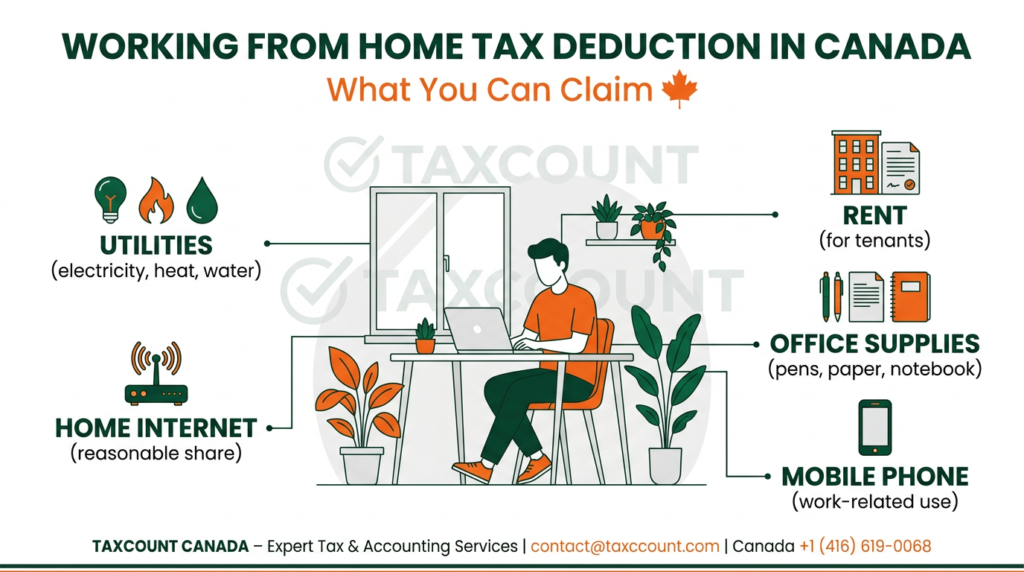
4. The Detailed Method: What You Can Claim
For Employees (with T2200):
- Rent (if you rent your home)
- Electricity, heat, and water
- Internet access fees
- Maintenance and minor repairs to your home office space
- Home internet costs (the portion used for work)
Note: Employees who rent cannot claim mortgage interest. Employees who own their home can claim electricity, heat, and utilities but not mortgage interest, insurance, or capital cost allowance.
For Self-Employed Workers:
A broader list of expenses is available:
- Rent or mortgage interest (not the principal)
- Property taxes
- Insurance
- Utilities
- Maintenance and repairs
- Internet
- Capital Cost Allowance (CCA) on the portion of the home used for business (use with caution, as this can affect the principal residence exemption)
5. How to Calculate the Business-Use Portion
The CRA requires that you only claim the portion of your home expenses that relate to your workspace. To calculate this:
Method 1 – Square Footage:
Divide the area of your workspace by the total area of your home.
Example:
- Home office: 150 square feet
- Total home: 1,500 square feet
- Business-use percentage: 10%
You can then claim 10% of eligible home expenses.
Method 2 – Number of Rooms:
Divide the number of rooms used for work by the total number of rooms in your home (if rooms are of similar size).
For spaces used for both work and personal purposes (like a dining room used as a home office), you may also need to account for the time the space is used for work vs. personal use.
6. What Is the T2200 Form?
The T2200 (Declaration of Conditions of Employment) is a form your employer completes and signs. It confirms that:
- You were required to work from home
- You were not reimbursed for home office expenses
- The type of expenses you are allowed to claim
You do not submit the T2200 with your return, but you must keep it on file in case the CRA asks to see it. Many employers provide this form to eligible employees by February.
7. Self-Employed Workers vs. Employees
There are key differences between how employees and self-employed individuals claim home office expenses:
Employees:
- Need a T2200 from employer
- Cannot claim mortgage interest or property taxes
- Deduct on line 22900 of their T1 return
- Cannot use the deduction to create a business loss
Self-Employed:
- Do not need a T2200
- Can claim a broader range of expenses including mortgage interest and property taxes
- Deduct as part of their business expenses on Form T2125
- Can claim CCA (depreciation) on the home office portion, but this has long-term tax implications
If you are both an employee and self-employed (for example, you have a side business), you may be able to claim home office expenses under both categories.
8. What You Cannot Claim
Some expenses are specifically excluded:
- Mortgage principal payments
- Home internet used exclusively for personal reasons
- Furniture and decorations (these may be separate capital expenditures)
- Expenses for areas not used for work
- Any expense reimbursed by your employer
Remember: if you claim Capital Cost Allowance (CCA) on your home as a self-employed person, it can reduce your principal residence exemption when you eventually sell. Many professionals recommend avoiding CCA on a home office for this reason.
9. Keeping Records
Whether you are an employee or self-employed, the CRA expects you to keep documentation:
- Receipts and invoices for all expenses claimed
- A copy of your T2200 (employees)
- Floor plan or measurements showing the workspace
- Any records showing the business use of the space
- Bank and credit card statements as backup
Keep records for at least six years from the date you filed your return.
Table of Summary
| Topic | Key Information |
|---|---|
| Can You Claim Work-From-Home Expenses? | Yes. Both employees and self-employed individuals may claim eligible home office expenses if they meet the CRA’s requirements. These deductions can reduce taxable income and offset home office costs. |
| Employee Eligibility | Employees may qualify if their employer required them to work from home, they regularly and exclusively used a dedicated workspace for work, and their employer completed Form T2200. |
| Self-Employed Eligibility | Self-employed individuals may claim home office expenses if their home is their principal place of business or is used regularly and exclusively to meet clients or customers. |
| T2200 Requirement for Employees | Employees generally need a completed and signed Form T2200 – Declaration of Conditions of Employment to claim home office expenses under the detailed method. |
| T2200 Requirement for Self-Employed Individuals | Self-employed individuals do not need a T2200 but must be able to justify their business use of the home. |
| Flat Rate Method | The flat rate method allows eligible employees to claim a fixed amount for each day worked from home without tracking individual receipts. It was introduced during the pandemic and may still apply in certain situations, subject to current CRA availability. |
| Detailed Method | The detailed method involves calculating actual home office expenses and claiming the business-use portion. It requires receipts and, for employees, a T2200. It may provide a larger deduction. |
| Method for Self-Employed Workers | Self-employed individuals must use the detailed method to calculate eligible home office expenses. |
| Employee Home Office Expenses | Eligible employees may claim rent, electricity, heat, water, internet access fees, maintenance, and minor repairs related to their workspace. |
| Expenses Employees Cannot Claim | Employees who rent cannot claim mortgage interest. Employees who own their homes cannot claim mortgage interest, home insurance, or CCA. |
| Self-Employed Home Office Expenses | Self-employed individuals may claim eligible rent or mortgage interest (not principal), property taxes, insurance, utilities, maintenance, repairs, internet, and applicable CCA. |
| Capital Cost Allowance (CCA) | Self-employed individuals may claim CCA on the business-use portion of their home, but doing so can affect the principal residence exemption when the property is sold. |
| Square Footage Calculation | Divide the workspace area by the total area of the home to determine the business-use percentage. |
| Square Footage Example | A 150-square-foot home office in a 1,500-square-foot home represents 10% business use. The taxpayer may claim 10% of eligible home expenses. |
| Number of Rooms Calculation | Divide the number of rooms used for work by the total number of rooms, provided the rooms are of similar size. |
| Shared Workspace Calculation | If a space is used for both personal and work purposes, such as a dining room, the calculation may also need to account for the time spent using the space for work. |
| What Is Form T2200? | Form T2200 is a declaration completed and signed by the employer confirming the employee’s work-from-home requirements and eligible employment expenses. |
| Information Confirmed by T2200 | The form confirms that the employee was required to work from home, was not reimbursed for home office expenses, and identifies the expenses they are allowed to claim. |
| Submitting Form T2200 | Employees do not submit the T2200 with their tax return but must keep it available in case the CRA requests it. Employers often provide the form to eligible employees by February. |
| Employee Tax Reporting | Employees claim eligible home office expenses on line 22900 of their T1 tax return. |
| Self-Employed Tax Reporting | Self-employed individuals claim eligible home office expenses as business expenses on Form T2125 – Statement of Business or Professional Activities. |
| Creating a Business Loss | Employees cannot use home office expense deductions to create a business loss. |
| Employees and Self-Employment Together | Individuals who are both employees and self-employed, such as those operating a side business, may be able to claim home office expenses under both categories if they meet the applicable requirements. |
| Non-Deductible Mortgage Payments | Mortgage principal payments cannot be claimed as home office expenses. |
| Personal Internet Expenses | Home internet costs used exclusively for personal purposes are not deductible. Only the eligible business-use portion can be claimed. |
| Furniture and Decorations | Furniture and decorations are not included as regular home office expenses and may need to be treated as separate capital expenditures. |
| Personal-Use Areas | Expenses relating to areas of the home that are not used for work cannot be claimed. |
| Reimbursed Expenses | Expenses reimbursed by an employer cannot also be claimed as deductions by the employee. |
| CCA and Principal Residence Exemption | Claiming CCA on a home office may reduce the principal residence exemption when the property is eventually sold. The article notes that many professionals recommend avoiding CCA on a home office for this reason. |
| Records and Receipts | Keep receipts and invoices for all expenses claimed, along with bank and credit card statements as supporting evidence. |
| Workspace Documentation | Maintain a floor plan or measurements showing the workspace and records demonstrating how the space is used for business. |
| Employee Documentation | Employees should retain a copy of their completed T2200 as supporting documentation. |
| Record Retention Period | Keep supporting records for at least six years from the date the tax return was filed. |
| Working From Home Part of the Year | Expenses can be claimed for the period the taxpayer actually worked from home. The calculation should be prorated to reflect the work-from-home period. |
| Working From a Coffee Shop | Home office deductions must relate to the home workspace. The eligible work-related portion of home internet may be claimed, but coffee shop purchases such as drinks generally are not deductible. |
| Renters vs. Homeowners | Both renters and homeowners may qualify. Renters can claim eligible rent based on business use, while homeowners may claim eligible utilities and related expenses under the applicable rules. |
| Employer Home Office Allowance | If an employer provides a tax-free home office allowance, the employee cannot claim deductions for the same expenses. Only personally paid, unreimbursed eligible expenses may be claimed. |
| Key Takeaway | Employees generally need a T2200 and may claim eligible expenses through the applicable method. Self-employed individuals use the detailed method and can claim a broader range of expenses. Accurate business-use calculations, supporting documents, and proper records are essential. |
Frequently Asked Questions
Can I claim home office expenses if I only worked from home part of the year?
Yes. You can claim expenses for the period you actually worked from home. The calculation is prorated to reflect only the time the home was used for work.
Can I claim a home office if I work at a coffee shop sometimes?
The expense must relate to your home workspace. If you pay for your home internet, that portion used for work is claimable. Costs at a coffee shop (like a drink purchase) generally are not.
Do I need to own the home to claim these expenses?
No. Both renters and homeowners can claim eligible home office expenses. Renters claim their rent (prorated for business use). Homeowners claim utilities and related costs instead.
What if my employer gave me a home office allowance?
If your employer paid you a tax-free home office allowance, you cannot also claim home office expenses for the same costs. The deduction is only for expenses you paid personally without reimbursement.
Conclusion
Working from home comes with real costs, and the CRA allows many Canadians to deduct a portion of those costs to reduce their tax bill. Whether you are an employee with a T2200 or a self-employed person running a business from home, there is a path to claiming these expenses.
The key is to document everything properly, calculate your business-use percentage accurately, and only claim what you are genuinely entitled to.
If you are unsure whether your home office qualifies or want help getting the most from your claim, a tax professional can review your situation and make sure everything is done correctly.
Get Help With Your Canadian Tax Return
Working from home may create opportunities to reduce your taxable income, but claiming the wrong expenses or using an incorrect calculation can lead to CRA questions or adjustments.
Taxccount Canada helps individuals, employees, freelancers, and self-employed professionals understand eligible tax deductions and prepare accurate Canadian income tax returns.
Contact Taxccount Canada to book a free consultation and get professional assistance with your tax filing and home office expense claims.
Let Taxccount handle your home office deductions accurately
☎️ Get HelpThis is general information only and not professional advice. Consult a professional before acting.
 Written and fact-checked by Udit Gupta
 Written and fact-checked by
Ex Big4, Ernst & Young, Deloitte | International & Cross-Border Tax Specialist | CPA Canada In Depth Tax Training | Licensed Chartered Accountant from ICAI & MIA
Udit Gupta has over 15 years of experience helping corporations & business owners with corporate structuring, corporate tax filing, bookkeeping, payroll, GST/HST, cross-border tax and CRA representation. Big 4 trained at Ernst & Young and Deloitte, and qualified as a Chartered Accountant in India and Malaysia, he founded accounting firm in 2014 to serve entrepreneurs, startups and non-resident business owners across Canada. View Full Member Bio.
Indian Institute of Chartered Accountant Member No. (521458) | Malaysian Institute of Accountants Membership number (CA 44667) | Ex Big4,Ex Ernst & Young (EY), Ex-Deloitte | CPA Canada In-Depth Tax Training 19 Dec 2023, 12 Jul 2022, 5 Jul 2023
Editorial policy. Every article is researched against primary sources — the Income Tax Act, CRA publications and CPA Canada.