Canada Workers Benefit: Who Qualifies and How Much You Can Get

If you work and earn a low to modest income, the federal government has a refundable tax credit designed specifically for you. The Canada Workers Benefit (CWB) puts money back in your pocket just for being a working Canadian. It is one of the most valuable tax credits for low-income workers because it is refundable — meaning you can receive money even if you owe no income tax.
This guide explains who qualifies, how much you can receive, and how to make sure you get every dollar you are entitled to.
What Is the Canada Workers Benefit?
The Canada Workers Benefit is a refundable federal tax credit for individuals and families who work and earn low to modest incomes. It is administered by the Canada Revenue Agency (CRA) and is claimed on your annual personal tax return.
Unlike non-refundable credits, the CWB is refundable — this means that if the credit amount is more than what you owe in taxes, the government pays you the difference as a cash refund.
The CWB was enhanced in recent years to provide more support to working Canadians.
Talk to Taxccount today
☎️ Get HelpWho Is Eligible?
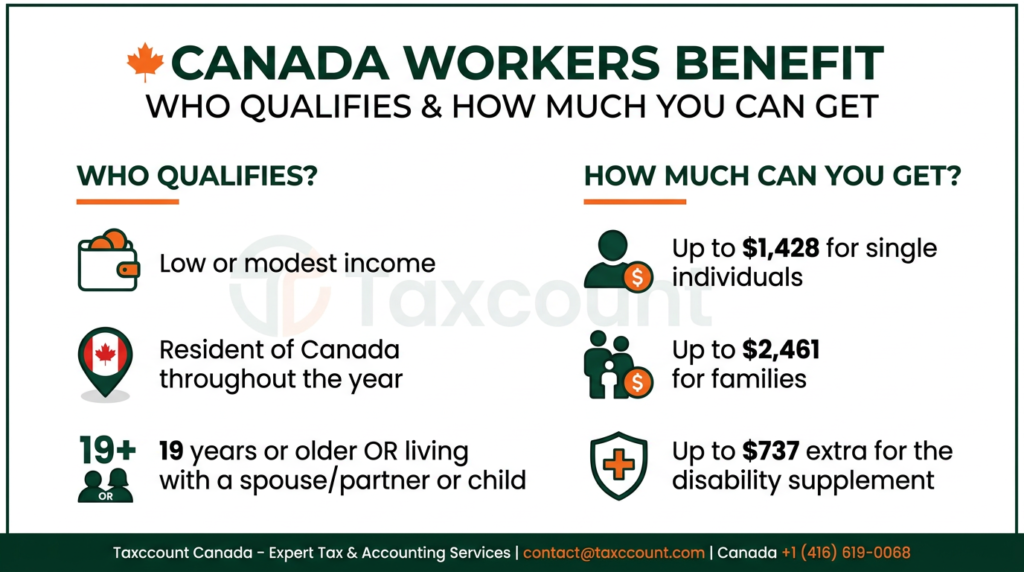
To qualify for the Canada Workers Benefit, you must:
1. Be a Canadian resident throughout the entire year
2. Be 19 years of age or older (or have a spouse or common-law partner, or have a child who lived with you during the year)
3. Have earned working income (employment or self-employment income) during the year
4. Not be a full-time student for more than 13 weeks in the year (unless you have a dependent child)
5. Not be incarcerated
You do not qualify if you are claimed as a dependent by someone else for the year.
Working income includes:
- Employment income (T4 income)
- Net self-employment income
- Taxable scholarships and bursaries in some cases
How Much Is the Canada Workers Benefit?
The amount depends on your working income, marital status, and whether you have a dependent.
Basic amount for single individuals:
- The benefit increases as your working income rises up to a maximum
- The maximum for single individuals (without dependants) is approximately $1,518 per year (subject to annual indexation)
- Once your net income exceeds a certain threshold, the benefit begins to phase out
- The credit reaches zero once your net income exceeds approximately $33,015
Basic amount for families (couples or single parents):
- The maximum for families is approximately $2,616 per year
- The phase-out begins at a higher income threshold
- The benefit reaches zero at a net income of approximately $43,212
Note: These amounts are indexed to inflation and may change slightly each year. Always check the CRA website for the most current figures.
The Disability Supplement
If you qualify for the Disability Tax Credit (DTC), you may also be eligible for a disability supplement on top of the basic CWB.
The supplement adds approximately $737 for single individuals and approximately $737 per eligible partner in a couple.
This supplement phases out at a different (higher) income threshold than the basic benefit, so eligible individuals with disabilities can receive additional support.
To get the disability supplement, you must be approved for the DTC, which requires certification from a qualified health professional and approval from the CRA.
How to Claim the CWB
You claim the Canada Workers Benefit by completing Schedule 6 (Canada Workers Benefit) and including it with your T1 personal tax return.
Most tax software handles this automatically. You just need to make sure you have entered your employment and self-employment income accurately.
The CRA will calculate your benefit based on your income, family situation, and disability status.
You do not need to apply separately — filing your tax return is how you claim it. This is one more reason why filing your taxes every year is important, even if your income is low.
Advance Payments
The CRA offers advance payments of the Canada Workers Benefit. This means you can receive a portion of your estimated CWB benefit during the year, rather than waiting until you file your return.
Advance payments are issued quarterly (in January, April, July, and October) to eligible individuals who applied. The total advance payments represent up to 50% of your estimated annual CWB.
This can help with cash flow throughout the year instead of receiving a lump sum at tax time. However, if you receive advance payments and your final CWB turns out to be lower than expected, you may need to repay the difference when you file.
What Reduces the CWB?
The Canada Workers Benefit is reduced (phased out) based on your adjusted net income. The reduction starts at a certain net income threshold and phases out completely at a higher threshold.
For the basic benefit:
- For single individuals: reduction starts at approximately $24,975 and ends at approximately $33,015
- For families: reduction starts at approximately $27,493 and ends at approximately $43,212
Your adjusted net income includes employment income, self-employment income, investment income, and other sources.
Table of Summary
| Topic | Key Information |
|---|---|
| What Is the Canada Workers Benefit (CWB)? | The CWB is a refundable federal tax credit designed to support individuals and families earning low to modest working incomes. It is administered by the CRA and claimed through an annual personal tax return. |
| Refundable Tax Credit | Because the CWB is refundable, eligible individuals may receive a payment even if they owe no income tax. If the benefit exceeds the tax payable, the difference is paid as a refund. |
| Who Is Eligible for the CWB? | Applicants must generally be Canadian residents throughout the year, earn working income, and meet the applicable age and family-status requirements. |
| Age Requirement | You must generally be at least 19 years old by December 31, or live with a spouse or common-law partner or an eligible dependent child. |
| Canadian Residency Requirement | You must be a resident of Canada throughout the tax year to qualify under the eligibility conditions described in the article. |
| Working Income Requirement | You must earn employment income or net self-employment income during the year. Certain taxable scholarships and bursaries may also count in some circumstances. |
| Full-Time Students | You generally cannot qualify if you are a full-time student for more than 13 weeks during the year, unless you have an eligible dependent child. |
| Incarceration | Individuals who are incarcerated for at least 90 days during the year are generally not eligible under the rules described in the article. |
| Dependent Status | You cannot claim the CWB if another person is entitled to claim you as a dependent for the year. |
| Employment Income | Employment income reported on a T4 slip can count as working income when determining CWB eligibility and payment amounts. |
| Self-Employment Income | Net income from self-employment can qualify as working income. Self-employed individuals should accurately report their business income and eligible expenses. |
| Maximum CWB for Single Individuals | The article estimates the maximum basic benefit for single individuals without dependants at approximately $1,518 annually, subject to annual indexation. |
| CWB for Single Individuals | The benefit increases as working income rises until the maximum is reached. It begins to decrease when adjusted net income exceeds the applicable threshold. |
| CWB for Families | Couples and single parents may qualify for a maximum basic benefit of approximately $2,616 annually, subject to annual adjustments and eligibility requirements. |
| CWB Phase-Out for Single Individuals | The article lists an approximate phase-out range of $24,975 to $33,015 in adjusted net income. The benefit decreases as income rises within this range. |
| CWB Phase-Out for Families | For families, the article lists an approximate phase-out range of $27,493 to $43,212 in adjusted net income. |
| Disability Supplement | Individuals who qualify for the Disability Tax Credit (DTC) may also receive an additional CWB disability supplement on top of the basic benefit. |
| Disability Supplement Amount | The article estimates the supplement at approximately $737 for eligible single individuals and approximately $737 per eligible partner in a couple, subject to applicable rules and annual changes. |
| Disability Tax Credit Requirement | To receive the disability supplement, you must qualify for the DTC. This generally requires certification by a qualified health professional and approval by the CRA. |
| How to Claim the CWB | Claim the benefit by completing Schedule 6 (Canada Workers Benefit) and submitting it with your T1 personal income tax return. |
| Automatic Calculation Through Tax Software | Most tax preparation software calculates the CWB automatically when employment or self-employment income and family information are entered correctly. |
| No Separate Application Required | You generally do not need to submit a separate application for the basic CWB. Filing your annual tax return allows the CRA to determine your eligibility and calculate the benefit. |
| Advance CWB Payments | Eligible individuals can receive part of their estimated CWB during the year instead of waiting until tax filing. Advance payments can help manage regular living expenses. |
| Quarterly Payment Schedule | Advance payments are generally issued in January, April, July, and October to eligible individuals who have applied. |
| Advance Payment Amount | Advance payments can represent up to 50% of the estimated annual CWB, with the remaining amount determined when the tax return is assessed. |
| Repayment of Excess Advance Payments | If the advance payments received exceed the final CWB entitlement, you may have to repay the difference when filing your tax return. |
| Adjusted Net Income | The CWB is reduced based on adjusted net income, which may include employment income, self-employment income, investment income, and other sources. |
| Does the CWB Affect Other Benefits? | The CWB is generally not considered income for certain other federal benefit programs. However, provincial programs may apply different rules. |
| Can Self-Employed Individuals Claim the CWB? | Yes. Eligible self-employed individuals can claim the CWB using their net business income as working income, provided they meet the other requirements. |
| Can Both Partners Claim the CWB? | Couples generally receive one family benefit rather than separate basic benefits for each partner. The claim is made according to the applicable family rules. |
| Importance of Filing an Annual Tax Return | Even if you have little or no income tax payable, filing your tax return is essential to receive the CWB and other benefits for which you may qualify. |
| Key CWB Planning Considerations | Review your working income, adjusted net income, family status, disability eligibility, and advance payments each year. Ensure Schedule 6 is completed correctly to receive the benefit you are entitled to. |
Frequently Asked Questions
Do I automatically receive the CWB if I qualify?
No. You must file a tax return to receive the CWB. The CRA calculates it based on the information in your return. You do not receive it if you do not file.
Can I claim the CWB if I am self-employed?
Yes. Net self-employment income counts as working income for CWB purposes. You must report your income accurately on your tax return to receive the correct benefit.
Can couples both claim the CWB?
No. Only one person in a couple claims the CWB for the family. The higher-income partner typically files the claim, but only one family benefit is paid.
Does the CWB affect other benefits?
The CWB is a refundable tax credit and is generally not considered income for purposes of other federal benefits. However, some provincial programs may have different rules.
Conclusion
The Canada Workers Benefit is one of the most direct forms of financial support available to low-income working Canadians. If you work and earn below the income thresholds, you are likely entitled to this benefit — and the only thing you need to do to get it is file your tax return.
Make sure you or your tax preparer is claiming Schedule 6 each year, and consider applying for advance payments if you need the money throughout the year rather than as a lump sum at filing time.
How Taxccount Canada Can Help
The Canada Workers Benefit can provide valuable financial support to eligible low-income workers and families. However, eligibility and payment calculations depend on several factors, including income, family status, and province or territory of residence.
Taxccount Canada provides personal tax preparation and accounting services across Canada. Our team can help review your income information, identify potentially eligible tax credits, and prepare your tax return accurately.
Contact Taxccount Canada to book a free consultation and discuss your tax filing needs.
Book a free consultation with Taxccount
☎️ Get HelpThis is general information only and not professional advice. Consult a professional before acting.
 Written and fact-checked by Udit Gupta
 Written and fact-checked by
Ex Big4, Ernst & Young, Deloitte | International & Cross-Border Tax Specialist | CPA Canada In Depth Tax Training | Licensed Chartered Accountant from ICAI & MIA
Udit Gupta has over 15 years of experience helping corporations & business owners with corporate structuring, corporate tax filing, bookkeeping, payroll, GST/HST, cross-border tax and CRA representation. Big 4 trained at Ernst & Young and Deloitte, and qualified as a Chartered Accountant in India and Malaysia, he founded accounting firm in 2014 to serve entrepreneurs, startups and non-resident business owners across Canada. View Full Member Bio.
Indian Institute of Chartered Accountant Member No. (521458) | Malaysian Institute of Accountants Membership number (CA 44667) | Ex Big4,Ex Ernst & Young (EY), Ex-Deloitte | CPA Canada In-Depth Tax Training 19 Dec 2023, 12 Jul 2022, 5 Jul 2023
Editorial policy. Every article is researched against primary sources — the Income Tax Act, CRA publications and CPA Canada.