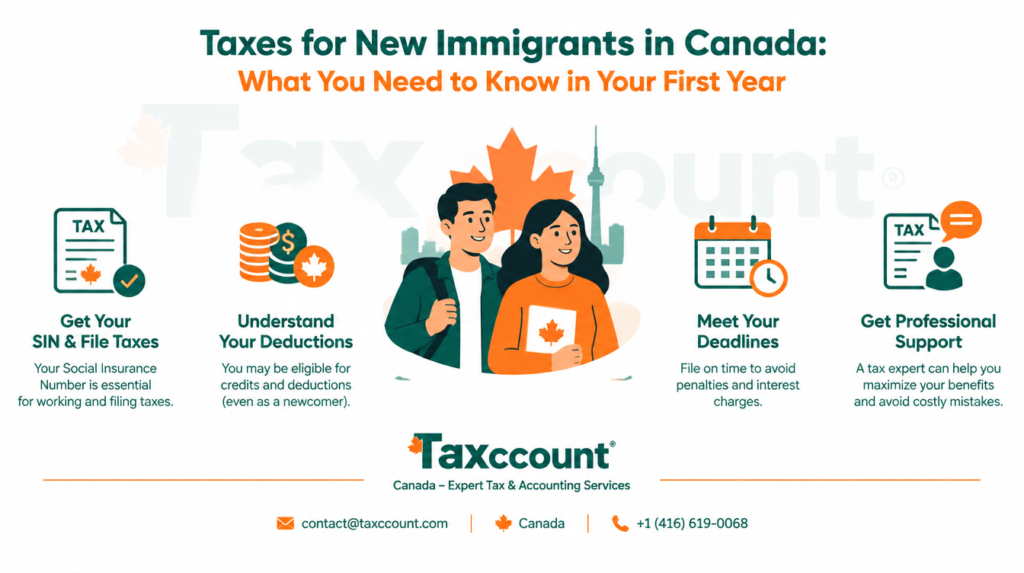
Taxes for New Immigrants in Canada: What You Need to Know in Your First Year

Moving to a new country is exciting, but it comes with a lot of paperwork — including taxes. Canada’s tax system may be different from what you are used to, and it is important to understand your obligations from the start.
As a new immigrant, you are responsible for filing a Canadian tax return starting from the year you arrived. This guide explains everything you need to know to get started on the right foot.
When Do You Become a Tax Resident of Canada?
You become a Canadian tax resident on the date you establish residential ties to Canada. This is typically your arrival date — the day you moved into your home, started a job, or opened a bank account in Canada.
Let Taxccount help you report it correctly
☎️ Get HelpResidential ties include:
- A home in Canada (whether owned or rented)
- A spouse or common-law partner living in Canada
- Children in Canada
- Canadian bank accounts, credit cards, or driver’s licence
From your residency date forward, you must report your worldwide income to the Canada Revenue Agency (CRA). Income earned before your arrival date — from your home country — is not taxable in Canada.
Filing Your First Tax Return in Canada
You file your first Canadian tax return for the year in which you arrived. Even if you only lived in Canada for part of the year, you must file a return.
The return covers:
- All Canadian income earned from your arrival date to December 31
- Any foreign income earned after you became a Canadian tax resident
The deadline to file is April 30 of the following year (or June 15 if you or your spouse are self-employed).
You file using Form T1 General, which is the standard personal income tax return for individuals.
What Income Do You Report?
You report income earned from your date of arrival onward:
- Employment income earned in Canada
- Business income earned in Canada or abroad (from your arrival date)
- Investment income (interest, dividends, capital gains) from Canadian and foreign sources
- Foreign income earned after your arrival date (converted to Canadian dollars)
Income from your home country before your arrival is not included. For example, if you moved to Canada on July 1, income you earned in your home country from January to June is generally not subject to Canadian tax.
Tax Slips You May Receive
As a new immigrant who worked or received income in Canada, you may receive various tax slips by late February:
- T4: Employment income from Canadian employers
- T5: Investment income (interest and dividends) from Canadian financial institutions
- T3: Income from trusts, including certain investment funds
- T4A: Other income, including self-employment or certain benefits
- T4E: Employment Insurance benefits if you received EI
Use these slips to fill in your T1 return. If you used the CRA’s auto-fill feature through certified tax software and your CRA My Account, some of this information may be pre-filled.
Benefits and Credits Available to New Immigrants
Once you file a tax return, you may be eligible for the following benefits:
1. GST/HST Credit
This is a quarterly, tax-free payment to help lower-income Canadians offset the cost of the GST or HST they pay. Eligibility is based on your net income. Filing a return is how you apply.
2. Canada Child Benefit (CCB)
If you have children under 18, you may qualify for the CCB, a monthly tax-free benefit. You apply by submitting Form RC66 and filing your tax return.
3. Ontario Trillium Benefit and other provincial benefits
Depending on your province, there may be additional benefits available. Many provinces require you to file your tax return to access them.
4. Basic Personal Amount
This is a non-refundable tax credit everyone can claim to reduce their federal tax. For your first partial year in Canada, the credit is prorated based on how many days you were a resident.
Common Deductions and Credits
New immigrants can claim many of the same deductions as other Canadians:
- RRSP contributions: If you have Canadian earned income, you build RRSP room and can contribute
- Childcare expenses: If you paid for childcare to work or go to school
- Medical expenses: Eligible medical costs paid in Canada
- Tuition credits: If you attended a Canadian post-secondary institution
- Moving expenses: If you moved to Canada to work or study and your new home is at least 40 km closer to your new workplace
Reporting Assets You Brought to Canada
When you become a Canadian resident, the CRA treats you as if you purchased all of your assets at their fair market value on your arrival date. This is important for future capital gains calculations.
For example:
- You owned shares in your home country worth $50,000 when you moved to Canada
- Your cost base in Canada is set to $50,000
- Only gains above $50,000 (earned after your arrival) will be taxable when you sell
If you own foreign property worth more than $100,000 CAD, you may need to file Form T1135 (Foreign Income Verification Statement).
Social Insurance Number and CRA Account
To file taxes in Canada, you need:
1. A Social Insurance Number (SIN): Apply at a Service Canada office with your immigration documents
2. A CRA My Account: Register online to access your tax records, view benefit payments, and manage your tax affairs
With a SIN and My Account set up, you can file electronically using NETFILE-certified software, which is the fastest way to file and receive your refund.
Table of Summary
| Tax Topic | Key Information |
|---|---|
| Taxes for New Immigrants in Canada | New immigrants generally need to file a Canadian tax return for the year they arrive and report income earned after becoming Canadian tax residents. |
| Canadian Tax Residency | Tax residency generally begins when an individual establishes significant residential ties to Canada. The residency date determines when Canadian tax obligations begin. |
| Residential Ties | Common ties include a home in Canada, a spouse or common-law partner, children, Canadian bank accounts, credit cards, and a driver’s licence. |
| Worldwide Income Reporting | From the date Canadian tax residency begins, residents must generally report worldwide income, including Canadian and foreign employment, business, investment, and other income. |
| Income Earned Before Arrival | Income earned in the home country before becoming a Canadian tax resident is generally not taxable in Canada, according to the article. |
| First-Year Tax Return | New immigrants file Form T1 General for the calendar year in which they arrived, even if they lived in Canada for only part of that year. |
| Tax Filing Deadlines | The general filing deadline is April 30 of the following year. Self-employed individuals and their spouses generally have until June 15 to file, although payment deadlines may differ. |
| Employment Income | Report employment income earned in Canada from the date of arrival and Canadian tax residency onward. |
| Business and Investment Income | Report eligible business income, interest, dividends, and capital gains from Canadian and foreign sources earned after becoming a Canadian tax resident. |
| Foreign Income Conversion | Foreign income earned after becoming a Canadian tax resident must be converted into Canadian dollars for reporting on the Canadian tax return. |
| T4 Tax Slip | Reports employment income and related deductions from Canadian employers. |
| T5 Tax Slip | Reports investment income, including interest and dividends from Canadian financial institutions. |
| T3 Tax Slip | Reports income from trusts, including certain investment funds. |
| T4A Tax Slip | Reports certain other income, including some self-employment income and benefits. |
| T4E Tax Slip | Reports Employment Insurance (EI) benefits received during the year. |
| CRA Auto-Fill | Eligible taxpayers using certified tax software and CRA My Account may be able to pre-fill certain tax information from available CRA records. |
| GST/HST Credit | Eligible lower-income Canadians may receive quarterly, tax-free payments to help offset GST/HST costs. Filing a tax return is necessary to determine eligibility. |
| Canada Child Benefit (CCB) | Eligible families with children under 18 may receive monthly, tax-free payments. The article identifies Form RC66 and filing a tax return as part of the application process. |
| Provincial Benefits | New immigrants may qualify for provincial benefits, such as the Ontario Trillium Benefit, depending on their province and eligibility. |
| Basic Personal Amount | This non-refundable federal tax credit reduces federal income tax. For the first partial year of Canadian tax residency, the article states that it is prorated based on the number of days of residency. |
| RRSP Contributions | New immigrants may build RRSP contribution room through eligible Canadian earned income and contribute according to their available room. |
| Childcare Expenses | Eligible childcare expenses may be deductible when incurred to work or attend school, subject to applicable requirements. |
| Medical Expenses | Eligible medical costs may qualify for a medical expense tax credit. |
| Tuition Tax Credits | Eligible tuition fees from Canadian post-secondary institutions may qualify for tuition tax credits. |
| Moving Expenses | Eligible moving expenses may be deductible when moving to Canada to work or study, provided the applicable conditions are met, including the 40-kilometre distance test described in the article. |
| Assets Brought to Canada | When an individual becomes a Canadian tax resident, many assets are generally treated as acquired at their fair market value on the residency date for future tax calculations, subject to applicable exceptions. |
| Foreign Investments and Capital Gains | The arrival-date fair market value may establish the Canadian tax cost base for eligible assets. Subsequent gains may be taxable when the assets are sold. |
| Foreign Property Reporting: Form T1135 | New immigrants who own specified foreign property with a total cost amount exceeding $100,000 CAD may need to file Form T1135, subject to applicable exceptions. |
| Money Brought from Abroad | Bringing personal savings or money from a home country to Canada is generally not income. However, income subsequently earned from those funds may be taxable. |
| Social Insurance Number (SIN) | A SIN is needed to file a Canadian tax return. New immigrants can apply through Service Canada using their immigration documents. |
| CRA My Account | Registering for CRA My Account allows taxpayers to access tax records, check benefit payments, and manage their tax affairs online. |
| Electronic Tax Filing | Once a SIN is available, eligible taxpayers can use NETFILE-certified software to file electronically and receive refunds more efficiently. |
| Tax Refunds | New immigrants may receive a refund if their employer withheld too much tax or if eligible deductions and credits reduce their tax payable. |
| Working Without a SIN | Individuals who began working without a SIN should apply as soon as possible and consult a tax professional to ensure their employment income is correctly reported. |
| Key Takeaway | New immigrants should establish their tax residency date, report income earned after that date, obtain a SIN, set up CRA My Account, check their eligibility for benefits and credits, and meet their filing obligations. |
Frequently Asked Questions
I arrived in Canada in November. Do I still need to file a tax return for that year?
Yes. Even if you only lived in Canada for a few weeks, you are required to file a return for the portion of the year you were a Canadian resident.
Do I need to report the money I brought from my home country?
Generally no — bringing money to Canada is not income. However, if that money earns interest or investment income in Canada, you report that income. And if you have foreign investments worth over $100,000, T1135 may apply.
Can I get a tax refund as a new immigrant?
Yes. If too much tax was withheld by your employer, or if your credits and deductions exceed your tax, you will receive a refund.
I did not have a SIN when I started working. What do I do?
Apply for a SIN as soon as possible. File your return with your SIN once it arrives. If you were working without a SIN, speak with a tax professional to ensure your employment income is properly reported.
Conclusion
The Canadian tax system can seem complex at first, but it is manageable once you understand the basics. As a new immigrant, your main obligation is to file a tax return for the year you arrived, report income earned from your arrival date, and apply for the benefits you are entitled to.
Getting off to a good start with the CRA makes everything easier in future years. Setting up your CRA My Account, getting your SIN, and working with a tax professional in your first year can save you time, money, and stress.
How Taxccount Canada Can Help New Immigrants
Your first Canadian tax return may involve questions about residency, foreign income, benefits, deductions, and assets held outside Canada. Getting these details right can help you meet your obligations and avoid missing eligible tax benefits.
Taxccount Canada provides tax and accounting services to individuals, families, self-employed professionals, and businesses across Canada. Our team can help you understand your first-year filing requirements, review your income documents, identify relevant credits, and prepare your return based on your circumstances.
Contact Taxccount Canada to book a free consultation and get help preparing your first Canadian tax return.
Book a free consultation with Taxccount today
☎️ Get HelpThis is general information only and not professional advice. Consult a professional before acting.
 Written and fact-checked by Udit Gupta
 Written and fact-checked by
Ex Big4, Ernst & Young, Deloitte | International & Cross-Border Tax Specialist | CPA Canada In Depth Tax Training | Licensed Chartered Accountant from ICAI & MIA
Udit Gupta has over 15 years of experience helping corporations & business owners with corporate structuring, corporate tax filing, bookkeeping, payroll, GST/HST, cross-border tax and CRA representation. Big 4 trained at Ernst & Young and Deloitte, and qualified as a Chartered Accountant in India and Malaysia, he founded accounting firm in 2014 to serve entrepreneurs, startups and non-resident business owners across Canada. View Full Member Bio.
Indian Institute of Chartered Accountant Member No. (521458) | Malaysian Institute of Accountants Membership number (CA 44667) | Ex Big4,Ex Ernst & Young (EY), Ex-Deloitte | CPA Canada In-Depth Tax Training 19 Dec 2023, 12 Jul 2022, 5 Jul 2023
Editorial policy. Every article is researched against primary sources — the Income Tax Act, CRA publications and CPA Canada.