Do You Pay Tax on Lottery Winnings in Canada?
Imagine you just won a major lottery prize and your first question is: how much of this goes to taxes? The good news for Canadians is: nothing. But there are important exceptions you should know about.
This guide explains Canada’s tax rules on lottery winnings, casino winnings, and what happens when your winnings start earning income.
Are Lottery Winnings Taxable in Canada?
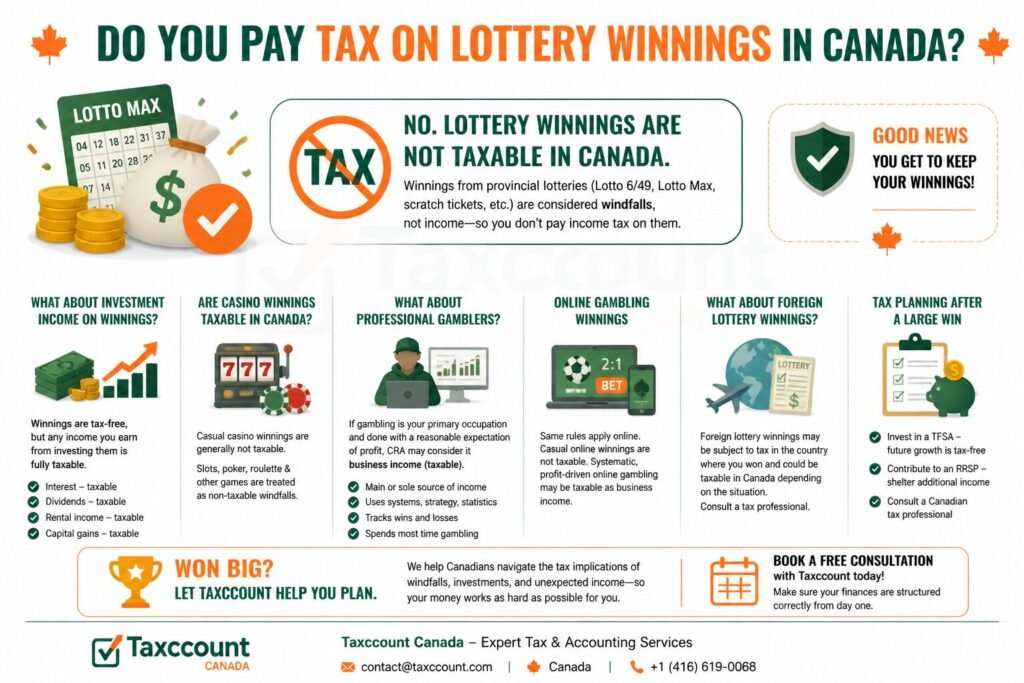
No. In Canada, lottery winnings are generally not taxable. If you win the Lotto 6/49, Lotto Max, a scratch-and-win ticket, or any other lottery administered by a provincial lottery corporation, you do not pay income tax on that amount.
Plan Lottery Winnings Wisely
☎️ Get HelpWhy Are Lottery Winnings Not Taxed?
Canada’s Income Tax Act taxes income from employment, business, and property. A lottery win is considered a windfall — an unexpected gain — not income. Since you did not earn it through work or investment activity, it falls outside the definition of taxable income under Canadian tax law.
What About Investment Income on Lottery Winnings?
While lottery winnings themselves are tax-free, any income you earn by investing those winnings is fully taxable. For example:
- Interest earned in a savings account from your winnings — taxable
- Dividends from stocks purchased with winnings — taxable
- Rental income from a property bought with winnings — taxable
- Capital gains from selling investments made with winnings — taxable
The winnings themselves start a tax-free clock, but the moment they generate income, that income is subject to CRA’s normal rules.
Are Casino Winnings Taxable in Canada?
For most Canadians, casual casino winnings are not taxable. If you go to a casino occasionally and win money at the slots, poker, or roulette, CRA generally treats these as non-taxable windfalls, just like lottery wins.
However, the rules change if gambling becomes a systematic, professional activity.
What About Professional Gamblers?
If gambling is your primary occupation and you approach it with a reasonable expectation of profit — using strategy, tracking statistics, and managing risk systematically — CRA may consider your gambling income to be business income, which is fully taxable.
Signs that CRA may classify you as a professional gambler include:
- Gambling is your main or sole source of income
- You use specialized systems, software, or strategies consistently
- You track wins and losses like a business
- You spend most of your time gambling
Online Gambling Winnings in Canada
The same rules apply to online gambling. Casual online winnings are generally not taxable. If you are systematically profiting from online poker, sports betting, or other online gambling as a primary income source, CRA may apply the professional gambler classification.
What About Foreign Lottery Winnings?
Foreign lottery winnings are more complicated. The country where you won may withhold local taxes (for example, US lottery winnings are subject to US federal withholding). For Canadian tax purposes, foreign lottery winnings may also be considered taxable depending on the nature of the win. Consult a tax professional if you win a foreign lottery.
Tax Planning After a Large Win
If you win a significant amount, smart tax planning can protect your wealth. Consider:
- Investing in a TFSA (Tax-Free Savings Account) so future growth is also tax-free
- Contributing to an RRSP to shelter additional income
- Consulting a Canadian tax professional before making large financial decisions
Won Big? Let Taxccount Help You Plan
A large windfall requires smart planning to protect your future. Taxccount helps Canadians navigate the tax implications of unexpected income, investments, and financial windfalls — so your money works as hard as possible for you.
Book a free consultation with Taxccount today and make sure your finances are structured correctly from day one.
Table of Summary
Here is the blog information in 6 easy rows for quick understanding:
| Section | Easy Information |
|---|---|
| 1. Topic | The blog explains what Canadians can claim on their taxes, including deductions and credits. |
| 2. Key Difference | Deductions reduce taxable income (e.g., RRSP, child care, moving expenses), while credits reduce tax owed directly (e.g., basic personal amount, medical expenses, charitable donations). |
| 3. Common Deductions | RRSP contributions, child care expenses, moving expenses, support payments, employment expenses (home office, union dues, vehicle, tools). |
| 4. Common Credits | Basic personal amount, spouse/common-law amount, medical expenses, charitable donations, home buyers’ amount, Canada Workers Benefit, digital news subscriptions. |
| 5. Special Groups | Employees: T2200-required work expenses; Self-employed: T2125 deductions; Students: tuition/loan interest; Seniors: Age Amount, pension credits; Parents: child care, CCB, children’s programs. |
| 6. Simple Summary | Canadians should claim all eligible deductions and credits to reduce taxes or increase refunds. Filing accurately ensures nothing is missed. |
Frequently Asked Questions
Do I have to report lottery winnings on my tax return in Canada?
No. Lottery winnings from Canadian lotteries are not reportable as income on your T1 return. They are tax-free windfalls under Canadian tax law.
Are lottery winnings taxable if I give money to family?
Gifting money to family in Canada is generally not taxable for the recipient. However, if the recipient earns income on the gifted amount, attribution rules may apply.
Are casino winnings tax-free in Canada?
For casual recreational gamblers, yes. For individuals who gamble professionally as their primary income source, CRA may tax gambling winnings as business income.
What is a TFSA and how can it help after a big win?
A Tax-Free Savings Account (TFSA) allows investment growth to be completely tax-free. After a lottery win, depositing into your TFSA shelters future investment returns from CRA.
Get Gambling Tax Advice
☎️ Get HelpThis is general information only and not professional advice. Consult a professional before acting.
 Written and fact-checked by Udit Gupta
 Written and fact-checked by
 Ex Big4, Ernst & Young, Deloitte | International & Cross-Border Tax Specialist | CPA Canada In Depth Tax Training | Licensed Chartered Accountant from ICAI & MIA
Udit Gupta has over 15 years of experience helping corporations & business owners with corporate structuring, corporate tax filing, bookkeeping, payroll, GST/HST, cross-border tax and CRA representation. Big 4 trained at Ernst & Young and Deloitte, and qualified as a Chartered Accountant in India and Malaysia, he founded accounting firm in 2014 to serve entrepreneurs, startups and non-resident business owners across Canada. View Full Member Bio.
Indian Institute of Chartered Accountant Member No. (521458) | Malaysian Institute of Accountants Membership number (CA 44667) | Ex Big4,Ex Ernst & Young (EY), Ex-Deloitte | CPA Canada In-Depth Tax Training 19 Dec 2023, 12 Jul 2022, 5 Jul 2023
Editorial policy. Every article is researched against primary sources — the Income Tax Act, CRA publications and CPA Canada.