GST/HST Credit in Canada: Who Qualifies and How It Works
The GST/HST Credit is a tax-free quarterly payment from the federal government that helps lower-income Canadians offset some of the Goods and Services Tax and Harmonized Sales Tax they pay on everyday purchases. Many Canadians are unaware they qualify for this benefit or do not understand how it is calculated.
This guide explains everything you need to know.
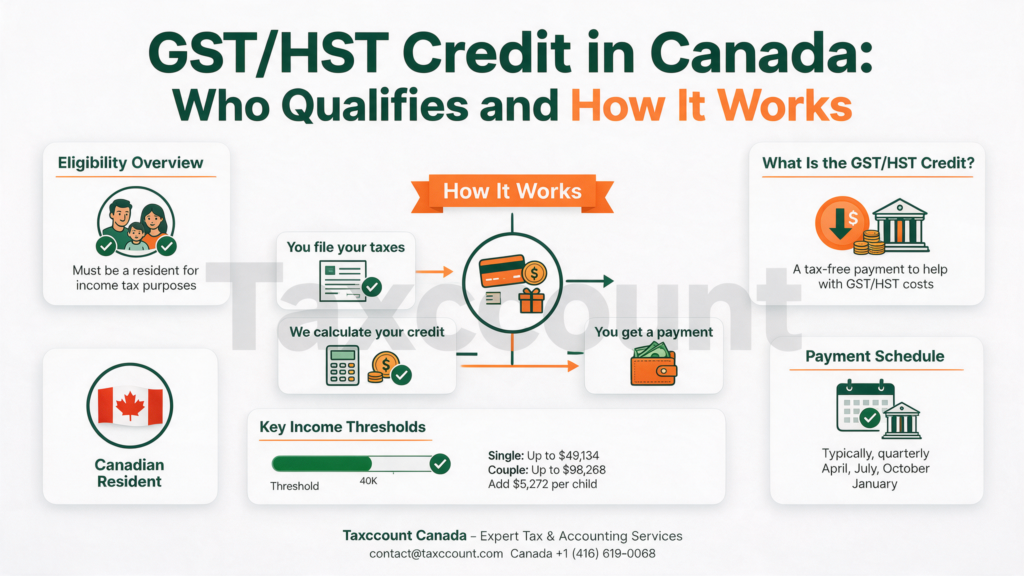
What Is the GST/HST Credit?
The Goods and Services Tax/Harmonized Sales Tax (GST/HST) credit is designed to reduce the impact of sales taxes on individuals and families with lower or modest incomes. It is paid out quarterly by CRA based on your family situation and income.
File My Return to Get the GST/HST Credit
☎️ Get HelpWho Is Eligible?
To receive the GST/HST Credit, you must:
- Be a Canadian resident for income tax purposes
- Be 19 years of age or older, OR
- Be younger than 19 if you have a spouse or common-law partner, or if you are a parent living with your child
- File a tax return, even if you have no income
You do not need to apply separately – CRA automatically determines your eligibility when you file your return.
How Much Is the Credit?
The amount depends on your family situation and your adjusted family net income. CRA calculates the credit based on:
- A base amount for yourself
- An additional amount if you have a spouse or common-law partner
- An additional amount per dependent child under age 19
As income rises above certain thresholds, the credit is gradually reduced. You can find the current amounts on the CRA website.
Is the GST/HST Credit Taxable?
No. The GST/HST Credit is completely tax-free. It is not included in your income and does not affect your other benefits, credits, or tax bracket.
When Are Payments Made?
The GST/HST Credit is paid quarterly:
- January
- April
- July
- October
Payments are made on the fifth of these months. If the payment is less than $50 per quarter, you may receive a lump sum payment instead.
CRA bases the July payment (which starts a new benefit year) on your prior year’s tax return.
How to Apply
You do not need to fill out a special form. Simply file your annual income tax return. CRA will automatically assess your eligibility and begin payments if you qualify.
For new residents to Canada, you should file Form RC151 (GST/HST Credit Application for Individuals Who Become Residents of Canada) to apply before filing your first full return.
How Your Tax Return Affects the Credit
The GST/HST Credit is recalculated each July when CRA processes prior-year returns. If you do not file your return, you may lose access to the benefit.
Even if your income is very low or zero, you must file to receive this credit. Low-income individuals who do not file miss out on hundreds of dollars in payments they are entitled to.
Related Provincial Credits
Several provinces combine their own sales tax credits with the federal GST/HST Credit and deliver them together:
- Ontario: Ontario Sales Tax Credit (combined with the Trillium Benefit)
- British Columbia: B.C. Climate Action Tax Credit
- New Brunswick, Nova Scotia, and others may have similar provincial credits
These additional amounts appear on the same payment you receive from CRA, increasing your total quarterly benefit.
Table of Summary
| GST/HST Credit Topic | Key Information |
|---|---|
| What Is the GST/HST Credit? | A tax-free quarterly payment designed to help lower-income Canadians offset GST/HST paid on everyday purchases |
| Who Is Eligible? | Canadian residents who meet the age and family-status requirements and file an income tax return |
| Age Requirement | Generally 19 or older, with exceptions for younger individuals who have a spouse/common-law partner or are parents living with their child |
| Income | The amount is based on adjusted family net income and family situation |
| Taxable? | No. The GST/HST Credit is tax-free and is not included in taxable income |
| Payment Frequency | Payments are generally made quarterly in January, April, July, and October |
| How to Apply | Most individuals do not need to apply separately; CRA automatically assesses eligibility when a tax return is filed |
| Tax Return Requirement | You generally need to file a tax return every year, even with little or no income, to receive the credit |
| New Residents | New residents may need to complete Form RC151 before filing their first full tax return |
| Provincial Credits | Some provinces provide additional sales tax or related credits that may be paid with the federal benefit |
| Direct Deposit | Eligible payments can be deposited directly into your bank account if CRA direct deposit is set up |
Frequently Asked Questions
What happens if I receive a large GST/HST Credit payment?
CRA occasionally pays out missed amounts in a lump sum if they discover you were eligible in prior years or if prior returns are filed late.
I am a student with no income. Can I still get the credit?
Yes. If you are 19 or older and a Canadian resident, you qualify to apply by filing a return. Even with no income, you should file to access this and other benefits.
Can the GST/HST Credit be deposited directly to my bank account?
Yes. If you are registered for direct deposit with CRA, the credit will be deposited automatically.
Conclusion
The GST/HST Credit is a straightforward but valuable benefit for lower-income Canadians. It is tax-free, automatically calculated when you file your return, and paid quarterly throughout the year.
The only thing you need to do to receive it is file your tax return every year. Make sure you do, even if you have little or no income.
Need Help With tax return filing services?
Taxccount provides tax and accounting services across Canada and can help individuals understand their tax filing requirements, prepare their returns, and identify applicable tax benefits and credits.
Whether you need help with tax filing or have questions about your GST/HST credit eligibility, our team can help you understand your options.
Book a free consultation with Taxccount Canada today.
Check My Eligibility for Government Benefits
☎️ Get HelpThis is general information only and not professional advice. Consult a professional before acting.
 Written and fact-checked by Udit Gupta
 Written and fact-checked by
 Ex Big4, Ernst & Young, Deloitte | International & Cross-Border Tax Specialist | CPA Canada In Depth Tax Training | Licensed Chartered Accountant from ICAI & MIA
Udit Gupta has over 15 years of experience helping corporations & business owners with corporate structuring, corporate tax filing, bookkeeping, payroll, GST/HST, cross-border tax and CRA representation. Big 4 trained at Ernst & Young and Deloitte, and qualified as a Chartered Accountant in India and Malaysia, he founded accounting firm in 2014 to serve entrepreneurs, startups and non-resident business owners across Canada. View Full Member Bio.
Indian Institute of Chartered Accountant Member No. (521458) | Malaysian Institute of Accountants Membership number (CA 44667) | Ex Big4,Ex Ernst & Young (EY), Ex-Deloitte | CPA Canada In-Depth Tax Training 19 Dec 2023, 12 Jul 2022, 5 Jul 2023
Editorial policy. Every article is researched against primary sources — the Income Tax Act, CRA publications and CPA Canada.