Canada Child Benefit (CCB): How It Works and How Much You Get

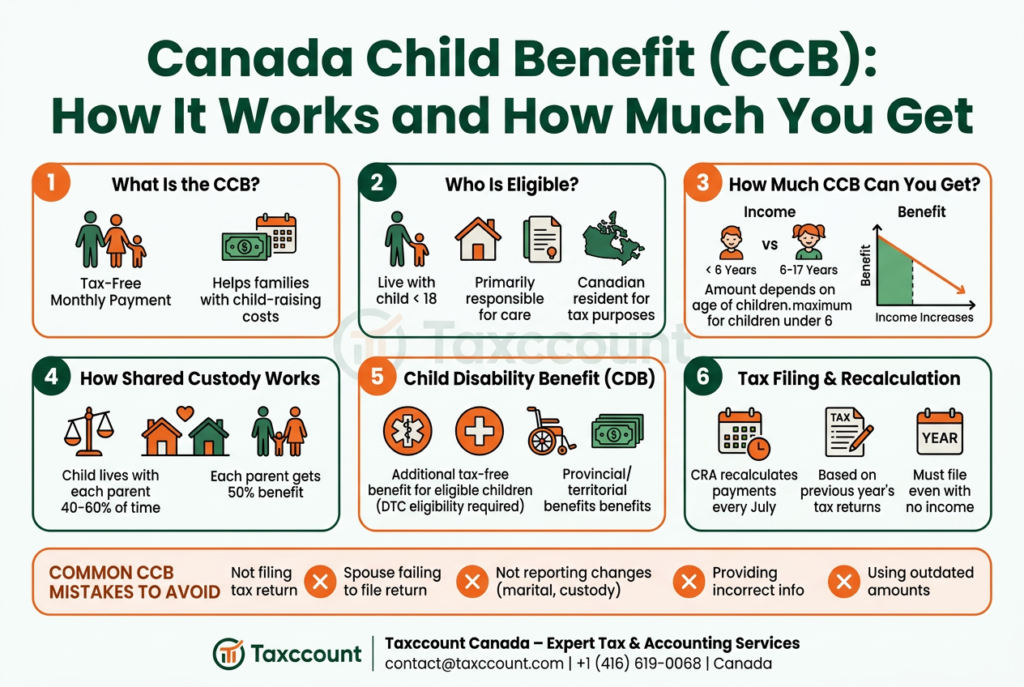
The Canada Child Benefit (CCB) is a tax-free monthly payment designed to help eligible families with the cost of raising children under age 18.
The amount a family receives depends mainly on the number and ages of eligible children and the family’s adjusted family net income (AFNI). As family income increases, CCB payments are gradually reduced.
Understanding the CCB is also an important part of annual tax filing because CRA uses information from your income tax return to determine your benefit entitlement.
What Is the Canada Child Benefit?
The Canada Child Benefit is administered by the Canada Revenue Agency (CRA) and provides monthly financial assistance to eligible families with children under 18.
CCB payments are tax-free. Unlike employment or investment income, you generally do not report your CCB payments as taxable income on your Canadian tax return.
Eligible families may also receive other benefits, including the Child Disability Benefit and certain provincial or territorial benefits.
Get CCB Tax Help
☎️ Get HelpWho Is Eligible for the CCB?
Generally, to qualify for the CCB, you must:
- Live with a child who is under 18
- Be primarily responsible for the child’s care and upbringing
- Be a resident of Canada for tax purposes
- Meet the applicable citizenship or immigration status requirements
Canadian citizens, permanent residents, protected persons and certain temporary residents may qualify if they meet the applicable conditions.
How Does Shared Custody Affect the CCB?
Special rules apply when parents share custody of a child.
CRA generally considers an arrangement to be shared custody when the child lives with each parent approximately 40% to 60% of the time.
In a qualifying shared-custody arrangement, each parent generally receives 50% of the CCB they would have received if the child lived with them full-time. Each parent’s benefit is calculated separately based on their circumstances and adjusted family net income.
How Much CCB Can You Receive?
There is no single CCB payment amount for every family.
The amount you may receive depends primarily on:
- Your adjusted family net income
- Number of eligible children
- Age of each child
- Custody arrangements
Children under age 6 generally qualify for a higher maximum benefit than children aged 6 to 17.
CCB amounts and income thresholds are indexed over time, so families should check the current CRA amounts for the applicable benefit period.
How Is the CCB Calculated?
CRA generally starts with the maximum benefit available for your eligible children and then reduces the benefit based on adjusted family net income.
Adjusted family net income generally considers the net income of you and your spouse or common-law partner, with certain adjustments.
As family income increases, the CCB is gradually reduced using the applicable reduction rates.
When Does CRA Recalculate Your CCB?
CRA generally recalculates CCB payments every July using information from the previous year’s income tax returns.
For example, CCB payments from July 2026 through June 2027 are generally calculated using adjusted family net income from the family’s 2025 tax returns.
This is why timely tax filing is important even when you have little or no taxable income.
Is the Canada Child Benefit Taxable?
No. The Canada Child Benefit is tax-free.
You generally do not include CCB payments as taxable income on your Canadian income tax return.
However, you still need to file your tax return because CRA uses your tax information to determine your eligibility and calculate future CCB payments.
Using professional tax return filing services can help ensure the income information CRA uses for your benefits is reported correctly.
How Do You Apply for the CCB?
There are several ways to apply for the Canada Child Benefit.
When Registering a Birth
In participating provinces and territories, you may be able to apply for child benefits when registering your newborn’s birth.
Through CRA My Account
Eligible individuals can apply using the child benefits section of CRA My Account.
By Mail
You can complete Form RC66, Canada Child Benefits Application, and submit it to CRA.
Newcomers and certain other applicants may also need to provide additional status and income information.
Do Both Spouses Need to File Tax Returns?
If you have a spouse or common-law partner, both individuals generally need to file an income tax and benefit return every year for CCB purposes.
This can apply even when one spouse had no income.
Failing to complete your tax filing can result in CCB and related benefit payments being interrupted.
An accountant for taxes or experienced tax accountants can help families ensure their annual returns are filed correctly and on time.
When Are CCB Payments Made?
CCB payments are generally issued monthly, usually around the 20th of the month.
If you have registered for CRA direct deposit, the payment can be deposited directly into your bank account.
Payment dates can change when the regular date falls on a weekend or applicable holiday.
What Changes Should You Report to CRA?
Certain changes in your personal circumstances should be reported to CRA because they may affect your eligibility or CCB amount.
These can include:
- Marriage or separation
- Change in address
- Change in child custody
- A child starting or stopping living with you
- Changes affecting Canadian residency
- Death of a spouse or common-law partner
Keeping your CRA information current can help prevent incorrect payments and potential repayment issues.
What Is the Child Disability Benefit?
The Child Disability Benefit (CDB) is an additional tax-free benefit for eligible families caring for a child who qualifies for the Disability Tax Credit.
When the applicable requirements are satisfied, CRA generally calculates the CDB as part of the family’s child benefit entitlement.
The maximum benefit and income thresholds can change, so current CRA figures should be checked for the applicable benefit period.
Provincial and Territorial Child Benefits
Families may also qualify for provincial or territorial child and family benefits depending on where they live.
Some of these programs are administered by CRA together with the Canada Child Benefit. Eligibility and payment amounts vary by province or territory.
Why Tax Filing Matters for Your CCB
Your income tax return does more than calculate how much income tax you owe.
CRA also uses information from your return to calculate various income-tested benefits, including the CCB.
Even if you have no income, filing your return may still be necessary to continue receiving benefits. If you search for tax filing near me, tax accountant near me, or income tax preparation near me because your CCB has stopped, one of the first things to check is whether all required family tax returns have been filed.
Professional tax and accounting services can also help correct previous returns or address CRA requests when inaccurate information has affected your benefits.
Common CCB Mistakes to Avoid
Common mistakes include:
- Not filing a tax return because you had no income
- A spouse or common-law partner failing to file
- Not reporting a change in marital status
- Failing to update a custody arrangement
- Providing incorrect residency information
- Assuming CCB payments are taxable
- Using outdated benefit amounts or income thresholds
Accurate and timely tax filing can help prevent delayed, reduced or interrupted CCB payments.
Table of Summary
| Section | Easy Information |
|---|---|
| 1. Topic | The article explains how the Canada Child Benefit (CCB) works, including eligibility, payment calculations, shared custody, applications and annual tax filing requirements. |
| 2. What Is the CCB? | The Canada Child Benefit is a tax-free monthly payment administered by CRA to help eligible families with the cost of raising children under age 18. |
| 3. Who Is Eligible? | Generally, you must live with a child under 18, be primarily responsible for their care, be a Canadian resident for tax purposes, and meet the applicable citizenship or immigration requirements. |
| 4. How Is the CCB Calculated? | CCB payments depend mainly on adjusted family net income (AFNI), the number and ages of eligible children, and custody arrangements. Benefits generally decrease as family income increases. |
| 5. Shared Custody | CRA generally considers 40%–60% parenting time to be shared custody. In a qualifying arrangement, each parent generally receives 50% of the CCB amount they would otherwise receive, calculated using their own circumstances. |
| 6. Annual CCB Recalculation | CRA generally recalculates CCB every July using the previous year’s tax returns. For example, July 2026–June 2027 benefits are generally based on information from 2025 returns. |
| 7. Is CCB Taxable? | No. CCB payments are tax-free and generally are not included as taxable income. However, annual tax returns still need to be filed so CRA can calculate benefit eligibility. |
| 8. How to Apply | Families may apply when registering a newborn’s birth, through CRA My Account, or by submitting Form RC66 – Canada Child Benefits Application. Additional documents may be required in some situations. |
| 9. Other Benefits & CRA Updates | Eligible families may also receive the Child Disability Benefit (CDB) and certain provincial or territorial benefits. Changes to marital status, custody, address or residency should be reported to CRA. |
| 10. Key Takeaway | Both spouses or common-law partners generally need to file annual tax returns, even if one has no income. Accurate and timely filing helps prevent CCB payments from being delayed, reduced or interrupted. |
Frequently Asked Questions
Is the Canada Child Benefit taxable?
No. CCB payments are tax-free and generally do not need to be included as taxable income on your Canadian tax return.
How much CCB can I receive?
The amount depends primarily on your adjusted family net income, the number and ages of your eligible children and your custody arrangements.
Does my income affect my CCB?
Yes. As adjusted family net income increases, CCB payments are generally reduced according to the applicable calculation.
Do I need to file taxes to receive CCB?
Yes. You generally need to file an income tax and benefit return each year. Your spouse or common-law partner generally needs to file as well, even if they had no income.
What happens to CCB with shared custody?
For a qualifying shared-custody arrangement, each parent generally receives 50% of the amount they would otherwise receive if the child lived with them full-time.
When does CRA recalculate CCB?
CRA generally recalculates CCB every July using income information from the previous tax year.
Can newcomers to Canada receive CCB?
Yes, newcomers may qualify if they meet the residency, immigration status and other eligibility requirements. Additional documentation may be required.
Need Help With CCB and Tax Filing?
Taxccount Canada provides tax and accounting services and tax return filing services for individuals and families across Canada.
Our tax accountants can help with personal tax filing, review family-related credits and benefits, correct tax return issues and assist with CRA matters that may affect your Canada Child Benefit.
Contact Taxccount Canada for professional assistance with your Canadian tax return and family benefits.
Maximize Your CCB
☎️ Get HelpThis is general information only and not professional advice. Consult a professional before acting.
 Written and fact-checked by Udit Gupta
 Written and fact-checked by
 Ex Big4, Ernst & Young, Deloitte | International & Cross-Border Tax Specialist | CPA Canada In Depth Tax Training | Licensed Chartered Accountant from ICAI & MIA
Udit Gupta has over 15 years of experience helping corporations & business owners with corporate structuring, corporate tax filing, bookkeeping, payroll, GST/HST, cross-border tax and CRA representation. Big 4 trained at Ernst & Young and Deloitte, and qualified as a Chartered Accountant in India and Malaysia, he founded accounting firm in 2014 to serve entrepreneurs, startups and non-resident business owners across Canada. View Full Member Bio.
Indian Institute of Chartered Accountant Member No. (521458) | Malaysian Institute of Accountants Membership number (CA 44667) | Ex Big4,Ex Ernst & Young (EY), Ex-Deloitte | CPA Canada In-Depth Tax Training 19 Dec 2023, 12 Jul 2022, 5 Jul 2023
Editorial policy. Every article is researched against primary sources — the Income Tax Act, CRA publications and CPA Canada.