Moving Expenses Tax Deduction in Canada: What You Can and Cannot Claim

Moving to a new city or province for a job or school is a big deal. It costs money — truck rentals, storage, hotel stays, and more. The good news is that in Canada, you may be able to deduct many of those costs on your tax return.
The Canada Revenue Agency (CRA) allows eligible Canadians to deduct moving expenses from certain types of income. This can lower how much tax you owe. But not every move qualifies, and not every expense is deductible.
This guide explains who qualifies, what you can deduct, and how to claim it properly.
Who Can Claim Moving Expenses in Canada?
You can claim moving expenses if you moved to:
- Start a new job
- Start a new business
- Attend full-time post-secondary school (college or university)
You must have moved at least 40 kilometres closer to your new workplace or school. This is measured by the shortest normal route, not a straight line on a map.
For example, if your old home was 50 km from your new job and your new home is 5 km from your new job, you moved 45 km closer. That qualifies.
If you moved but your distance increased or stayed the same, you do not qualify.
Book a free consultation with Taxccount today
☎️ Get HelpWhat Counts as an Eligible Move?
The move must be within Canada. International moves generally do not qualify for this deduction unless you are a Canadian who was working abroad and returned to Canada.
Both the old and new homes must be in Canada. The key test is whether your new home is at least 40 km closer to your new workplace or school than your old home was.
Moving Expenses You Can Deduct
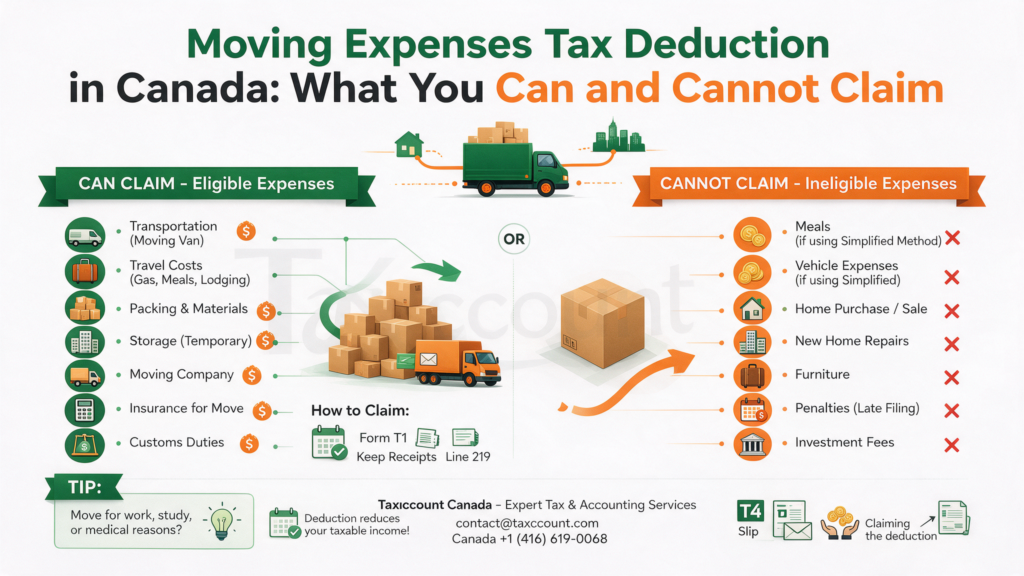
The CRA allows the following moving expenses:
1. Transportation and storage costs
This includes renting a moving truck, hiring movers, and storing your belongings while you settle in.
2. Travel costs
This includes gas, meals, and accommodations for you and your family during the move. The CRA uses a flat rate for meals instead of actual receipts — this is the simplified method.
3. Temporary living costs
If you need to stay in a hotel or rent a temporary place before your new home is ready, you can claim up to 15 days of temporary accommodation.
4. Costs to maintain your old home
If your old home was vacant after you moved and you were trying to sell it, you can claim up to $5,000 in costs such as mortgage interest, property taxes, and utilities — as long as your old home was not being rented out.
5. Lease cancellation fees
If you had to break your lease to move, you can deduct that cost.
6. Costs to sell your old home
This includes real estate commissions, legal fees, and advertising costs when you sold your old home.
7. Costs to buy your new home
Legal fees and land transfer taxes you paid to buy a new home at your new location are deductible.
8. Changing your address
Costs to update your address on your driver’s licence, vehicle registration, and other official documents are deductible.
9. Utility hook-up and disconnection
Fees to connect or disconnect utilities like gas, electricity, and water can be claimed.
Moving Expenses You Cannot Deduct
Not everything related to your move qualifies. Here is what you cannot deduct:
- Mail forwarding costs (beyond a small amount)
- Home improvements or repairs made before selling your old home
- Losses on the sale of your old home
- Any expenses that your employer already reimbursed you for
- Moving costs for items that do not come with you (like selling furniture)
- Travel costs for house-hunting trips before you moved
- Mortgage penalties for breaking your old mortgage
If your employer paid for part of your move, you can only deduct what you paid yourself.
How Much Can You Deduct?
You can only deduct moving expenses from the income you earn at your new location. If you are an employee, you can deduct expenses from your employment income at your new job. If you are a student, you can deduct expenses from scholarships, bursaries, or research grants you received.
You cannot use moving expenses to create or increase a loss. If your deduction is more than your eligible income for the year, you can carry the unused portion forward to the next year and claim it then.
For example:
- You moved and paid $8,000 in moving expenses
- You earned $5,000 at your new job that year
- You can deduct $5,000 this year and carry forward $3,000 to next year
How to Claim Moving Expenses on Your Tax Return
To claim moving expenses, you need to complete Form T1-M, Moving Expenses Deduction. This form asks for:
- Your old and new addresses
- The distance of the move
- A breakdown of all moving costs
You attach this form to your personal tax return (T1). You do not need to send your receipts to the CRA, but you must keep them in case you are asked to provide proof later. Keep all receipts for at least six years.
You report the deduction on Line 21900 of your tax return.
Special Rules for Students
Full-time students can claim moving expenses even if they do not have a job. The deduction is limited to the amount of scholarship, bursary, fellowship, or research grant income they received in the year.
Part-time students do not qualify unless they were attending school and were working at the same time.
Students cannot claim moving expenses against their student loans — only against the taxable portions of their bursary or scholarship income.
Table of Summary
| Moving Expenses Topic | Key Information |
|---|---|
| Who Can Claim | Individuals who move to start a new job, business, or attend full-time post-secondary school |
| 40-Kilometre Rule | The new home must generally be at least 40 km closer to the new workplace or school |
| Eligible Transportation Costs | Moving truck rentals, movers, and storage costs may be deductible |
| Travel Costs | Gas, meals, and accommodation during the move may qualify |
| Temporary Accommodation | Up to 15 days of temporary living expenses may be deductible |
| Old Home Costs | Certain mortgage interest, property taxes, and utilities may qualify when the old home is vacant and listed for sale |
| Selling Old Home | Real estate commissions, legal fees, and advertising costs may be deductible |
| Buying New Home | Certain legal fees and land transfer taxes may qualify |
| Lease Cancellation | Costs to cancel a lease because of the move may be deductible |
| Utility Costs | Eligible utility connection and disconnection charges may be claimed |
| Address Changes | Certain costs to update a driver’s licence, vehicle registration, and official documents may qualify |
| Non-Deductible Costs | Home improvements, mortgage penalties, house-hunting trips, and employer-reimbursed expenses generally cannot be claimed |
| Income Limitation | Moving expenses can generally only be deducted against eligible income earned at the new location |
| Unused Expenses | Eligible expenses not deductible in the current year may generally be carried forward |
| How to Claim | Complete Form T1-M and claim the deduction on Line 21900 of the tax return |
| Supporting Records | Keep receipts and other documentation in case CRA requests proof |
Frequently Asked Questions
Do I need receipts to claim moving expenses?
Yes. While you do not mail receipts to the CRA with your return, you must keep them in case the CRA asks to verify your claim. Keep receipts for at least six years.
Can I claim moving expenses if my employer paid for the move?
You can only claim the portion you paid yourself. If your employer reimbursed you for all costs, you cannot deduct anything. If they only covered part of the costs, you can deduct the part you paid.
What if I moved but have not started my new job yet?
You must start working or attending school at the new location. If you moved but never started the new job, you would not qualify for the deduction.
Can I claim moving expenses for a move within the same city?
No. The 40-kilometre rule applies. If your new home is not at least 40 km closer to your new workplace or school compared to your old home, you do not qualify.
Conclusion
Moving for work or school in Canada can be expensive. Fortunately, the CRA allows you to deduct many of those costs to reduce your tax bill. The key rules are simple: your new home must be at least 40 km closer to your new workplace or school, and you can only deduct expenses against income earned at the new location.
Keep all your receipts, fill out Form T1-M, and claim the deduction on Line 21900 of your return. If your expenses exceed your income this year, carry the rest forward to next year.
Need Help With tax return filing services?
Taxccount provides tax and accounting services across Canada for employees, self-employed individuals, students, and businesses. Our team can help you review your moving expenses, organize supporting documents, and prepare your tax return according to applicable CRA rules.
If you need help with tax filing after a qualifying move, contact Taxccount Canada to discuss your situation.
Get started with Taxccount now
☎️ Get HelpThis is general information only and not professional advice. Consult a professional before acting.
 Written and fact-checked by Udit Gupta
 Written and fact-checked by
 Ex Big4, Ernst & Young, Deloitte | International & Cross-Border Tax Specialist | CPA Canada In Depth Tax Training | Licensed Chartered Accountant from ICAI & MIA
Udit Gupta has over 15 years of experience helping corporations & business owners with corporate structuring, corporate tax filing, bookkeeping, payroll, GST/HST, cross-border tax and CRA representation. Big 4 trained at Ernst & Young and Deloitte, and qualified as a Chartered Accountant in India and Malaysia, he founded accounting firm in 2014 to serve entrepreneurs, startups and non-resident business owners across Canada. View Full Member Bio.
Indian Institute of Chartered Accountant Member No. (521458) | Malaysian Institute of Accountants Membership number (CA 44667) | Ex Big4,Ex Ernst & Young (EY), Ex-Deloitte | CPA Canada In-Depth Tax Training 19 Dec 2023, 12 Jul 2022, 5 Jul 2023
Editorial policy. Every article is researched against primary sources — the Income Tax Act, CRA publications and CPA Canada.