How to Claim Vehicle Expenses as a Tax Deduction in Canada
If you use a vehicle for work, you may be able to deduct a portion of your vehicle costs from your income taxes. Whether you are an employee, a self-employed individual, or a business owner, understanding the rules will help you claim what you are entitled to while staying on the right side of CRA.
This guide explains exactly how vehicle expense deductions work in Canada.
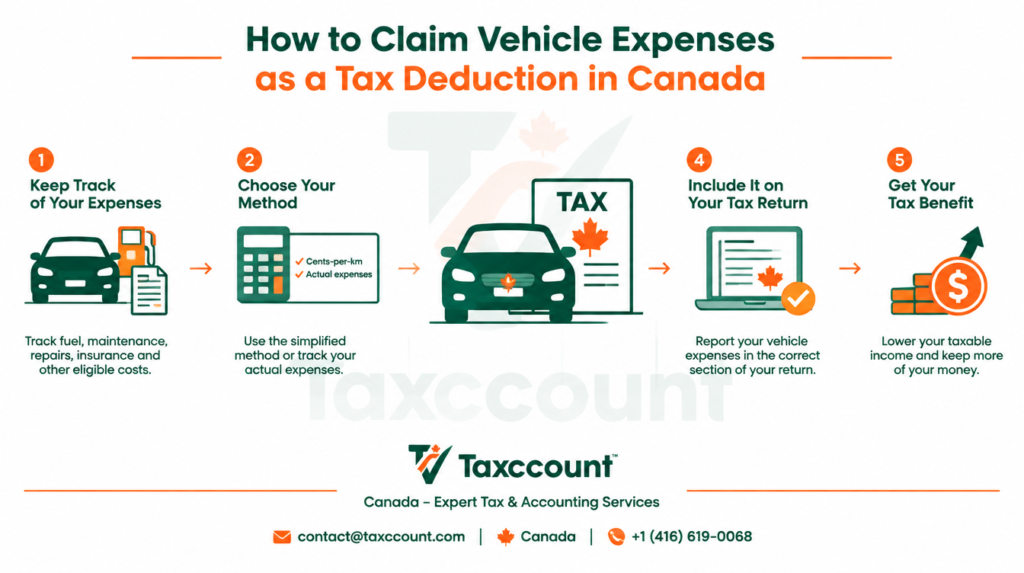
Who Can Claim Vehicle Expenses?
Vehicle expenses can be claimed by:
Self-Employed Individuals and Business Owners
If you use your vehicle to earn business income, you can claim the business-use portion of your vehicle costs as a deduction on Form T2125.
Employees
If your employer requires you to use your own vehicle to do your job (not just for commuting), and this is confirmed by your employer on Form T2200, you can claim vehicle expenses on Form T777.
Neither group can deduct the personal-use portion of their vehicle costs, nor can they deduct commuting to and from their regular place of work.
Calculate My Vehicle Expense Deduction
☎️ Get HelpWhat Vehicle Expenses Are Deductible?
Deductible vehicle costs include:
- Gasoline and oil
- Maintenance and repairs
- Insurance premiums
- License and registration fees
- Parking fees (for business destinations)
- Capital Cost Allowance (for purchased vehicles)
- Lease payments (for leased vehicles, subject to limits)
- Loan interest (for purchased vehicles, subject to limits)
What is NOT deductible:
- Fines and traffic tickets
- Vehicle wash that is personal in nature
- Commuting to work
How to Calculate the Business-Use Percentage
You can only deduct the business-use portion of your vehicle costs. The formula is:
Business-use percentage = Business kilometres driven / Total kilometres driven
For example, if you drove 20,000 km in a year and 14,000 km were for business, your business-use percentage is 70%. You can then claim 70% of all eligible vehicle expenses.
If your vehicle is used 100% for business (you have a separate personal vehicle), you can claim 100% of the costs.
The Importance of a Mileage Log
CRA may ask you to provide a logbook to support your vehicle claim. A proper logbook should include:
- Date of each trip
- Starting and ending location
- Purpose of the trip (business reason)
- Kilometres driven for the trip
You must also record the odometer reading at the start and end of the year to calculate total kilometres driven.
If you are audited and cannot provide a logbook, CRA may disallow your vehicle expenses. Apps and spreadsheets can make tracking easier.
Capital Cost Allowance on Vehicles
If you own your vehicle, you can claim Capital Cost Allowance (CCA), which is the tax version of depreciation. Passenger vehicles are placed in Class 10 or Class 10.1 depending on their cost.
Important limits:
- For Class 10.1 vehicles (those above a cost threshold set by CRA), there is a cap on the original cost used to calculate CCA. This means you cannot claim CCA on the full value of an expensive vehicle.
- The threshold is updated periodically. Check CRA for the current limit.
- When you sell the vehicle, you may have recapture (added to income) or a terminal loss (deductible).
Leased vs. Owned Vehicles
For Leased Vehicles:
Lease payments are deductible but subject to a monthly limit set by CRA. The deductible amount is the lesser of your actual lease payment and a formula-based limit.
For Purchased Vehicles:
You can claim interest on a loan used to buy the vehicle, but the interest deduction is limited. The limit is also updated periodically.
How to Claim Vehicle Expenses on Your Return
For self-employed individuals:
- Report on Form T2125 (Statement of Business Activities)
- Include total vehicle expenses and the business-use percentage
For employees:
- Complete Form T777 (Statement of Employment Expenses)
- Attach your T2200 from your employer
- Claim on Line 22900 of your T1 return
Common Mistakes to Avoid
1. Not keeping a logbook
This is the most common audit trigger for vehicle claims.
2. Claiming 100% business use for a single vehicle
Unless you have a separate personal vehicle and can prove 100% business use, CRA will challenge this.
3. Including commuting kilometres as business km
Driving from your home to your regular office is personal use, not business use.
4. Forgetting to adjust for a vehicle used part of the year
If you bought or sold the vehicle during the year, your calculations need to reflect that.
Table of Summary
| Vehicle Expense Topic | Key Information |
|---|---|
| Who Can Claim | Self-employed individuals, business owners, and employees who meet the applicable requirements |
| Deductible Expenses | Gas, oil, insurance, repairs, maintenance, parking, lease payments, loan interest, and CCA may be deductible |
| Business-Use Percentage | Calculate using business kilometres divided by total kilometres driven |
| Mileage Log | Keep the date, destination, purpose of each trip, kilometres driven, and beginning/end odometer readings |
| Personal Use | Personal driving and regular commuting are generally not deductible |
| Employee Claims | Employees generally need to be required to use their own vehicle for work and have the required employer certification |
| Self-Employed Claims | Business-use vehicle expenses are generally claimed through Form T2125 |
| Capital Cost Allowance | CCA may be claimed on an eligible owned vehicle, subject to applicable vehicle classes and limits |
| Leased Vehicles | Lease payments may be deductible, subject to applicable CRA limits |
| Loan Interest | Interest on money borrowed to purchase a vehicle may be deductible, subject to applicable limits |
| Records & Receipts | Keep receipts and supporting records for vehicle expenses in case CRA requests documentation |
Frequently Asked Questions
Can I claim an electric vehicle?
Yes. EVs follow the same rules. However, costs like charging may be partially claimable based on business-use percentage.
Can I claim Uber or taxi costs as a business expense?
Yes, if you are self-employed and use them for business purposes, taxi and rideshare costs can be deducted as travel expenses.
Do I need receipts for every gas purchase?
Yes. Keep all receipts related to your vehicle. CRA may ask for documentation during an audit.
Conclusion
Vehicle expenses are one of the most common tax deductions in Canada for self-employed individuals and employees who use their own vehicle for work. The key to a successful claim is accurate recordkeeping, especially your mileage log.
If you are unsure how to calculate or claim your vehicle expenses, a tax professional can ensure you maximize your deduction without running into problems with CRA.
Need Help With vehicle expense deductions?
If you need help with tax filing or vehicle expense deductions, contact Taxccount Canada to discuss your situation.
Get Help Filing Business Expenses
☎️ Get HelpThis is general information only and not professional advice. Consult a professional before acting.
 Written and fact-checked by Udit Gupta
 Written and fact-checked by
 Ex Big4, Ernst & Young, Deloitte | International & Cross-Border Tax Specialist | CPA Canada In Depth Tax Training | Licensed Chartered Accountant from ICAI & MIA
Udit Gupta has over 15 years of experience helping corporations & business owners with corporate structuring, corporate tax filing, bookkeeping, payroll, GST/HST, cross-border tax and CRA representation. Big 4 trained at Ernst & Young and Deloitte, and qualified as a Chartered Accountant in India and Malaysia, he founded accounting firm in 2014 to serve entrepreneurs, startups and non-resident business owners across Canada. View Full Member Bio.
Indian Institute of Chartered Accountant Member No. (521458) | Malaysian Institute of Accountants Membership number (CA 44667) | Ex Big4,Ex Ernst & Young (EY), Ex-Deloitte | CPA Canada In-Depth Tax Training 19 Dec 2023, 12 Jul 2022, 5 Jul 2023
Editorial policy. Every article is researched against primary sources — the Income Tax Act, CRA publications and CPA Canada.