Employment Insurance (EI) in Canada: How It Works and How It Is Taxed

If you lose your job through no fault of your own, or need time away from work for reasons like illness, pregnancy, or caring for a family member, Employment Insurance (EI) may provide temporary financial support. But many Canadians do not fully understand how EI works – especially the tax side.
This guide explains EI in plain language, including what you qualify for and how it affects your taxes.
What Is Employment Insurance (EI)?
EI is a federal program that provides temporary income replacement to eligible workers who lose their jobs or need to take time off for certain life events. It is funded through premiums paid by employees and employers.
Understand My EI Tax Obligations
☎️ Get HelpWho Pays into EI?
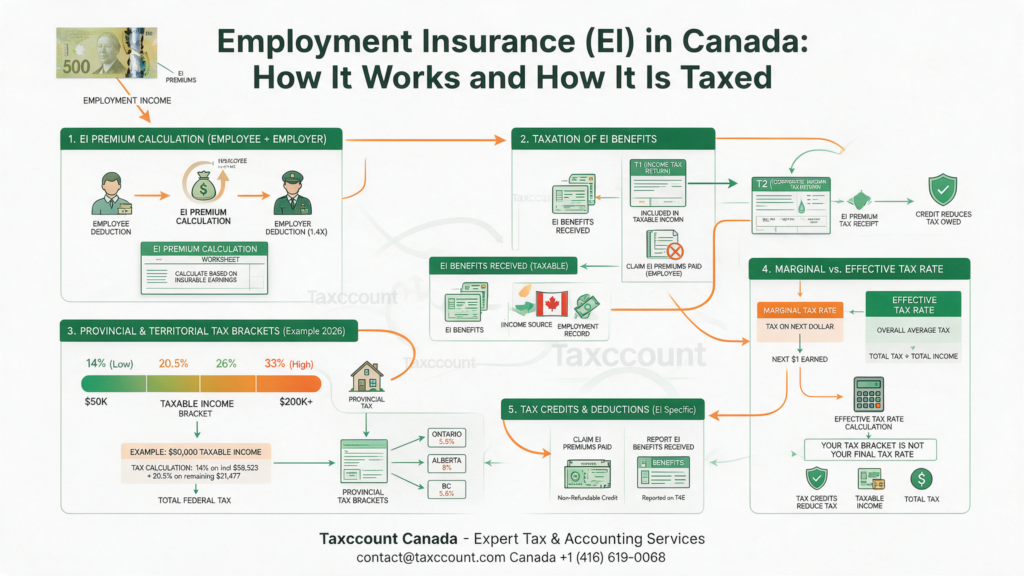
Most employees in Canada automatically have EI premiums deducted from their pay. The premium rate is set by the federal government each year and applies to all insurable earnings up to the Maximum Insurable Earnings (MIE) threshold.
Employers also pay EI premiums, at a rate of 1.4 times the employee premium for each worker.
Self-employed individuals do not contribute to EI by default (see below for the optional self-employed program).
Who Can Claim EI Benefits?
To receive EI benefits, you generally must:
- Have paid EI premiums
- Have worked a minimum number of insurable hours in the last 52 weeks (or since your last EI claim). The number of required hours varies depending on your local unemployment rate.
- Have lost your job through no fault of your own (for regular benefits)
- Be available and looking for work (for regular benefits)
For special benefits (illness, maternity, parental, compassionate care, family caregiver), different eligibility criteria apply.
Types of EI Benefits
1. Regular Benefits
For workers who lose their jobs through layoff or shortage of work.
2. Sickness Benefits
For workers unable to work due to illness, injury, or quarantine. You can receive benefits for up to 26 weeks.
3. Maternity Benefits
For birth mothers who need time off around the birth of a child. Up to 15 weeks.
4. Parental Benefits
For parents who need time to care for a newborn or newly adopted child. Can be taken by either parent.
- Standard: up to 40 weeks, paid at 55% of earnings
- Extended: up to 69 weeks, paid at 33% of earnings
5. Compassionate Care Benefits
For workers who need to care for a critically ill or injured family member. Up to 26 weeks.
6. Family Caregiver Benefit
For workers caring for a critically ill adult or child family member.
How Much Can You Receive?
Regular and some special EI benefits are paid at 55% of your average insurable weekly earnings, up to a weekly maximum. The maximum weekly benefit amount is set each year and changes with the MIE.
Low-income earners with dependants may receive a family supplement that increases the replacement rate above 55%.
How Long Can You Receive EI?
The duration of regular EI benefits ranges from 14 to 45 weeks, depending on:
- How many insurable hours you have accumulated
- Your regional unemployment rate
The higher the unemployment rate in your region and the more hours you worked, the longer your benefit period.
How Is EI Taxed?
EI benefits are fully taxable. They are included in your income for the year and taxed at your marginal rate.
Service Canada will issue you a T4E slip each year showing the total EI benefits you received and any tax already withheld at source.
You must report EI benefits on your T1 return. If not enough tax was withheld, you may owe additional tax when you file.
EI Repayment (Clawback)
If your net income exceeds a certain threshold (set by the government each year), you may have to repay a portion of your EI benefits. This is called the EI clawback.
The repayment is 30% of the lesser of:
- Your net income above the threshold, or
- The total regular EI benefits you received
The clawback does not apply to special benefits (maternity, parental, sickness, etc.).
EI for Self-Employed Individuals
Self-employed people are not automatically enrolled in EI. However, you can voluntarily register for the EI self-employed program through Service Canada. This makes you eligible for:
- Sickness benefits
- Maternity and parental benefits
- Compassionate care benefits
- Family caregiver benefits
You must register at least one year before making a claim. You pay the employee premium rate (not the employer rate) on your self-employment income up to the MIE.
Table of Summary
| EI Tax Topic | How It Works |
|---|---|
| Are EI benefits taxable? | Yes. EI benefits are included in your taxable income. |
| Tax withheld at source | Service Canada generally withholds income tax before paying EI benefits. |
| T4E slip | You receive a T4E showing EI benefits paid and tax deducted. |
| Tax return reporting | EI benefits must be reported on your T1 income tax return. |
| Additional tax owing | You may owe additional tax if the amount withheld was not enough. |
| EI clawback | Higher-income recipients may have to repay part of certain EI benefits, subject to the applicable rules. |
Frequently Asked Questions
Is severance pay considered income that affects EI eligibility?
Yes. Severance pay may be allocated to a waiting or delaying period before your EI begins. The rules depend on how the severance is structured.
Can I work while receiving EI?
Yes, but your benefits will be reduced by a percentage of what you earn. The rules vary depending on the type of claim, so check with Service Canada.
Do I get a T4E even if I repaid EI?
Yes. Your T4E will show the gross benefits paid and any repayment separately. The repayment may be deductible on your return.
Conclusion
Employment Insurance provides an important safety net for Canadian workers. Understanding the rules around how much you can receive, how long it lasts, and how it is taxed helps you plan your finances if you ever need to rely on it.
If you received EI during the year and are unsure how to report it on your tax return, a tax professional can help ensure you get it right and avoid any surprises.
Need Help With Canadian tax and accounting services?
Taxccount Canada provides tax and accounting services for individuals, employees, self-employed professionals, and businesses across Canada. If you need help preparing your return, you can contact Taxccount for professional assistance.
File My Return with EI Income
☎️ Get HelpThis is general information only and not professional advice. Consult a professional before acting.
 Written and fact-checked by Udit Gupta
 Written and fact-checked by
 Ex Big4, Ernst & Young, Deloitte | International & Cross-Border Tax Specialist | CPA Canada In Depth Tax Training | Licensed Chartered Accountant from ICAI & MIA
Udit Gupta has over 15 years of experience helping corporations & business owners with corporate structuring, corporate tax filing, bookkeeping, payroll, GST/HST, cross-border tax and CRA representation. Big 4 trained at Ernst & Young and Deloitte, and qualified as a Chartered Accountant in India and Malaysia, he founded accounting firm in 2014 to serve entrepreneurs, startups and non-resident business owners across Canada. View Full Member Bio.
Indian Institute of Chartered Accountant Member No. (521458) | Malaysian Institute of Accountants Membership number (CA 44667) | Ex Big4,Ex Ernst & Young (EY), Ex-Deloitte | CPA Canada In-Depth Tax Training 19 Dec 2023, 12 Jul 2022, 5 Jul 2023
Editorial policy. Every article is researched against primary sources — the Income Tax Act, CRA publications and CPA Canada.