How Long Do You Need to Keep Tax Records in Canada?
Knowing how long to keep your tax records in Canada is important. Keep them too briefly and you may not be able to support your claims if the CRA reviews your return. Keep them too long and you drown in paperwork unnecessarily. This guide explains the CRA rules so you know exactly what to keep and for how long.
Taxccount Canada helps individuals looking for tax filing near me understand CRA compliance and proper record keeping.
The General Rule: Six Years
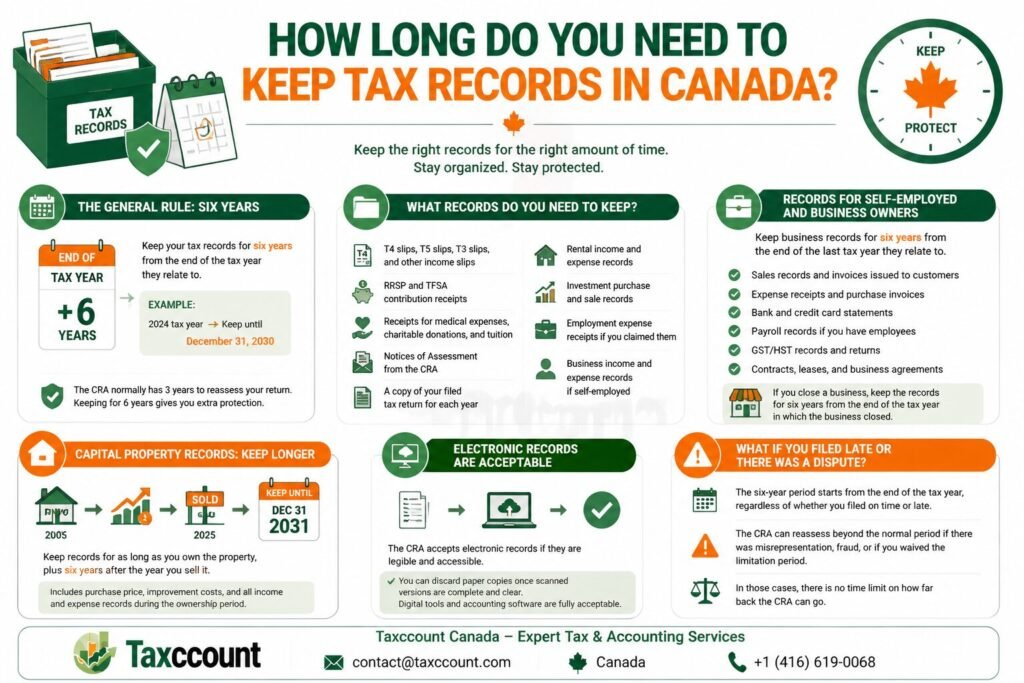
In Canada, the general rule is that you must keep your tax records for six years from the end of the tax year they relate to. For example, if you are filing your 2024 tax return, you must keep all supporting records until at least December 31, 2030. This is because the CRA normally has three years from the date of assessment to reassess your return, but keeping records for six years provides an extra safety margin and meets the legal requirement.
For proper compliance, many Canadians use tax return filing services.
Organize Tax Records Now
☎️ Get HelpWhat Records Do You Need to Keep?
The CRA requires you to keep any document that supports the income, deductions, and credits you claimed on your return. This includes:
- T4 slips, T5 slips, T3 slips, and other income slips
- RRSP and TFSA contribution receipts
- Receipts for medical expenses, charitable donations, and tuition
- Notices of Assessment from the CRA
- A copy of your filed tax return for each year
- Rental income and expense records
- Investment purchase and sale records
- Employment expense receipts if you claimed them
- Business income and expense records if self-employed
Tax and accounting services can help you organize and maintain these records.
Records for Self-Employed and Business Owners
If you operate a business, the CRA requires you to keep your business records for six years from the end of the last tax year they relate to. This includes:
- Sales records and invoices issued to customers
- Expense receipts and purchase invoices
- Bank and credit card statements
- Payroll records if you have employees
- GST/HST records and returns
- Contracts, leases, and business agreements
If you close a business, you must still keep the records for six years from the end of the tax year in which the business closed.
A small business accountant can help ensure all records are properly maintained.
Capital Property Records: Keep Longer
For capital property such as real estate, stocks, or other investments, the rules are different. You must keep records for as long as you own the property, plus six years after the year you sell it.
This means if you bought a rental property in 2005 and sold it in 2025, you would need to keep all related records until at least December 31, 2031. This includes the original purchase price, improvement costs, and all rental income and expense records throughout the ownership period.
A tax accountant near me can help track adjusted cost base accurately.
Electronic Records Are Acceptable
The CRA accepts electronic records, as long as they are legible and accessible. If you scan your paper receipts and store them digitally, you can discard the paper copies once the scanned versions are verified to be complete and clear. Digital record-keeping tools and accounting software are fully acceptable.
Many tax accountants recommend digital storage for easier access.
What If You Filed Late or There Was a Dispute?
The six-year retention period starts from the end of the tax year, regardless of whether you filed your return on time or late. However, the CRA can reassess a return beyond the normal period if there was misrepresentation, fraud, or if you waived the limitation period. In those cases, there is no time limit on how far back the CRA can go.
An accountant for taxes can help during CRA reviews or disputes.
Add this FAQ section at the end of the blog. One correction: if an income tax return was filed late, CRA requires records to be kept for six years from the filing date; records affecting the sale or winding-up of property may need to be kept indefinitely. (Canada)
Table of Summary
Here is the blog information in 6 easy rows for quick understanding:
| Section | Easy Information |
|---|---|
| 1. Topic | The blog explains how long Canadians need to keep tax records and what documents to retain. |
| 2. General Rule | Keep tax records for six years from the end of the tax year they relate to. Provides extra margin beyond CRA reassessment period. |
| 3. Records to Keep | Includes income slips (T4, T5, T3), RRSP/TFSA receipts, medical/tuition/charity receipts, Notices of Assessment, filed returns, rental/investment records, employment/business receipts. |
| 4. Self-Employed & Businesses | Keep sales invoices, expense receipts, bank/credit card statements, payroll, GST/HST records, contracts, leases for six years from end of last tax year. If business closes, continue to retain for six years after closure. |
| 5. Capital Property | For assets like real estate, stocks, or rental properties, keep records for as long as you own them plus six years after sale, including purchase price, improvements, income, and expenses. |
| 6. Electronic Records & Exceptions | Digital copies are acceptable if legible. CRA can reassess beyond six years for fraud, misrepresentation, or waived limitations. |
Frequently Asked Questions
How Can Tax Filing Near Me Services Help With Record Retention?
Tax filing near me services can help you identify which slips, receipts, bank statements, and CRA notices should be retained to support your tax return.
How Long Should I Keep Records for Tax Return Filing Services?
Keep tax records for at least six years from the end of the last tax year they relate to. If you filed late, keep them for six years from the filing date.
Can Tax and Accounting Services Organize Electronic Tax Records?
Yes. Tax and accounting services can help organize scanned receipts, cloud files, bookkeeping records, and digital backups in a CRA-ready format.
What Records Should a Small Business Accountant Keep for CRA?
A small business accountant should retain sales invoices, expense receipts, payroll records, GST/HST filings, contracts, and bank or credit card statements.
When Should I Contact a Tax Accountant Near Me About Old Records?
Contact a tax accountant near me before destroying records if you sold property, have a CRA review or dispute, filed late, or are unsure about your retention period.
Can an Accountant for Taxes Help With Capital Property Records?
Yes. An accountant for taxes can help track purchase costs, improvements, adjusted cost base, and sale records for real estate, shares, and investments.
Keep Records Compliantly
☎️ Get HelpThis is general information only and not professional advice. Consult a professional before acting.
 Written and fact-checked by Udit Gupta
 Written and fact-checked by
 Ex Big4, Ernst & Young, Deloitte | International & Cross-Border Tax Specialist | CPA Canada In Depth Tax Training | Licensed Chartered Accountant from ICAI & MIA
Udit Gupta has over 15 years of experience helping corporations & business owners with corporate structuring, corporate tax filing, bookkeeping, payroll, GST/HST, cross-border tax and CRA representation. Big 4 trained at Ernst & Young and Deloitte, and qualified as a Chartered Accountant in India and Malaysia, he founded accounting firm in 2014 to serve entrepreneurs, startups and non-resident business owners across Canada. View Full Member Bio.
Indian Institute of Chartered Accountant Member No. (521458) | Malaysian Institute of Accountants Membership number (CA 44667) | Ex Big4,Ex Ernst & Young (EY), Ex-Deloitte | CPA Canada In-Depth Tax Training 19 Dec 2023, 12 Jul 2022, 5 Jul 2023
Editorial policy. Every article is researched against primary sources — the Income Tax Act, CRA publications and CPA Canada.