How to File Taxes as a Self-Employed Person in Canada
Being self-employed in Canada gives you flexibility, but it also means you are responsible for reporting your income, claiming eligible business expenses, paying income tax and CPP contributions, and managing GST/HST obligations where applicable.
Whether you are a freelancer, consultant, contractor, tradesperson or gig worker, understanding the tax filing process can help you stay compliant with the Canada Revenue Agency (CRA) and avoid unexpected tax bills.
What Does Self-Employed Mean for Tax Purposes?
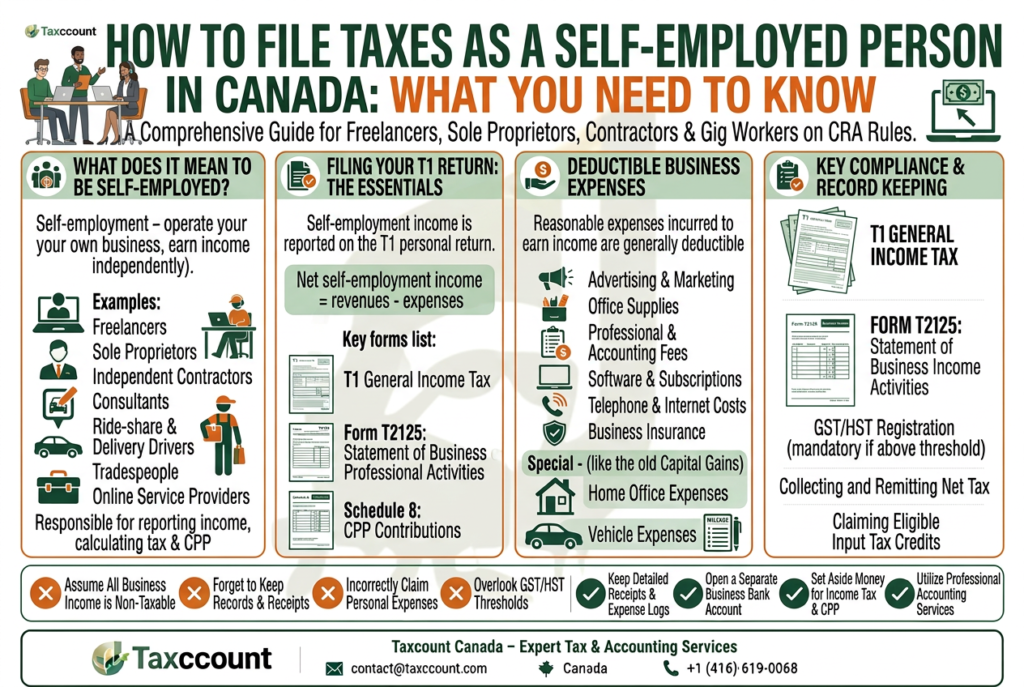
You may be considered self-employed when you operate your own business or earn income independently rather than as an employee.
This can include:
- Sole proprietors
- Freelancers
- Independent contractors
- Consultants
- Ride-share and delivery drivers
- Tradespeople
- Online service providers
Self-employed individuals generally do not have an employer automatically deducting income tax and CPP contributions from their business earnings. This means you are responsible for calculating and paying these amounts yourself.
Get Self-Employed Tax Help
☎️ Get HelpDo Self-Employed People Have to File a Tax Return?
Self-employment income generally needs to be reported on your T1 personal income tax return.
Your business income and eligible expenses are used to calculate your net self-employment income. CPP contributions may also apply when your net self-employment income exceeds the applicable threshold.
Even if your business is small or operates part-time, you should maintain complete records of your income and expenses for tax filing purposes.
What Forms Do Self-Employed People Need?
Common forms and schedules can include:
- T1 General Income Tax and Benefit Return
- Form T2125, Statement of Business or Professional Activities
- Schedule 8 for CPP contributions, where applicable
Form T2125 is generally used to report your business or professional revenue and eligible expenses.
Professional tax return filing services can help ensure your business income and deductions are reported in the appropriate sections of your return.
What Self-Employment Income Do You Report?
You should generally report all income earned from your business or professional activities, regardless of how customers pay you.
This can include:
- Cash
- Cheques
- E-transfers
- Credit card payments
- Online payment platforms
- Direct deposits
- Barter transactions
Your net business income is generally your business revenue minus eligible business expenses.
Keeping accurate records throughout the year makes tax filing easier and helps support the amounts reported to the CRA.
What Business Expenses Can You Deduct?
Reasonable expenses incurred to earn business income may generally be deductible, subject to CRA rules.
Common expenses can include:
- Advertising and marketing
- Business insurance
- Office supplies
- Professional and accounting fees
- Software and subscriptions
- Business-use vehicle expenses
- Telephone and internet costs
- Home office expenses
- Certain travel expenses
- Eligible meals and entertainment expenses
If an expense has both personal and business use, only the reasonable business portion should generally be claimed.
A small business accountant can help identify eligible expenses and avoid incorrectly claiming personal costs.
Can You Deduct Vehicle Expenses?
If you use a vehicle to earn business income, you may be able to deduct the business-use portion of eligible expenses.
These can include fuel, insurance, repairs and maintenance, licence and registration costs, certain financing or leasing costs, and capital cost allowance where applicable.
Maintaining an accurate mileage log can help establish the percentage of vehicle use related to your business.
Can You Claim Home Office Expenses?
Self-employed individuals who meet the applicable business-use-of-home requirements may be able to deduct a reasonable portion of household expenses.
Eligible costs can include:
- Rent
- Mortgage interest
- Utilities
- Property taxes
- Home insurance
- Maintenance expenses
- Certain internet costs
The deduction generally depends on how much of your home is used for business and, where relevant, how often the workspace is used for personal purposes.
CPP Contributions for Self-Employed Individuals
Self-employed individuals generally pay both the employee and employer portions of CPP contributions on eligible self-employment earnings.
CPP contributions are calculated based on applicable annual contribution limits and net self-employment income.
Because CPP can significantly affect the amount payable at tax time, it is important to consider these contributions when setting aside money throughout the year.
Do Self-Employed People Need to Register for GST/HST?
GST/HST registration is generally required once you cease to qualify as a small supplier. The general small-supplier threshold is $30,000 of worldwide taxable supplies, with specific rules determining when registration becomes mandatory.
Once registered, you may generally need to:
- Charge the applicable GST/HST
- Include required information on invoices
- File GST/HST returns
- Remit net tax
- Claim eligible input tax credits
Businesses may also choose to register voluntarily before registration becomes mandatory.
Tax and accounting services can be useful when determining your registration date, filing frequency and applicable GST/HST obligations.
How Do Self-Employed People Pay Taxes?
Unlike most employees, self-employed individuals generally do not have income tax automatically deducted from each payment.
It can therefore be helpful to regularly set aside funds for:
- Income tax
- CPP contributions
- GST/HST collected, where applicable
The CRA may also require you to make tax instalments if you meet the applicable conditions.
Planning ahead can help prevent an unexpected balance when your tax return is filed.
What Is the Self-Employed Tax Filing Deadline?
Self-employed individuals and their spouses or common-law partners generally have until June 15 to file their personal income tax returns.
If June 15 falls on a Saturday, Sunday or CRA-recognized public holiday, the return is generally considered on time if received or postmarked by the next business day.
However, any balance owing is generally due by April 30. This means the payment deadline can occur before the self-employed filing deadline.
Tips to Stay Organized for Tax Filing
Good bookkeeping can make income tax preparation easier and help support your deductions.
- Keep receipts and invoices.
- Separate business and personal transactions.
- Consider using a separate business bank account.
- Record income and expenses regularly.
- Maintain a mileage log for business vehicle use.
- Track GST/HST separately where applicable.
- Keep documents supporting your deductions.
- Set aside money for income tax and CPP.
- Review your accounts before the tax filing deadline.
Table of Summary
| Section | Easy Information |
|---|---|
| 1. Topic | The article explains how to file taxes as a self-employed person in Canada, including income reporting, business expenses, CPP and GST/HST obligations. |
| 2. Who Is Self-Employed? | Self-employed individuals can include sole proprietors, freelancers, contractors, consultants, gig workers, tradespeople and online service providers. |
| 3. Reporting Self-Employment Income | Self-employment income is generally reported on your T1 personal income tax return. You should report income received through cash, cheques, e-transfers, cards, online platforms and other payment methods. |
| 4. Forms Required | Common forms include the T1 General, Form T2125 for business or professional activities, and Schedule 8 for CPP contributions where applicable. |
| 5. Business Expenses | Eligible expenses may include advertising, insurance, office supplies, professional fees, software, vehicle costs, phone and internet, home office, travel, and eligible meals and entertainment. |
| 6. Vehicle & Home Office Expenses | You may deduct the reasonable business-use portion of eligible vehicle and home office expenses. Records such as mileage logs and household expense documents should be maintained. |
| 7. CPP Contributions | Self-employed individuals generally pay both the employee and employer portions of CPP contributions on eligible self-employment earnings, subject to annual rules and limits. |
| 8. GST/HST Registration | Registration is generally required when you cease to qualify as a small supplier. The general threshold is $30,000 of worldwide taxable supplies, subject to the applicable threshold rules. |
| 9. Tax Filing & Payment Deadline | Self-employed individuals and their spouses or common-law partners generally have until June 15 to file, while any balance owing is generally due by April 30. |
| 10. Key Takeaway | Keep accurate income records, receipts, invoices, mileage logs and GST/HST records, separate business and personal transactions, and regularly set aside funds for income tax and CPP. |
Frequently Asked Questions
What form do self-employed people use to file taxes in Canada?
Self-employed individuals generally file a T1 income tax return and use Form T2125 to report their business or professional income and expenses.
Do I have to report cash and e-transfer income?
Yes. Business income generally needs to be reported regardless of whether you receive payment by cash, cheque, e-transfer, credit card or another method.
What expenses can self-employed people deduct?
Eligible expenses may include advertising, professional fees, office costs, software, vehicle expenses, home office costs, telephone and internet expenses and certain travel costs.
Do self-employed people pay CPP in Canada?
Generally, yes. Self-employed individuals are responsible for both the employee and employer portions of CPP contributions on eligible self-employment earnings.
When do I need to register for GST/HST?
Registration generally becomes mandatory when you exceed the applicable $30,000 small-supplier threshold. The exact registration date depends on how the threshold is exceeded.
What is the tax deadline for self-employed people in Canada?
Self-employed individuals generally have until June 15 to file their T1 return, while any balance owing is generally due by April 30.
Can a self-employed person claim home office expenses?
Yes. If the applicable requirements are met, a self-employed individual may deduct a reasonable business-use portion of eligible home expenses.
Need Help Filing Self-Employed Taxes?
Taxccount Canada provides tax and accounting services, business tax filing and tax return filing services for freelancers, contractors, sole proprietors and other self-employed Canadians.
Our tax accountants can help organize business income and expenses, prepare Form T2125, calculate CPP contributions, review GST/HST obligations and complete your Canadian tax filing.
If you are looking for a small business accountant or an accountant for taxes, contact Taxccount Canada for professional self-employed tax and accounting assistance.
File Your Taxes Right
☎️ Get HelpThis is general information only and not professional advice. Consult a professional before acting.
 Written and fact-checked by Udit Gupta
 Written and fact-checked by
 Ex Big4, Ernst & Young, Deloitte | International & Cross-Border Tax Specialist | CPA Canada In Depth Tax Training | Licensed Chartered Accountant from ICAI & MIA
Udit Gupta has over 15 years of experience helping corporations & business owners with corporate structuring, corporate tax filing, bookkeeping, payroll, GST/HST, cross-border tax and CRA representation. Big 4 trained at Ernst & Young and Deloitte, and qualified as a Chartered Accountant in India and Malaysia, he founded accounting firm in 2014 to serve entrepreneurs, startups and non-resident business owners across Canada. View Full Member Bio.
Indian Institute of Chartered Accountant Member No. (521458) | Malaysian Institute of Accountants Membership number (CA 44667) | Ex Big4,Ex Ernst & Young (EY), Ex-Deloitte | CPA Canada In-Depth Tax Training 19 Dec 2023, 12 Jul 2022, 5 Jul 2023
Editorial policy. Every article is researched against primary sources — the Income Tax Act, CRA publications and CPA Canada.