What Is the Disability Tax Credit in Canada and How Do You Qualify?

The Disability Tax Credit (DTC) is a Canadian tax credit designed to reduce the income tax burden for eligible individuals with severe and prolonged impairments. Eligibility is based primarily on how an impairment affects everyday functioning rather than simply on having a particular medical diagnosis.
Understanding the DTC eligibility requirements and application process can help individuals and supporting family members claim available tax benefits.
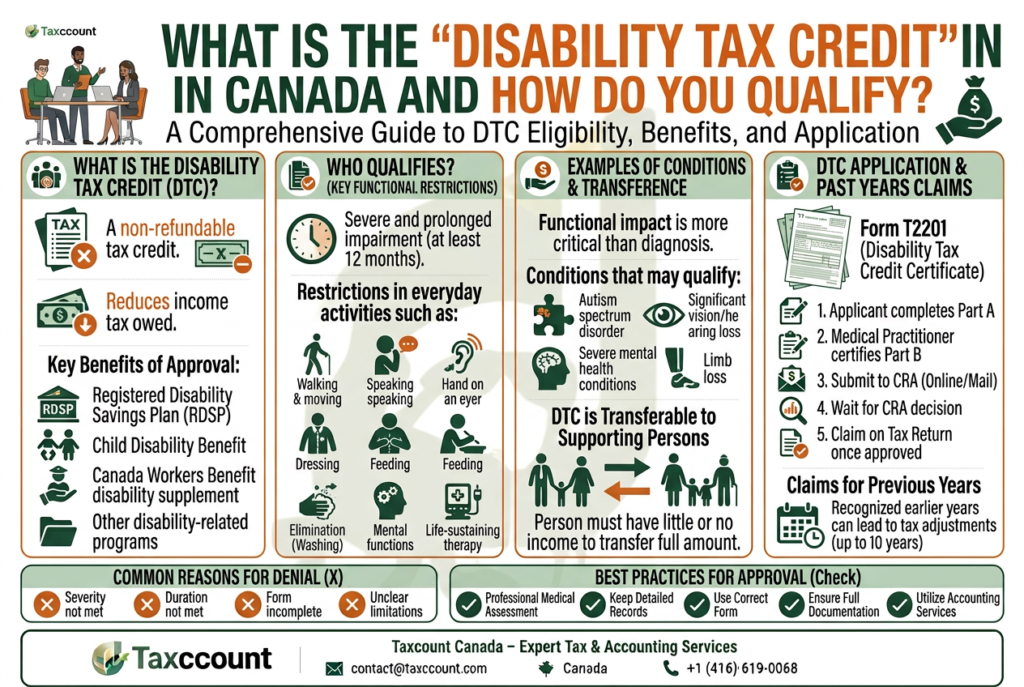
What Is the Disability Tax Credit?
The Disability Tax Credit is a non-refundable tax credit. It can reduce the income tax an eligible person owes but does not, by itself, create a refund when there is no tax payable.
Approval for the DTC can also provide access to other programs and benefits, depending on eligibility, including:
- Registered Disability Savings Plan (RDSP)
- Child Disability Benefit
- Canada Workers Benefit disability supplement
- Other disability-related tax measures
Get DTC Tax Help
☎️ Get HelpWho Can Qualify for the DTC?
Eligibility generally depends on having a severe and prolonged impairment in physical or mental functions.
The impairment generally needs to have lasted, or be expected to last, for a continuous period of at least 12 months.
The CRA considers restrictions involving areas such as:
- Walking
- Speaking
- Hearing
- Vision
- Dressing
- Feeding
- Eliminating
- Mental functions necessary for everyday life
- Life-sustaining therapy
Eligibility can also arise in certain situations involving significant limitations across multiple categories.
What Conditions Qualify for the Disability Tax Credit?
There is no simple list of medical conditions that automatically qualify for the DTC.
Instead, the CRA considers the effects of the impairment on the person’s ability to perform activities of daily living.
Conditions associated with successful applications may include:
- Autism spectrum disorder
- Significant vision impairment
- Significant hearing impairment
- Certain severe mental health conditions
- Cerebral palsy
- Spinal cord injuries
- Limb loss or amputation
- Certain learning disabilities
- Conditions requiring qualifying life-sustaining therapy
Having a diagnosis alone does not guarantee DTC approval. The nature, severity, duration and functional impact of the impairment are important.
How to Apply for the Disability Tax Credit
The application process generally involves Form T2201, Disability Tax Credit Certificate.
Step 1: Complete the Applicant’s Section
The individual with the impairment or their legal representative completes the applicable portion of Form T2201.
Step 2: Ask a Medical Practitioner to Certify the Impairment
An appropriate medical practitioner completes the relevant medical section and provides information about the impairment and its effects.
The type of practitioner permitted to certify the application can depend on the category of impairment.
Step 3: Submit the Application to the CRA
Form T2201 can be submitted to the CRA using an available submission method, including applicable online services or by mail.
Step 4: Wait for the CRA’s Decision
The CRA reviews the information and determines whether the individual meets the DTC eligibility requirements.
Additional information may sometimes be requested from the applicant or medical practitioner.
Step 5: Claim the Disability Amount
Once approved, the eligible disability amount can generally be claimed when completing the individual’s Canadian income tax return.
Professional tax return filing services can help ensure the available disability amount is correctly reported.
How Much Is the Disability Tax Credit Worth?
The value of the DTC can change from year to year because the disability amount is indexed.
The DTC is a non-refundable tax credit, so the actual tax savings depend on the applicable disability amount, tax rates and the individual’s circumstances.
Provincial or territorial disability-related amounts may also be available.
Rather than relying on an older fixed dollar amount, taxpayers should use the amount applicable to the tax year being filed.
Can the DTC Be Transferred to a Family Member?
In certain circumstances, an unused portion of the disability amount may be transferred to an eligible supporting person.
Depending on the relationship and applicable requirements, this could include a:
- Spouse or common-law partner
- Parent
- Grandparent
- Child
- Grandchild
- Brother or sister
- Other qualifying relative
This can be particularly useful where the person eligible for the DTC has little or no taxable income and cannot use the entire disability amount themselves.
Can You Claim the DTC for Previous Years?
In some cases, CRA approval can recognize eligibility beginning in an earlier year.
Where this happens, it may be possible to request adjustments to previous income tax returns for eligible years, subject to CRA rules and applicable reassessment periods.
This can potentially result in additional tax savings where the DTC was not previously claimed.
Tax and accounting services can be useful when reviewing prior-year returns after receiving DTC approval.
Why Are DTC Applications Denied?
Applications may be denied when the information provided does not demonstrate that the applicable DTC criteria have been satisfied.
Common issues can include:
- The impairment does not meet the required severity criteria
- The impairment does not meet the duration requirement
- The functional limitations are not adequately explained
- Required sections of Form T2201 are incomplete
- The medical certification does not support the applicable eligibility criteria
Providing clear and accurate information about the functional effects of the impairment is therefore important.
What Can You Do If Your DTC Application Is Denied?
A CRA denial does not necessarily end the process.
Depending on the circumstances, you may be able to provide additional medical information, request a review or use the applicable CRA objection process.
Before responding, carefully review the CRA’s decision letter to understand why eligibility was denied.
Table of Summary
| Section | Easy Information |
|---|---|
| 1. Topic | The article explains what the Disability Tax Credit (DTC) is in Canada, who may qualify, how to apply, and how the credit can affect tax filing. |
| 2. What Is the DTC? | The DTC is a non-refundable tax credit that can reduce income tax payable for eligible individuals with severe and prolonged impairments. |
| 3. Who Can Qualify? | Eligibility generally depends on a severe and prolonged impairment in physical or mental functions that has lasted, or is expected to last, for at least 12 continuous months. |
| 4. Activities Considered by CRA | The CRA considers limitations involving walking, speaking, hearing, vision, dressing, feeding, eliminating, mental functions for everyday life, and life-sustaining therapy. |
| 5. Medical Conditions | There is no automatic list of qualifying conditions. Approval depends mainly on the severity, duration, and functional impact of the impairment rather than the diagnosis alone. |
| 6. How to Apply | The application generally uses Form T2201, Disability Tax Credit Certificate. The applicant completes their section, an appropriate medical practitioner certifies the impairment, and the form is submitted to the CRA. |
| 7. Value of the Credit | The DTC amount is indexed and can change each year. The actual tax savings depend on the applicable disability amount, tax rates, and the individual’s tax situation. |
| 8. Transfer to Family Member | In certain cases, an unused portion of the disability amount may be transferred to an eligible supporting family member, such as a spouse, parent, child, sibling, or other qualifying relative. |
| 9. Previous-Year Claims | If CRA approval recognizes eligibility for earlier years, it may be possible to adjust prior-year tax returns and claim the DTC for eligible previous years, subject to CRA rules. |
| 10. If the Application Is Denied | A denial may result from insufficient evidence, incomplete forms, or failure to meet the severity or duration criteria. Depending on the situation, additional information, a review, or the CRA objection process may be available. |
Frequently Asked Questions
Is the Disability Tax Credit a monthly payment?
No. The DTC is a non-refundable tax credit used to reduce eligible income tax. Other disability-related government programs may provide separate payments.
Does having a disability automatically qualify you for the DTC?
No. Eligibility depends on the nature, severity, duration and functional effects of the impairment rather than diagnosis alone.
What form do I need to apply for the DTC?
Form T2201, Disability Tax Credit Certificate, is used to apply for DTC eligibility.
How long must an impairment last to qualify?
The impairment generally needs to have lasted, or be expected to last, for a continuous period of at least 12 months.
Can unused DTC be transferred to a spouse or family member?
In certain circumstances, the unused disability amount can be transferred to an eligible supporting spouse, common-law partner or other qualifying family member.
Can I claim the Disability Tax Credit for previous years?
Potentially. If the CRA approves eligibility for previous years, prior tax returns may be eligible for adjustment, subject to the applicable rules.
Can a child qualify for the Disability Tax Credit?
Yes. A child who meets the applicable DTC eligibility requirements may qualify. DTC eligibility can also be relevant to certain other disability-related benefits.
Need Help With Disability Tax Credit Filing?
Taxccount Canada provides tax and accounting services and tax return filing services for individuals and families dealing with disability-related tax matters.
Our tax accountants can help with reporting an approved Disability Tax Credit, reviewing eligible prior-year adjustments and determining whether an unused disability amount can be transferred to an eligible supporting person.
Need help with your Canadian tax filing after DTC approval? Contact Taxccount Canada for professional tax assistance.
Claim Your DTC Right
☎️ Get HelpThis is general information only and not professional advice. Consult a professional before acting.
 Written and fact-checked by Udit Gupta
 Written and fact-checked by
 Ex Big4, Ernst & Young, Deloitte | International & Cross-Border Tax Specialist | CPA Canada In Depth Tax Training | Licensed Chartered Accountant from ICAI & MIA
Udit Gupta has over 15 years of experience helping corporations & business owners with corporate structuring, corporate tax filing, bookkeeping, payroll, GST/HST, cross-border tax and CRA representation. Big 4 trained at Ernst & Young and Deloitte, and qualified as a Chartered Accountant in India and Malaysia, he founded accounting firm in 2014 to serve entrepreneurs, startups and non-resident business owners across Canada. View Full Member Bio.
Indian Institute of Chartered Accountant Member No. (521458) | Malaysian Institute of Accountants Membership number (CA 44667) | Ex Big4,Ex Ernst & Young (EY), Ex-Deloitte | CPA Canada In-Depth Tax Training 19 Dec 2023, 12 Jul 2022, 5 Jul 2023
Editorial policy. Every article is researched against primary sources — the Income Tax Act, CRA publications and CPA Canada.