How to Deduct Home Office Expenses in Canada
Working from home can create additional costs for employees and self-employed individuals. Depending on your situation, the Canada Revenue Agency (CRA) may allow you to deduct eligible home office expenses and reduce your taxable income.
Understanding which expenses qualify, how to calculate the business-use portion of your home, and how to report the deduction can help make your tax filing more accurate.
What Are Home Office Expenses?
Home office expenses are costs associated with using part of your home to earn employment or business income.
Eligible expenses can include a reasonable work-related portion of costs such as utilities, rent and certain maintenance expenses. The rules differ depending on whether you are an employee or self-employed.
Get Home Office Tax Help
☎️ Get HelpWho Can Claim Home Office Expenses?
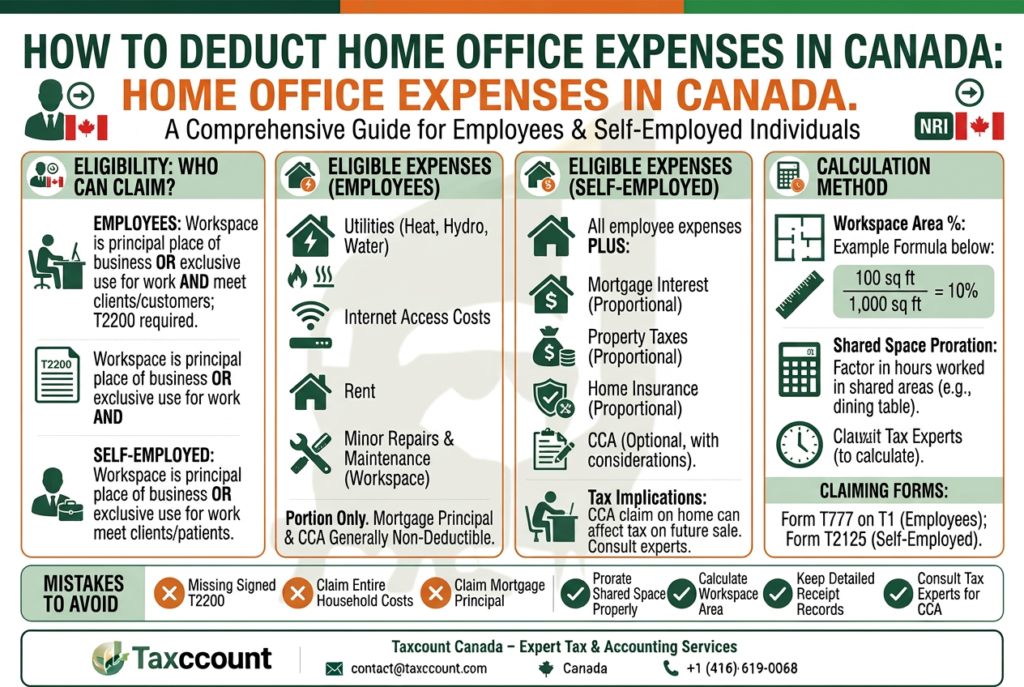
Employees may qualify to deduct home office expenses when they are required to work from home and satisfy the CRA’s applicable workspace requirements. A completed and signed Form T2200 from the employer may also be required.
Generally, the workspace must be where the employee principally performs employment duties or be used exclusively to earn employment income and regularly and continuously meet clients, customers or other people in the ordinary course of employment.
Self-employed individuals follow separate business-use-of-home rules. Generally, the workspace must be the individual’s principal place of business or used exclusively to earn business income and regularly and continuously meet clients, customers or patients.
Detailed Method vs. Temporary Flat Rate Method
Employees currently claiming home office expenses generally use the detailed method.
Under the detailed method, you calculate the actual eligible expenses associated with your workspace. This requires supporting records and, where required, a signed Form T2200 from your employer.
The temporary flat rate method was introduced for certain COVID-19 tax years and is no longer available for current claims.
This is an important distinction because taxpayers should not use the former flat-rate method when preparing a current-year tax return.
What Expenses Can Employees Deduct?
Depending on the employee’s circumstances, eligible home office expenses can include:
- Electricity
- Heat
- Water
- Certain utility costs
- Rent
- Minor repairs and maintenance related to the workspace
- Certain internet access costs
Only the employment-related portion of eligible expenses can generally be claimed.
Employees generally cannot deduct mortgage principal or capital cost allowance on their home as home office employment expenses. Other expenses, including property taxes and home insurance, depend on the employee’s circumstances and applicable employment-expense rules.
Professional tax return filing services can help determine which expenses qualify.
What Can Self-Employed Individuals Deduct?
Self-employed individuals may generally claim a broader range of reasonable business-use-of-home expenses.
Depending on the circumstances, these may include:
- Rent
- Mortgage interest
- Property taxes
- Home insurance
- Electricity and heating
- Water
- Maintenance and repairs
- Certain internet expenses
- Other eligible costs related to earning business income
Capital cost allowance may also be available in some circumstances, but claiming CCA on a home can have future tax implications, including potential considerations when the property is sold.
A small business accountant or taxation accountant can help determine whether claiming CCA is appropriate.
How to Calculate Your Home Office Deduction
If only part of your home is used for work, you generally need to determine a reasonable percentage of household expenses attributable to the workspace.
One common approach is:
Workspace area ÷ Total finished area of the home × 100
For example, suppose your office occupies 100 square feet of a 1,000-square-foot home.
100 ÷ 1,000 = 10%
If you have $2,000 of eligible shared expenses, the initial workspace portion would be:
$2,000 × 10% = $200
Additional adjustments may be required if the workspace is also used personally.
What If You Use the Room for Both Work and Personal Purposes?
If a room is used for both employment and personal purposes, you may need to further prorate the expenses based on the amount of time the space is used for work.
For example, a dedicated office used exclusively for employment can be different from a dining room used for work for several hours each day.
Your calculation should reasonably reflect the actual employment or business use of the space.
How to Claim Home Office Expenses on Your Tax Return
Employees generally calculate eligible employment expenses using Form T777, Statement of Employment Expenses. The resulting deduction is generally claimed on line 22900 of the T1 income tax return.
The employer generally completes Form T2200, Declaration of Conditions of Employment, where required. Employees should retain the form and supporting documentation with their tax records.
Self-employed individuals generally report business-use-of-home expenses through Form T2125, Statement of Business or Professional Activities.
Tax and accounting services can be useful where a taxpayer has several expense categories or uses the same property for personal and business purposes.
What Records Should You Keep?
Keep supporting documents for your home office deduction, including:
- Form T2200, where applicable
- Rent receipts
- Utility bills
- Internet bills
- Maintenance and repair invoices
- Home insurance records, where applicable
- Property tax records, where applicable
- Mortgage interest statements, where applicable
- Workspace measurements
- Records supporting the time the workspace was used for work
Good documentation can help support your deduction if the CRA reviews your tax return.
Common Home Office Expense Mistakes
Common mistakes include:
- Claiming the entire household expense instead of the work-related portion
- Claiming expenses that are not deductible for your type of employment
- Failing to obtain Form T2200 when required
- Claiming mortgage principal as an expense
- Incorrectly calculating the workspace percentage
- Ignoring personal use of a shared workspace
- Claiming the former temporary flat rate method for an ineligible year
- Failing to keep receipts and supporting records
Accurate records can make income tax preparation easier and reduce the risk of incorrect claims.
Table of Summary
| Section | Easy Information |
|---|---|
| 1. Topic | The article explains how to deduct home office expenses in Canada for employees and self-employed individuals, including eligible expenses, calculations and CRA reporting. |
| 2. Who Can Claim? | Employees and self-employed individuals may qualify if their workspace meets the applicable CRA requirements for earning employment or business income. |
| 3. Employees & Form T2200 | Employees may need a completed and signed Form T2200 from their employer to support their home office expense claim. |
| 4. Detailed Method | Employees currently claiming home office expenses generally use the detailed method. The temporary COVID-19 flat-rate method is no longer available for current claims. |
| 5. Employee Expenses | Eligible employee expenses may include a work-related portion of rent, electricity, heat, water, certain internet costs, and minor repairs and maintenance. |
| 6. Self-Employed Expenses | Self-employed individuals may generally claim a broader range of expenses, including rent, mortgage interest, property taxes, home insurance, utilities, maintenance and certain internet costs. |
| 7. Calculating the Deduction | A reasonable workspace percentage can generally be calculated using workspace area ÷ total finished home area × 100. Further adjustment may be needed for personal use. |
| 8. How to Report | Employees generally calculate expenses using Form T777 and claim the deduction on line 22900. Self-employed individuals generally report business-use-of-home expenses on Form T2125. |
| 9. Records to Keep | Keep Form T2200, rent receipts, utility and internet bills, repair invoices, workspace measurements, and other supporting documents for your claim. |
| 10. Key Takeaway | Claim only the eligible work-related portion of home expenses. Correct calculations and proper documentation can help support the deduction if the CRA reviews your return. |
Frequently Asked Questions
Can employees deduct home office expenses in Canada?
Yes, eligible employees may deduct certain home office expenses when they meet the applicable CRA requirements.
Do I need Form T2200 to claim home office expenses?
Employees using the detailed method generally need their employer to complete and sign Form T2200 where required under the employment-expense rules.
Can I deduct my mortgage payments?
Mortgage principal is not deductible as a home office expense. Different rules can apply to mortgage interest for self-employed individuals using part of their home for business.
Can I claim rent for a home office?
Eligible employees who rent their home may generally claim the reasonable employment-use portion of rent. Self-employed individuals may also be able to deduct the business-use portion.
Is the temporary flat rate method still available?
The temporary flat rate method was available for specified COVID-19 tax years and is not available for current home office expense claims.
Where do employees claim home office expenses?
Eligible employment expenses are generally calculated on Form T777 and claimed on line 22900 of the T1 income tax return.
Can self-employed people claim home office expenses?
Yes. Eligible self-employed individuals can generally claim reasonable business-use-of-home expenses through Form T2125, subject to applicable rules.
Need Help Claiming Home Office Expenses?
Taxccount Canada provides tax and accounting services and tax return filing services for employees, self-employed individuals and business owners.
Our tax accountants can help determine eligible home office expenses, calculate the appropriate work-related percentage and correctly report deductions on your Canadian income tax return.
Need help with your home office deduction or tax filing? Contact Taxccount Canada for professional Canadian tax assistance.
Claim Your Expenses Right
☎️ Get HelpThis is general information only and not professional advice. Consult a professional before acting.
 Written and fact-checked by Udit Gupta
 Written and fact-checked by
 Ex Big4, Ernst & Young, Deloitte | International & Cross-Border Tax Specialist | CPA Canada In Depth Tax Training | Licensed Chartered Accountant from ICAI & MIA
Udit Gupta has over 15 years of experience helping corporations & business owners with corporate structuring, corporate tax filing, bookkeeping, payroll, GST/HST, cross-border tax and CRA representation. Big 4 trained at Ernst & Young and Deloitte, and qualified as a Chartered Accountant in India and Malaysia, he founded accounting firm in 2014 to serve entrepreneurs, startups and non-resident business owners across Canada. View Full Member Bio.
Indian Institute of Chartered Accountant Member No. (521458) | Malaysian Institute of Accountants Membership number (CA 44667) | Ex Big4,Ex Ernst & Young (EY), Ex-Deloitte | CPA Canada In-Depth Tax Training 19 Dec 2023, 12 Jul 2022, 5 Jul 2023
Editorial policy. Every article is researched against primary sources — the Income Tax Act, CRA publications and CPA Canada.