First-Time Home Buyer Tax Credit in Canada

Buying your first home is a major milestone, and the Canadian government offers a few financial incentives to help make it more affordable. One of these is the First-Time Home Buyers’ Tax Credit (HBTC), which provides a welcome reduction in your federal tax bill in the year you purchase your home.
This article explains exactly what the HBTC is, how much it is worth, who qualifies, and how to claim it.
What Is the First-Time Home Buyers’ Tax Credit?
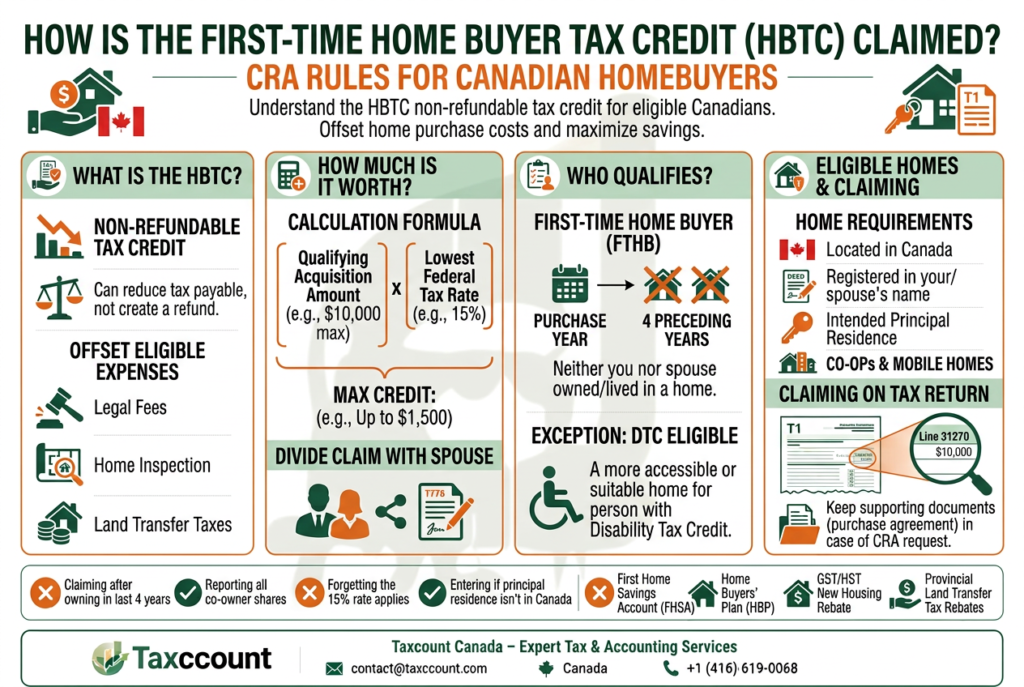
The First-Time Home Buyers’ Tax Credit (HBTC) is a non-refundable federal tax credit available to Canadians who purchase a qualifying home for the first time. It was introduced to help offset some of the costs associated with buying a home, such as legal fees, land transfer taxes, and home inspections.
Claim Your Homebuyer Tax Benefits
☎️ Get HelpHow Much Is the Credit Worth?
The HBTC is calculated by multiplying a fixed dollar amount by the lowest federal tax rate (15%). The federal government has increased this amount in recent years to provide more relief to first-time buyers.
Because the HBTC is non-refundable, it can reduce your federal income tax owing to zero — but it cannot generate a refund if the credit exceeds your tax. If you and your spouse or common-law partner are splitting the claim, the combined total cannot exceed the maximum allowed amount. Always check the CRA website for the current year’s HBTC amount.
Who Qualifies as a First-Time Home Buyer?
You are considered a first-time home buyer if neither you nor your spouse or common-law partner has owned and lived in another home in the calendar year of the purchase or in any of the four preceding calendar years.
There is an important exception: if you are eligible for the Disability Tax Credit (DTC), or you are buying a home for a related person who qualifies for the DTC, you may claim the HBTC even if you are not technically a first-time buyer.
What Types of Homes Are Eligible?
The home must be a qualifying home, which means:
- It must be located in Canada
- It must be registered in your name or your spouse/common-law partner’s name
- You must intend to use it as your principal place of residence within one year of purchase
Eligible home types include:
- Single-family homes
- Semi-detached homes
- Townhouses
- Mobile homes
- Condominium units
- Shares in a co-operative housing corporation (if they give you an equity interest)
How to Claim the First-Time Home Buyers’ Tax Credit
Claiming the HBTC is straightforward:
- On your T1 income tax return, enter the qualifying home acquisition amount on Line 31270
- The tax credit will be automatically calculated based on the applicable federal tax rate
- If you and your spouse are sharing the claim, each person claims their portion — but the total combined claim cannot exceed the maximum allowed amount
You do not need to submit documentation with your return, but you should keep your purchase agreement and related records in case the CRA requests them.
Other First-Time Buyer Benefits in Canada
Beyond the HBTC, first-time buyers in Canada may also benefit from:
- First Home Savings Account (FHSA) — A registered account that lets you save up to $40,000 tax-free toward your first home
- Home Buyers’ Plan (HBP) — Allows you to withdraw up to $35,000 from your RRSP tax-free to put toward your first home purchase
- GST/HST New Housing Rebate — May apply if you purchase a new construction home and the purchase price is below a certain threshold
- Provincial land transfer tax rebates — Several provinces, including Ontario, offer rebates for first-time buyers on land transfer tax
Buying Your First Home in Canada? Let Taxccount Help.
Taxccount supports first-time homebuyers, families, and self-employed Canadians in understanding the Home Buyers’ Tax Credit (HBTC) along with other tax credits and deductions they may be eligible for. Get professional guidance to make informed tax decisions and take full advantage of the available benefits when purchasing your first home. Book a free consultation today.
Table of Summary
| Section | Easy Information |
|---|---|
| 1. Topic | The article explains the First-Time Home Buyers’ Tax Credit (HBTC) in Canada, including what it is, who qualifies, eligible homes, how to claim it, and other programs available to first-time buyers. |
| 2. What Is the HBTC? | The First-Time Home Buyers’ Tax Credit is a non-refundable federal tax credit for eligible Canadians who purchase a qualifying home. |
| 3. Purpose of the Credit | The credit is designed to help offset some costs associated with purchasing a home, such as: • Legal fees • Land transfer taxes • Home inspection costs • Other eligible home-buying expenses |
| 4. How Does the Credit Work? | Because the HBTC is non-refundable, it can reduce federal income tax payable, but it cannot create a refund by itself when the taxpayer has no federal tax payable. |
| 5. How Much Is the Credit? | The credit is calculated using the qualifying home acquisition amount and the lowest federal tax rate. The applicable maximum can depend on the tax year in which the home is purchased. |
| 6. Sharing the Credit | If the home is purchased with a spouse or common-law partner, the HBTC can be divided between them. However, the combined claim cannot exceed the maximum allowed for that tax year. |
| 7. First-Time Buyer Requirement | Generally, you qualify if neither you nor your spouse/common-law partner owned and lived in another home during the year of purchase or the four preceding calendar years. |
| 8. Disability Tax Credit Exception | A person who qualifies for the Disability Tax Credit may qualify under special rules even if they do not meet the usual first-time buyer definition, where the home is acquired to provide a more accessible or suitable residence. |
| 9. Qualifying Homes | The home generally must: • Be located in Canada • Be registered in your or your spouse/common-law partner’s name • Become your principal place of residence within the required timeframe |
| 10. Examples of Eligible Homes | Qualifying homes may include: • Single-family homes • Semi-detached homes • Townhouses • Mobile homes • Condominiums • Certain shares in a co-operative housing corporation |
| 11. How to Claim the HBTC | To claim the credit: 1. Complete your T1 return for the year you purchased the home. 2. Enter the qualifying home acquisition amount on Line 31270. 3. Divide the claim between spouses/common-law partners if applicable. 4. Keep purchase documents and supporting records. |
| 12. Supporting Documents | You generally do not submit supporting documents with your return unless requested. Keep the purchase agreement and other relevant documents in case the CRA asks for proof. |
| 13. Other First-Time Home Buyer Programs | Other programs may also help eligible buyers, including: • First Home Savings Account (FHSA) • Home Buyers’ Plan (HBP) • GST/HST New Housing Rebate • Provincial land transfer tax rebates |
| 14. FHSA | The First Home Savings Account provides eligible first-time buyers with tax advantages when saving toward a qualifying home purchase. |
| 15. Home Buyers’ Plan | The HBP allows eligible individuals to withdraw money from an RRSP for a qualifying home purchase, subject to the applicable CRA rules. |
| 16. Provincial Benefits | Some provinces provide additional first-time home buyer benefits. For example, Ontario offers land transfer tax rebates for eligible first-time buyers. |
| 17. Key Takeaway | The HBTC is a federal non-refundable tax credit that can reduce federal tax payable when an eligible taxpayer purchases a qualifying first home. Buyers should also review other federal and provincial programs to determine whether they qualify for additional benefits. |
FAQs
Can Tax Filing Near Me Services Help Claim the First-Time Home Buyers’ Tax Credit?
Yes. Tax filing near me services can help determine your eligibility and ensure the HBTC is correctly claimed on your tax return.
How Much Can I Claim Through Tax Return Filing Services?
The available HBTC amount depends on the tax year and qualifying home acquisition amount. Tax return filing services can calculate the applicable claim.
Can an Accountant for Taxes Help With First-Time Home Buyer Benefits?
Yes. An accountant for taxes can review the HBTC, FHSA, Home Buyers’ Plan, and other benefits that may apply to your purchase.
Do Tax and Accounting Services Help With FHSA and HBP?
Yes. Tax and accounting services can help you understand the tax treatment and eligibility requirements for FHSA contributions and HBP withdrawals.
Can Income Tax Preparation Near Me Services Claim the HBTC?
Yes. Income tax preparation near me services can include the HBTC on your T1 return and help ensure the claim is entered correctly.
Should I Contact a Tax Accountant Near Me Before Buying a Home?
Yes. A tax accountant near me can help you understand available homebuyer programs and plan your tax claims before or after purchasing your home.
Can Tax Accountants Help If I Previously Owned a Home?
Yes. Tax accountants can review the first-time buyer rules, including the four-year lookback period and applicable exceptions.
Maximize Your First Home Savings
☎️ Get Help Written and fact-checked by Udit Gupta
 Written and fact-checked by
 Ex Big4, Ernst & Young, Deloitte | International & Cross-Border Tax Specialist | CPA Canada In Depth Tax Training | Licensed Chartered Accountant from ICAI & MIA
Udit Gupta has over 15 years of experience helping corporations & business owners with corporate structuring, corporate tax filing, bookkeeping, payroll, GST/HST, cross-border tax and CRA representation. Big 4 trained at Ernst & Young and Deloitte, and qualified as a Chartered Accountant in India and Malaysia, he founded accounting firm in 2014 to serve entrepreneurs, startups and non-resident business owners across Canada. View Full Member Bio.
Indian Institute of Chartered Accountant Member No. (521458) | Malaysian Institute of Accountants Membership number (CA 44667) | Ex Big4,Ex Ernst & Young (EY), Ex-Deloitte | CPA Canada In-Depth Tax Training 19 Dec 2023, 12 Jul 2022, 5 Jul 2023
Editorial policy. Every article is researched against primary sources — the Income Tax Act, CRA publications and CPA Canada.