How to Reduce Your Tax Bill in Canada

Nobody wants to pay more tax than they have to. Canada’s tax system includes a range of registered accounts, deductions, and credits that allow individuals, families, and business owners to legally reduce what they owe each year. This guide covers the most effective strategies available within the rules set by the Canada Revenue Agency (CRA).
Taxccount Canada helps individuals searching for tax filing near me understand available deductions, credits, and tax-saving strategies under CRA rules.
Maximize Your RRSP Contributions
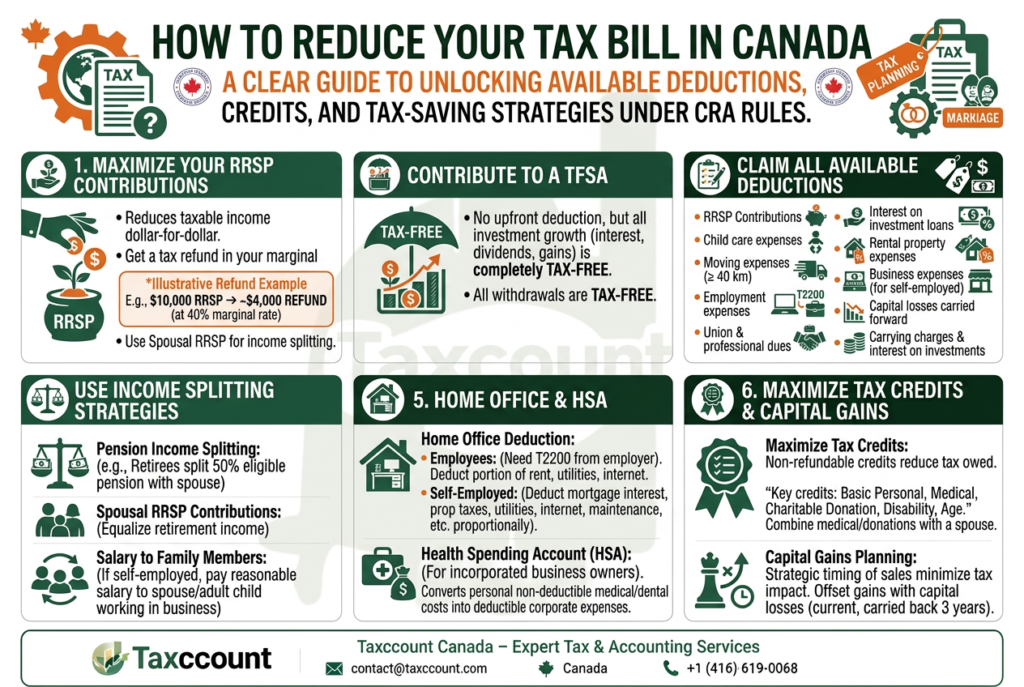
One of the most powerful tax reduction tools available to Canadians is the Registered Retirement Savings Plan (RRSP). Contributions reduce your taxable income dollar for dollar. For example, if you are in a 40% marginal tax bracket and contribute $10,000 to your RRSP, you could receive approximately $4,000 as a tax refund. Spousal RRSP contributions are also a valuable income-splitting strategy for couples in different tax brackets.
Professional tax return filing services can help ensure eligible RRSP contributions are properly reported.
Reduce Your Tax Bill
☎️ Get HelpContribute to a TFSA
A Tax-Free Savings Account (TFSA) does not provide an upfront deduction, but all investment growth and withdrawals are completely tax-free. This makes the TFSA ideal for sheltering interest income, dividends, and capital gains that would otherwise be taxable each year.
An accountant for taxes can help you understand how registered accounts fit into your overall tax planning.
Claim All Available Deductions
Many Canadians miss deductions they are entitled to. Common deductions include:
- RRSP contributions
- Child care expenses
- Moving expenses (if you moved at least 40 km closer to a new job or school)
- Employment expenses (with a signed T2200 from your employer)
- Union and professional dues
- Interest paid on investment loans
- Rental property expenses
- Business expenses for self-employed individuals
- Capital losses carried forward from previous years
- Carrying charges and interest paid on investments
Tax and accounting services can help identify deductions that may apply to your individual financial situation.
Use Income Splitting Strategies
Canada taxes individuals, not households, so shifting income to a lower-earning family member reduces the combined tax burden. Effective strategies include:
Pension Income Splitting
Pension income splitting: Retirees can split up to 50% of eligible pension income with a spouse.
Spousal RRSP Contributions
Spousal RRSP contributions: Contribute to a spousal RRSP to equalize retirement income.
Salary to Family Members
Salary to family members: If you are self-employed, paying a reasonable salary to a spouse or adult child who works in the business is deductible.
Income tax preparation near me services can help determine which income-splitting strategies may be available.
Claim the Home Office Deduction
If you work from home, you may be eligible to deduct a proportion of home expenses:
Employees
Employees: You must have a signed Form T2200 from your employer. Eligible costs include rent, utilities, and internet.
Self-Employed
Self-employed: No T2200 required. You can deduct rent or mortgage interest, property taxes, utilities, internet, and maintenance on a proportional basis.
Tax accountants can help calculate the business or employment portion of eligible home office expenses.
Use a Health Spending Account
A Health Spending Account (HSA) allows incorporated business owners to pay for medical and dental expenses through the corporation, converting non-deductible personal costs into deductible business expenses. This can significantly reduce the overall tax cost of medical care.
A corporate tax accountant can help business owners determine how eligible health-related expenses should be handled by a corporation.
Maximize Tax Credits
Beyond deductions, non-refundable tax credits reduce the amount of tax you owe. Key credits include the basic personal amount, medical expense tax credit, charitable donation credit, disability tax credit, and age amount. Combining medical expenses and donations with a spouse’s return can increase the value of these credits.
Capital Gains Planning
Only a portion of capital gains are included in your taxable income, so timing the sale of investments or property strategically can minimize your annual tax impact. If you have capital losses in your portfolio, you can trigger them to offset taxable capital gains in the current year or carry them back up to three years.
A tax accountant near me can help review capital gains and available capital losses before your return is filed.
| Section | Easy Information |
|---|---|
| 1. Topic | The article explains how Canadians can legally reduce their tax bill using CRA-approved strategies, including RRSP contributions, TFSA savings, deductions, income splitting, home office claims, tax credits, and capital gains planning. |
| 2. Use RRSP Contributions | A Registered Retirement Savings Plan (RRSP) is one of the most effective tax-saving tools in Canada. RRSP contributions reduce taxable income, which can lower the amount of tax payable. The higher your marginal tax rate, the greater the potential tax benefit. |
| 3. Example of RRSP Tax Savings | If someone contributes $10,000 to an RRSP while in a 40% marginal tax bracket, the contribution may reduce taxable income enough to create approximately a $4,000 tax benefit. Actual savings depend on income level and tax situation. |
| 4. Spousal RRSP Strategy | Couples with different income levels can use spousal RRSP contributions to balance retirement income between spouses. This may help reduce future taxes by shifting retirement income to the lower-income spouse. |
| 5. Contribute to a TFSA | A Tax-Free Savings Account (TFSA) does not reduce taxable income when contributing, but investment growth and withdrawals are generally tax-free. It can help shelter interest, dividends, and capital gains from future taxation. |
| 6. Claim Available Tax Deductions | Many Canadians miss deductions that can reduce taxable income. Common deductions include: • RRSP contributions • Childcare expenses • Moving expenses (when CRA conditions are met) • Employment expenses with Form T2200 • Union and professional dues • Investment interest expenses • Rental property expenses • Business expenses for self-employed individuals • Capital losses from previous years |
| 7. Income Splitting Strategies | Canada taxes individuals separately, so certain strategies can help reduce the combined family tax burden by allocating income more efficiently between family members. |
| 8. Pension Income Splitting | Eligible retirees can split up to 50% of qualifying pension income with their spouse or common-law partner, potentially reducing overall household taxes. |
| 9. Salary to Family Members | Self-employed individuals may pay a reasonable salary to a spouse or adult child who works in the business. This can allow income to be allocated to family members while creating a deductible business expense. |
| 10. Home Office Deduction for Employees | Employees working from home may claim eligible home office expenses if CRA requirements are met. A signed Form T2200 from the employer may be required. Eligible expenses can include rent, utilities, and internet costs. |
| 11. Home Office Deduction for Self-Employed Individuals | Self-employed individuals generally have broader home office deduction options. They may claim a reasonable business-use portion of expenses such as rent, mortgage interest, property taxes, utilities, internet, and maintenance. |
| 12. Health Spending Account (HSA) | Incorporated business owners may use a Health Spending Account to provide eligible medical and dental benefits through their corporation. This can help convert certain personal healthcare costs into deductible business expenses when properly structured. |
| 13. Maximize Tax Credits | Tax credits reduce the amount of tax payable. Important credits may include: • Basic personal amount • Medical expense tax credit • Charitable donation credit • Disability tax credit • Age amount |
| 14. Pooling Expenses With a Spouse | Combining certain claims, such as medical expenses and charitable donations, on one spouse’s return may increase the overall tax benefit depending on each spouse’s income and circumstances. |
| 15. Capital Gains Planning | Strategic planning before selling investments or property can help manage capital gains tax. Since only the taxable portion of a capital gain is included in income, timing sales carefully can reduce the annual tax impact. |
| 16. Use Capital Losses | Capital losses from investments can generally be used to offset taxable capital gains. Unused losses may be carried back to previous years or carried forward to future years according to CRA rules. |
| 17. Key Takeaway | Canadians can reduce their tax bill legally by using available deductions, credits, registered accounts, and tax planning strategies. Proper planning throughout the year can help minimize taxes while staying compliant with CRA rules. |
Frequently Asked Questions
How Can I Legally Reduce My Taxes in Canada?
You may be able to reduce your taxes through RRSP contributions, eligible deductions, tax credits, income-splitting strategies, home office expenses, and capital gains planning.
Does Contributing to an RRSP Reduce Taxable Income?
Yes. Eligible RRSP contributions generally reduce your taxable income, subject to your available RRSP deduction limit.
Does a TFSA Give You a Tax Deduction?
No. TFSA contributions do not provide an income tax deduction, but eligible investment income and withdrawals within the account are generally tax-free.
Can I Claim Home Office Expenses in Canada?
You may qualify depending on your employment or self-employment situation and whether you meet the applicable CRA requirements.
Can Capital Losses Reduce Capital Gains?
Yes. Eligible capital losses can generally be applied against taxable capital gains and may also be carried back up to three years or carried forward for use in future years.
Maximize Your Tax Savings
☎️ Get HelpThis is general information only and not professional advice. Consult a professional before acting.
 Written and fact-checked by Udit Gupta
 Written and fact-checked by
 Ex Big4, Ernst & Young, Deloitte | International & Cross-Border Tax Specialist | CPA Canada In Depth Tax Training | Licensed Chartered Accountant from ICAI & MIA
Udit Gupta has over 15 years of experience helping corporations & business owners with corporate structuring, corporate tax filing, bookkeeping, payroll, GST/HST, cross-border tax and CRA representation. Big 4 trained at Ernst & Young and Deloitte, and qualified as a Chartered Accountant in India and Malaysia, he founded accounting firm in 2014 to serve entrepreneurs, startups and non-resident business owners across Canada. View Full Member Bio.
Indian Institute of Chartered Accountant Member No. (521458) | Malaysian Institute of Accountants Membership number (CA 44667) | Ex Big4,Ex Ernst & Young (EY), Ex-Deloitte | CPA Canada In-Depth Tax Training 19 Dec 2023, 12 Jul 2022, 5 Jul 2023
Editorial policy. Every article is researched against primary sources — the Income Tax Act, CRA publications and CPA Canada.