Are Wedding Expenses Tax Deductible in Canada?

Planning a wedding involves significant costs, from the venue and catering to flowers, photography, and attire. It is natural to wonder whether any of these expenses can reduce your tax bill. The short answer is no — wedding expenses are generally not tax deductible in Canada. A wedding is considered a personal celebration, not a business or employment-related activity. However, there are some limited exceptions and post-wedding tax benefits worth knowing about.
Taxccount Canada helps individuals searching for tax filing near me understand how personal expenses and marriage-related tax benefits are treated under Canadian tax rules.
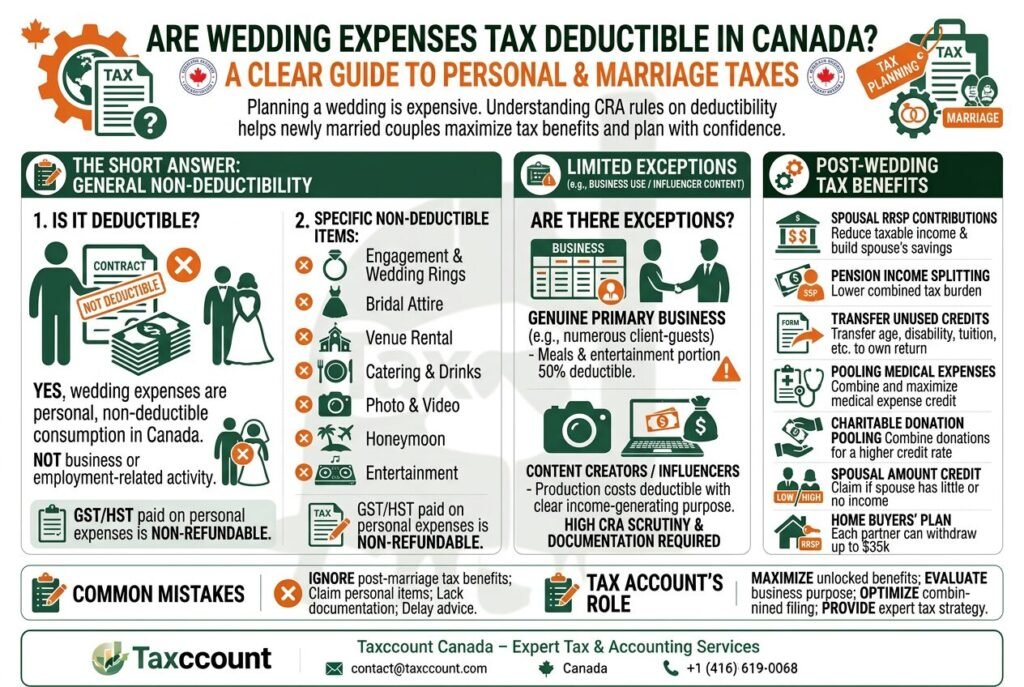
Are Wedding Expenses Deductible?
The Canada Revenue Agency (CRA) does not allow deductions for personal expenses, and weddings fall firmly in that category. The following costs are not tax deductible:
- Venue rental
- Catering and food and beverage costs
- Flowers and decorations
- Photography and videography
- Wedding attire
- Engagement and wedding rings
- Honeymoon travel
- Entertainment and DJ
GST/HST paid on personal wedding expenses is also not refundable through the tax system.
Professional tax return filing services can help ensure personal wedding costs are not incorrectly claimed on a tax return.
Explore Marriage Tax Benefits
☎️ Get HelpCan a Wedding Ever Be a Business Expense?
In rare cases, a portion of wedding costs could qualify as a business expense if the event had a genuine primary business purpose — for example, if a significant number of business clients attended and the event was structured as a business function. In that case, the meals and entertainment portion might be 50% deductible. However, the CRA scrutinizes these claims carefully. Personal celebrations dressed up as business events rarely survive an audit.
Content creators or influencers who create commercial wedding content may be able to deduct related production costs if they can demonstrate a clear income-generating purpose, but strong documentation is required.
An accountant for taxes can help determine whether any part of an event has a legitimate business purpose.
Tax Benefits After Getting Married
While the wedding itself does not provide tax deductions, marriage does unlock several valuable tax benefits in Canada:
Spousal RRSP Contributions
Spousal RRSP contributions: You can contribute to a spousal RRSP and reduce your own taxable income while building retirement savings for your spouse.
Pension Income Splitting
Pension income splitting: Couples can split eligible pension income to reduce their combined tax burden.
Transfer of Unused Credits
Transfer of unused credits: You can transfer your spouse’s unused age amount, disability amount, tuition amount, and other credits to your own return.
Pooling Medical Expenses
Pooling medical expenses: Combining medical expenses on one return can help you exceed the threshold and maximize the medical expense tax credit.
Charitable Donation Pooling
Charitable donation pooling: You can combine donations and claim them on one return to access the higher 29% federal credit rate.
Spousal Amount Credit
Spousal amount credit: If your spouse or common-law partner has little or no income, you may be eligible to claim the spousal amount on your return.
Home Buyers’ Plan
Home Buyers’ Plan: Both partners can each withdraw up to $35,000 from their RRSPs to purchase a qualifying home.
Tax and accounting services can help newly married couples review available credits, deductions, and income-splitting opportunities.
Table of Summary
| Section | Easy Information |
|---|---|
| 1. Topic | The article explains whether wedding expenses are tax deductible in Canada, why most wedding costs cannot be claimed, limited business exceptions, and tax benefits available after marriage. |
| 2. Are Wedding Expenses Tax Deductible? | No. Wedding expenses are considered personal expenses by the CRA and cannot be deducted from your taxable income. A wedding is treated as a personal celebration, not a business or employment-related activity. |
| 3. Common Wedding Expenses That Cannot Be Claimed | The following expenses are generally not tax deductible: • Venue rental costs • Catering and food expenses • Flowers and decorations • Photography and videography • Wedding clothing and attire • Engagement and wedding rings • Honeymoon travel • Entertainment and DJ costs |
| 4. GST/HST on Wedding Expenses | GST/HST paid on personal wedding expenses cannot be recovered through the tax system because these costs are considered personal, not business expenses. |
| 5. Can Wedding Costs Ever Be a Business Expense? | In rare situations, some wedding-related costs may qualify if the event has a genuine business purpose. For example, a business event involving clients may allow certain meals and entertainment expenses to be considered. However, the CRA carefully reviews these claims. |
| 6. Business Events vs. Personal Celebrations | A personal wedding cannot simply be classified as a business event to obtain deductions. The taxpayer must prove that the expense was directly related to earning business income and maintain proper documentation. |
| 7. Wedding Content Creators and Influencers | Content creators or influencers may deduct certain wedding-related production costs if the event content is created specifically for income-generating purposes. They must show a clear connection between the expense and business income. |
| 8. Spousal RRSP Benefits After Marriage | Married couples can contribute to a spousal RRSP. This may allow the higher-income spouse to reduce taxable income while helping build retirement savings for the lower-income spouse. |
| 9. Pension Income Splitting | Eligible couples may split pension income between spouses to reduce their combined tax burden and potentially lower overall taxes. |
| 10. Transfer of Unused Credits | After marriage, spouses may be able to transfer unused credits such as age amount, disability amount, tuition amounts, and other eligible credits between each other. |
| 11. Pooling Medical Expenses | Couples can combine eligible medical expenses on one tax return. This may help them exceed the CRA medical expense threshold and maximize the available medical expense tax credit. |
| 12. Charitable Donation Pooling | Spouses can combine charitable donations and claim them on one return, which may allow access to higher federal donation credit rates. |
| 13. Spousal Amount Credit | If one spouse has little or no income, the other spouse may qualify to claim the spousal amount credit, reducing overall tax payable. |
| 14. Home Buyers’ Plan Benefits | Newly married couples planning to buy a home may use the Home Buyers’ Plan. Eligible individuals can withdraw funds from their RRSPs to help purchase a qualifying home, subject to CRA limits. |
| 15. Key Takeaway | Wedding expenses themselves are generally not tax deductible in Canada because they are personal costs. However, marriage can provide valuable tax planning opportunities through spousal credits, RRSP strategies, income splitting, and other CRA-approved benefits. |
Frequently Asked Questions
Can I Claim My Wedding Venue as a Tax Deduction?
No. Wedding venue costs are considered personal expenses and cannot be claimed on a Canadian income tax return.
Are Wedding Catering Costs Tax Deductible?
Generally, no. Catering and food expenses for a personal wedding are not deductible.
Can Influencers Deduct Wedding Content Expenses?
Possibly. Expenses may qualify if they have a clear income-generating purpose and are properly documented as business costs.
Are Honeymoon Expenses Tax Deductible?
No. Honeymoon travel is a personal expense and cannot be claimed as a tax deduction.
What Tax Benefits Become Available After Marriage?
Marriage may provide access to spousal RRSP contributions, pension income splitting, transfers of unused credits, medical expense pooling, charitable donation pooling, and the spousal amount credit.
Plan Your Tax Savings
☎️ Get HelpThis is general information only and not professional advice. Consult a professional before acting.
 Written and fact-checked by Udit Gupta
 Written and fact-checked by
 Ex Big4, Ernst & Young, Deloitte | International & Cross-Border Tax Specialist | CPA Canada In Depth Tax Training | Licensed Chartered Accountant from ICAI & MIA
Udit Gupta has over 15 years of experience helping corporations & business owners with corporate structuring, corporate tax filing, bookkeeping, payroll, GST/HST, cross-border tax and CRA representation. Big 4 trained at Ernst & Young and Deloitte, and qualified as a Chartered Accountant in India and Malaysia, he founded accounting firm in 2014 to serve entrepreneurs, startups and non-resident business owners across Canada. View Full Member Bio.
Indian Institute of Chartered Accountant Member No. (521458) | Malaysian Institute of Accountants Membership number (CA 44667) | Ex Big4,Ex Ernst & Young (EY), Ex-Deloitte | CPA Canada In-Depth Tax Training 19 Dec 2023, 12 Jul 2022, 5 Jul 2023
Editorial policy. Every article is researched against primary sources — the Income Tax Act, CRA publications and CPA Canada.