Is Severance Pay Taxable in Canada?

Losing a job is stressful, and dealing with the tax implications of severance pay adds another layer of complexity. In Canada, severance pay is generally taxable, but there are strategies that may help you reduce the amount of tax you owe. This article explains how severance pay is taxed, how it differs from a retiring allowance, and what options you have to minimize your tax burden.
Taxccount Canada helps individuals searching for tax filing near me understand how severance payments should be reported on a Canadian tax return.
Is Severance Pay Taxable in Canada?
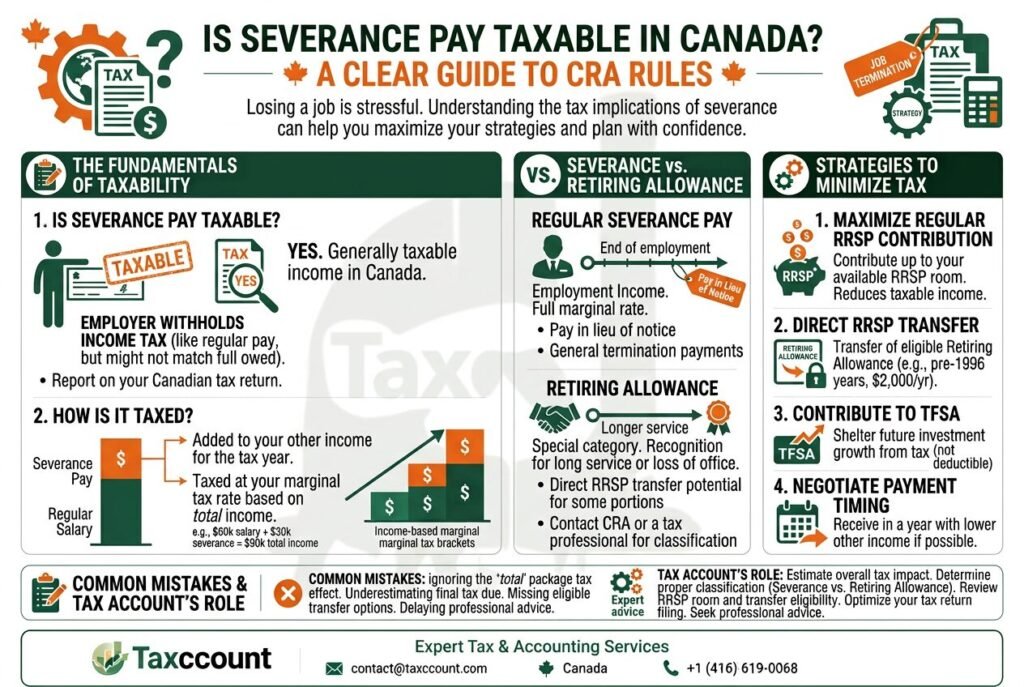
Yes. Severance pay is taxable income in Canada. When you receive it, the amount is included in your total income for the year and taxed at your marginal tax rate. Your employer is required to withhold income tax from severance payments before paying you, similar to how tax is withheld from your regular paycheques. However, the withholding may not always match what you ultimately owe, so it is important to plan accordingly.
Professional tax return filing services can help determine whether additional tax may be payable after the severance amount is included in your annual income.
Reduce Severance Tax Impact
☎️ Get HelpSeverance Pay vs. Retiring Allowance
Not all amounts paid when you leave a job are treated the same way by the CRA. Understanding the distinction matters because it affects your options:
Regular Severance Pay
Regular severance pay: Amounts paid for the loss of employment, such as pay in lieu of notice, are considered employment income and are taxed at your full marginal rate.
Retiring Allowance
Retiring allowance: A retiring allowance is a specific category of payment made in recognition of long service or the loss of an office or employment. Some portions of a retiring allowance may be eligible to be transferred directly to your RRSP without using your regular contribution room.
An accountant for taxes can help determine how each part of your payment should be classified.
How Is Severance Pay Taxed?
Severance pay is generally added to your other income for the tax year in which you receive it. For example, if you earned $60,000 from employment and then received $30,000 in severance, your total income for the year would be $90,000, and you would be taxed at the marginal rates that apply to that higher income level.
Tax and accounting services can help estimate the overall tax impact before you file.
Can You Transfer Severance to an RRSP?
There are two RRSP-related options that may be available:
Regular RRSP Contribution
Regular RRSP contribution: You can contribute severance pay to your RRSP up to your available contribution room. This reduces your taxable income for the year.
Direct RRSP Transfer of a Retiring Allowance
Direct RRSP transfer of a retiring allowance (pre-1996 years of service): If part of your payment qualifies as a retiring allowance and relates to pre-1996 years of service, you may be eligible to transfer $2,000 per qualifying year of service directly to your RRSP without affecting your regular contribution room.
Income tax preparation near me services can help review your RRSP room and the treatment of any eligible retiring allowance.
Tips to Reduce Tax on Severance Pay
Maximize Your RRSP Contribution
Maximize your RRSP contribution to offset the increased income from severance.
Contribute to Your TFSA
Contribute to your TFSA to shelter future investment growth.
Negotiate the Timing of Your Severance Payment
Negotiate the timing of your severance payment if possible (receiving it in a lower-income year can reduce the tax impact).
Consult a Tax Professional Early
Consult a tax professional early to understand your options before accepting a severance package.
Tax accountants can help compare different payment and contribution strategies before the severance is finalized.
Table of Summary
| Section | Easy Information |
|---|---|
| 1. Topic | The article explains how severance pay is taxed in Canada, the difference between severance pay and a retiring allowance, RRSP transfer options, and strategies to reduce the overall tax impact. |
| 2. Is Severance Pay Taxable in Canada? | Yes. Severance pay is considered taxable income in Canada. It is added to your total income for the year and taxed at your marginal tax rate. Employers usually withhold income tax before making the payment, but the amount withheld may not always match the final tax owing. |
| 3. How Severance Pay Affects Your Tax | Severance payments are added on top of your other income for the year. For example, if you earn $60,000 in employment income and receive $30,000 severance, your total taxable income becomes $90,000, which may increase your marginal tax rate. |
| 4. Severance Pay vs. Retiring Allowance | These payments are treated differently under CRA rules. Regular severance pay (such as pay in lieu of notice) is generally treated as employment income. A retiring allowance is a special type of payment related to long service or loss of employment and may have additional tax planning options. |
| 5. Regular Severance Pay | Regular severance payments are fully taxable as employment income and taxed at the applicable marginal tax rate. Examples include compensation for job loss or pay received instead of notice. |
| 6. Retiring Allowance | A retiring allowance may qualify for special treatment. Certain eligible portions related to qualifying years of service may be transferred directly to an RRSP without using normal RRSP contribution room. |
| 7. Can Severance Be Transferred to RRSP? | There are two possible options: Regular RRSP Contribution: You can contribute severance money to your RRSP if you have available contribution room, reducing your taxable income. Direct RRSP Transfer: If the payment qualifies as a retiring allowance related to pre-1996 service years, certain amounts may be transferred directly to an RRSP without affecting regular contribution limits. |
| 8. Ways to Reduce Tax on Severance Pay | Tax planning strategies may include: • Making RRSP contributions to reduce taxable income. • Contributing available funds to a TFSA for future tax-free growth. • Planning the timing of the payment if possible, especially if a lower-income year is available. • Reviewing options before accepting a severance package. |
| 9. Importance of Timing | Receiving a large severance payment in a year with other high income may increase your tax burden. If possible, timing the payment across tax years may help reduce the overall tax impact. |
| 10. Employer Tax Withholding | Employers are required to deduct tax from severance payments, similar to regular payroll. However, withholding is only an estimate, and you may owe additional tax or receive a refund when filing your tax return. |
| 11. Documents to Keep | Keep severance agreements, employer statements, T4 or retiring allowance information slips, RRSP contribution receipts, and related tax documents for your records. |
| 12. Key Takeaway | Severance pay is generally taxable in Canada, but proper planning can help reduce the tax burden. Understanding whether your payment is regular severance or a retiring allowance and using available RRSP strategies can make a significant difference when filing your tax return. |
Frequently Asked Questions
Is Severance Pay Considered Taxable Income?
Yes. Severance pay is generally included in your income for the year and taxed at your applicable marginal tax rate.
Is Tax Deducted Before Severance Pay Is Paid?
Yes. Employers generally withhold income tax before paying severance, although the amount withheld may not equal your final tax liability.
Can I Put Severance Pay Into My RRSP?
Yes. You can contribute severance pay to your RRSP if you have available contribution room.
What Is the Difference Between Severance Pay and a Retiring Allowance?
Severance pay is generally treated as employment income, while a retiring allowance may qualify for special RRSP transfer rules in certain cases.
Can the Timing of Severance Affect My Taxes?
Yes. Receiving severance in a lower-income year may reduce the overall tax impact, depending on your circumstances.
Plan Your Severance Taxes
☎️ Get HelpThis is general information only and not professional advice. Consult a professional before acting.
 Written and fact-checked by Udit Gupta
 Written and fact-checked by
 Ex Big4, Ernst & Young, Deloitte | International & Cross-Border Tax Specialist | CPA Canada In Depth Tax Training | Licensed Chartered Accountant from ICAI & MIA
Udit Gupta has over 15 years of experience helping corporations & business owners with corporate structuring, corporate tax filing, bookkeeping, payroll, GST/HST, cross-border tax and CRA representation. Big 4 trained at Ernst & Young and Deloitte, and qualified as a Chartered Accountant in India and Malaysia, he founded accounting firm in 2014 to serve entrepreneurs, startups and non-resident business owners across Canada. View Full Member Bio.
Indian Institute of Chartered Accountant Member No. (521458) | Malaysian Institute of Accountants Membership number (CA 44667) | Ex Big4,Ex Ernst & Young (EY), Ex-Deloitte | CPA Canada In-Depth Tax Training 19 Dec 2023, 12 Jul 2022, 5 Jul 2023
Editorial policy. Every article is researched against primary sources — the Income Tax Act, CRA publications and CPA Canada.