When Do You Get Your Tax Return in Canada?

When Canadians talk about their “tax return,” they are usually referring to two different things: the paperwork they submit to the government and the refund they hope to receive. Understanding the difference and knowing the timelines for both can help you plan your finances more effectively during tax season.
Taxccount Canada helps individuals searching for tax filing near me understand when to expect their tax refund and how to avoid unnecessary processing delays.
Tax Return vs. Tax Refund: What Is the Difference?
Although these terms are often used interchangeably, they have different meanings.
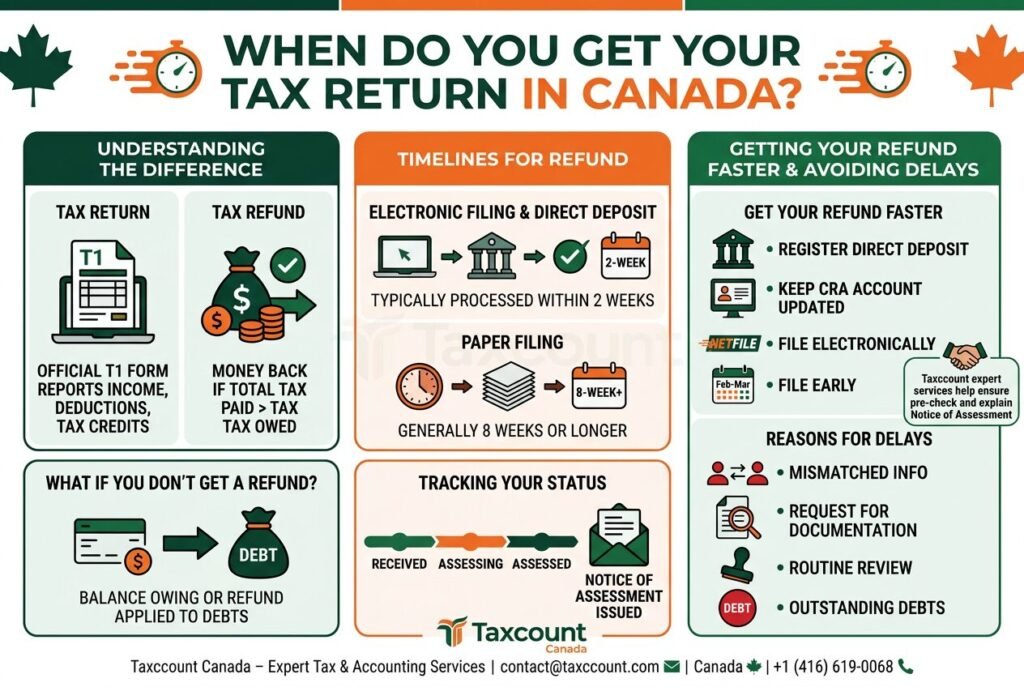
Tax Return
A tax return is the official income tax form (T1 Income Tax and Benefit Return) that you submit to the Canada Revenue Agency (CRA). It reports your income, deductions, tax credits, and taxes paid during the year.
Tax Refund
A tax refund is the money the CRA sends back to you if the total tax already paid through payroll deductions, instalments, or other sources is more than the tax you owe.
Professional tax return filing services can help ensure your return is completed accurately and processed without unnecessary delays.
Get Your Refund Faster
☎️ Get HelpWhen Do You Get Your Tax Refund?
The time it takes to receive your refund depends primarily on how you file your return.
Electronic Filing (NETFILE or EFILE)
If you file electronically and are enrolled in direct deposit, the CRA typically processes most returns within two weeks.
Paper Filing
Paper returns generally take eight weeks or longer to process, depending on the time of year and the complexity of the return.
An accountant for taxes can help ensure your return is complete before submission, reducing the chance of processing delays.
How to Get Your Refund Faster
You can often receive your refund more quickly by following these best practices.
Register for Direct Deposit
Direct deposit is the fastest way to receive your refund because the CRA deposits the money directly into your bank account.
Keep CRA My Account Updated
Ensure your mailing address, banking information, and personal details are current before filing.
File Electronically
Use CRA-certified NETFILE software or an authorized EFILE provider to submit your return online.
File Early
Submitting your return in late February or early March may help avoid the busiest part of the tax filing season.
Tax and accounting services can also help identify missing information before you submit your return.
Why Might Your Refund Be Delayed?
Although many refunds are processed quickly, delays can occur for several reasons, including:
- Information reported on your return does not match CRA records.
- The CRA requests additional documentation, such as receipts or supporting schedules.
- Your return is selected for a routine review.
- You have outstanding government debts or previous tax balances that may reduce or offset your refund.
Income tax preparation near me services can help resolve issues if your return requires additional review.
How to Track Your Tax Return
You can monitor the progress of your return through CRA My Account.
Your return status will typically move through the following stages:
- Received
- Assessing
- Assessed
Once your return has been assessed, the CRA will issue your Notice of Assessment (NOA), which confirms your final tax calculation and any refund or balance owing.
Tax accountants can also help explain your Notice of Assessment if adjustments are made by the CRA.
What If You Do Not Receive a Refund?
Not every taxpayer receives a refund.
If the tax already deducted during the year is less than the amount you owe, you may have a balance owing instead of a refund. In some cases, the CRA may also apply your refund to outstanding government debts before issuing any remaining amount.
A tax accountant near me can help review your return if your refund is smaller than expected or if you receive a balance owing.
Table of Summary
Here is the blog information in 6 easy rows for quick understanding:
| Section | Easy Information |
|---|---|
| 1. Topic | The blog explains when Canadians receive their tax return and refund and the difference between the two. |
| 2. Tax Return vs. Refund | Tax return: T1 form submitted to CRA reporting income, deductions, and credits. Refund: Money returned if tax paid exceeds tax owed. |
| 3. Processing Times | Electronic filing (NETFILE/EFILE) with direct deposit: ~2 weeks. Paper filing: ~8 weeks or longer. |
| 4. Getting Refund Faster | Use direct deposit, keep CRA My Account updated, file electronically, and file early (late Feb/early Mar). |
| 5. Reasons for Delay | Refund delays may occur due to mismatched info, CRA requests for documents, routine review, or outstanding government debts. |
| 6. Tracking & Issues | Track return in CRA My Account (Received → Assessing → Assessed). NOA confirms final tax/refund. Professional help can resolve discrepancies or balances owing. |
FAQs
How Long Does It Take to Receive a Tax Refund in Canada?
Most electronically filed returns with direct deposit are processed within approximately two weeks, while paper returns generally take eight weeks or longer.
What Is the Difference Between a Tax Return and a Tax Refund?
A tax return is the income tax form you submit to the CRA, while a tax refund is the money you receive if you paid more tax than you owed.
Can My Tax Refund Be Delayed?
Yes. Processing may take longer if the CRA requires additional information, performs a review, or if your return contains errors or missing documents.
How Can I Check the Status of My Tax Return?
You can track your return through CRA My Account, where you can view its processing status and access your Notice of Assessment once it is available.
Why Did I Not Receive a Tax Refund?
You may not receive a refund if you owe additional tax, have outstanding government debts, or if the amount already paid during the year was less than your total tax liability.
Track Your Tax Return
☎️ Get HelpThis is general information only and not professional advice. Consult a professional before acting.
 Written and fact-checked by Udit Gupta
 Written and fact-checked by
 Ex Big4, Ernst & Young, Deloitte | International & Cross-Border Tax Specialist | CPA Canada In Depth Tax Training | Licensed Chartered Accountant from ICAI & MIA
Udit Gupta has over 15 years of experience helping corporations & business owners with corporate structuring, corporate tax filing, bookkeeping, payroll, GST/HST, cross-border tax and CRA representation. Big 4 trained at Ernst & Young and Deloitte, and qualified as a Chartered Accountant in India and Malaysia, he founded accounting firm in 2014 to serve entrepreneurs, startups and non-resident business owners across Canada. View Full Member Bio.
Indian Institute of Chartered Accountant Member No. (521458) | Malaysian Institute of Accountants Membership number (CA 44667) | Ex Big4,Ex Ernst & Young (EY), Ex-Deloitte | CPA Canada In-Depth Tax Training 19 Dec 2023, 12 Jul 2022, 5 Jul 2023
Editorial policy. Every article is researched against primary sources — the Income Tax Act, CRA publications and CPA Canada.