How to Pay Taxes in Canada: Every Method Explained Simply

Once you have filed your tax return and discovered you owe money to the Canada Revenue Agency (CRA), the next step is making the actual payment. This is something many Canadians are unsure about, especially when they are not sure which method to use or what happens if they miss the deadline.
This guide explains every available way to pay your taxes in Canada, when payments need to be made, and what to do if you cannot pay the full amount right away.
Why Paying Your Taxes on Time Matters
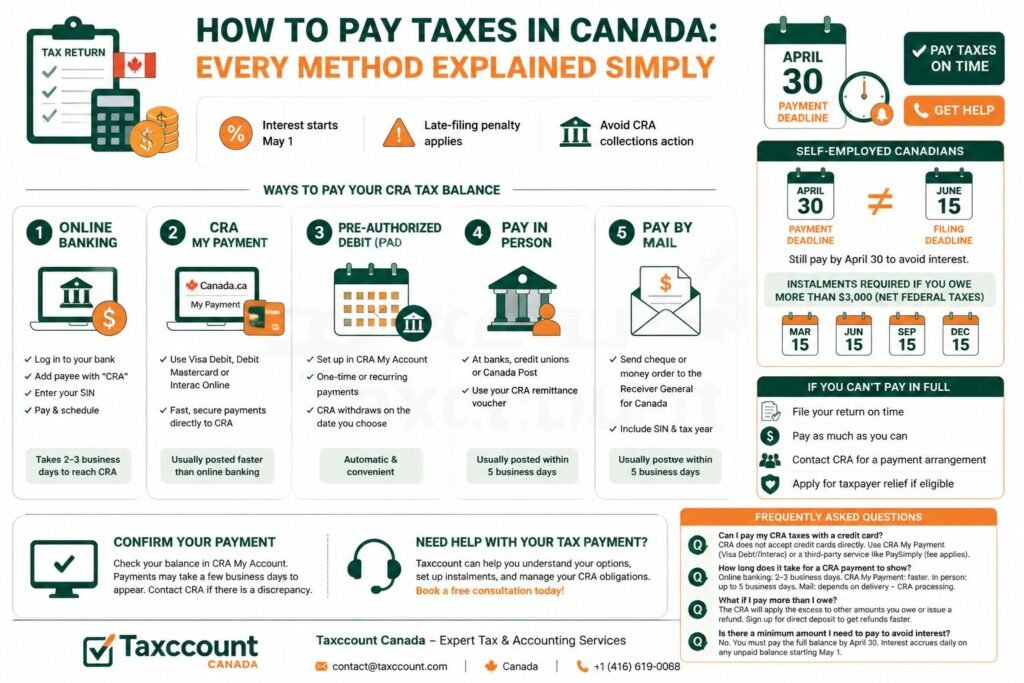
The CRA expects your tax balance to be paid by April 30 for most individuals. If you miss this deadline:
- Interest on unpaid taxes begins compounding daily starting May 1
- A late-filing penalty of five percent of the balance owing applies if you also filed your return late, plus one percent for each full month the return is late (up to 12 months)
- Continued non-payment can trigger CRA collections activity, including wage garnishment and bank account freezes
Filing your return on time, even if you cannot pay, at least avoids the late-filing penalty. The interest on the unpaid amount is a separate issue from the filing penalty.
Pay Taxes On Time
☎️ Get HelpHow to Pay Using Online Banking
Online banking is the most popular way Canadians pay their taxes. Here is how it works:
- Log in to your bank’s online or mobile banking platform
- Navigate to bill payments and search for a payee that includes “CRA” (e.g., “CRA (Revenue) Personal Tax – Current-Year Tax” or “CRA Personal Income Tax”)
- Enter your Social Insurance Number (SIN) as the account number
- Enter the amount and schedule the payment
Payments made through online banking typically reach the CRA within two to three business days. Make sure to initiate the payment a few days before the deadline to ensure it arrives on time.
How to Pay Using CRA My Payment
CRA My Payment is an online payment service available on the CRA website. It accepts:
- Visa Debit
- Debit Mastercard
- Interac Online
Note: CRA My Payment does not accept credit cards. Payments go directly to the CRA and are usually posted faster than standard online banking transfers.
To use CRA My Payment, go to Canada.ca and search for “CRA My Payment.” Select the appropriate payment type (Personal Income Tax), enter your SIN, and follow the prompts to complete the payment.
How to Set Up Pre-Authorized Debit
Pre-Authorized Debit (PAD) lets you schedule payments directly from your bank account through CRA My Account. You can set up one-time or recurring payments and choose the date you want the CRA to withdraw the funds.
This option is useful for people who want to plan ahead or spread payments across multiple dates. The withdrawal happens automatically, so you do not need to remember to make the payment manually.
How to Pay In Person
You can pay your taxes in person at most major Canadian banks, credit unions, and Canada Post locations. To pay in person, you will need a remittance voucher from the CRA. You can get this through CRA My Account or it may be included with your Notice of Assessment.
In-person payments are typically posted to your account within five business days.
How to Pay by Mail
You can mail a cheque or money order payable to the Receiver General of Canada. Include your SIN and the tax year on the back of the cheque, and mail it to your regional CRA tax centre.
Important: The CRA must receive your payment by the deadline, not just have it postmarked. Allow sufficient time for mail delivery, especially if you are sending it close to the deadline.
How to Pay If You Are Self-Employed
Self-employed Canadians have a later filing deadline of June 15, but the payment deadline is still April 30. If you owe taxes and do not pay by April 30, interest will begin accumulating even if you have not yet filed your return.
If you owe more than $3,000 in net federal taxes in the current or either of the two previous years, the CRA may require you to pay quarterly tax instalments:
- March 15
- June 15
- September 15
- December 15
What to Do If You Cannot Pay in Full
If you cannot pay the full amount by the deadline, take the following steps:
- File your return on time anyway to avoid the late-filing penalty
- Pay as much as you can to reduce the interest that will accumulate on the remaining balance
- Contact the CRA to discuss a payment arrangement — they may allow you to pay in instalments
- Apply for taxpayer relief if you are experiencing serious financial hardship, illness, or another extraordinary circumstance
How to Confirm Your Payment Was Received
After making a payment, you can confirm it was received by logging into CRA My Account and checking your account balance. Payments may take a few business days to appear. If you paid by mail, allow additional processing time.
If you see a discrepancy, contact the CRA directly with your payment details (date, amount, method) to resolve it.
Need Help with Your Tax Payment? Talk to Taxccount
Taxccount helps individuals, self-employed Canadians, and corporations manage their CRA obligations with confidence. Whether you need help understanding your payment options, setting up instalments, or managing a tax debt, our team is here to help. Book a free consultation with Taxccount today.
Table of Summary
Here is the blog information in 6 easy rows:
| Section | Easy Information |
|---|---|
| 1. Topic | The blog explains how to pay taxes owed to CRA in Canada after filing a tax return. |
| 2. Payment Deadline | Most individuals must pay their CRA balance by April 30. If unpaid, interest starts from May 1. |
| 3. Main Payment Methods | Canadians can pay using online banking, CRA My Payment, Pre-Authorized Debit, in person, or by cheque/money order. |
| 4. Self-Employed Rule | Self-employed people can file by June 15, but any balance owing must still be paid by April 30. |
| 5. If You Cannot Pay | File on time, pay as much as possible, contact CRA for a payment arrangement, or apply for taxpayer relief if eligible. |
| 6. Simple Summary | Pay your CRA tax balance by April 30 using a CRA-approved method, and if you cannot pay fully, contact CRA early to arrange instalments. |
Frequently Asked Questions
Can I pay my CRA taxes with a credit card?
The CRA does not directly accept credit card payments. You can use a third-party service such as PaySimply to pay by credit card, but a convenience fee applies. Alternatively, some Canadians use a line of credit or loan to pay the CRA and then repay the lender at a potentially lower interest rate.
How long does it take for a CRA payment to show in my account?
Online banking payments typically take two to three business days. CRA My Payment (via Visa Debit or Interac) is processed faster. In-person payments may take up to five business days. Mail payments depend on delivery time plus CRA processing.
What if I pay more than I owe?
If you overpay, the CRA will apply the excess to any other amounts you owe or issue a refund. You can speed up the refund process by signing up for direct deposit through CRA My Account.
Is there a minimum amount I need to pay to avoid interest?
You must pay the full balance owing by April 30 to avoid interest. There is no partial payment threshold — interest accrues daily on any unpaid balance starting May 1, even if you have paid most of what you owe.
Manage CRA Payments Easily
☎️ Get HelpThis is general information only and not professional advice. Consult a professional before acting.
 Written and fact-checked by Udit Gupta
 Written and fact-checked by
 Ex Big4, Ernst & Young, Deloitte | International & Cross-Border Tax Specialist | CPA Canada In Depth Tax Training | Licensed Chartered Accountant from ICAI & MIA
Udit Gupta has over 15 years of experience helping corporations & business owners with corporate structuring, corporate tax filing, bookkeeping, payroll, GST/HST, cross-border tax and CRA representation. Big 4 trained at Ernst & Young and Deloitte, and qualified as a Chartered Accountant in India and Malaysia, he founded accounting firm in 2014 to serve entrepreneurs, startups and non-resident business owners across Canada. View Full Member Bio.
Indian Institute of Chartered Accountant Member No. (521458) | Malaysian Institute of Accountants Membership number (CA 44667) | Ex Big4,Ex Ernst & Young (EY), Ex-Deloitte | CPA Canada In-Depth Tax Training 19 Dec 2023, 12 Jul 2022, 5 Jul 2023
Editorial policy. Every article is researched against primary sources — the Income Tax Act, CRA publications and CPA Canada.