What Expenses Can I Claim on My Taxes in Canada?

One of the best ways to reduce your tax bill in Canada is to claim every eligible expense on your return. But many Canadians miss deductions they qualify for, or claim expenses they are not entitled to altogether. This guide covers the most common and valuable expenses you can claim on your Canadian tax return.
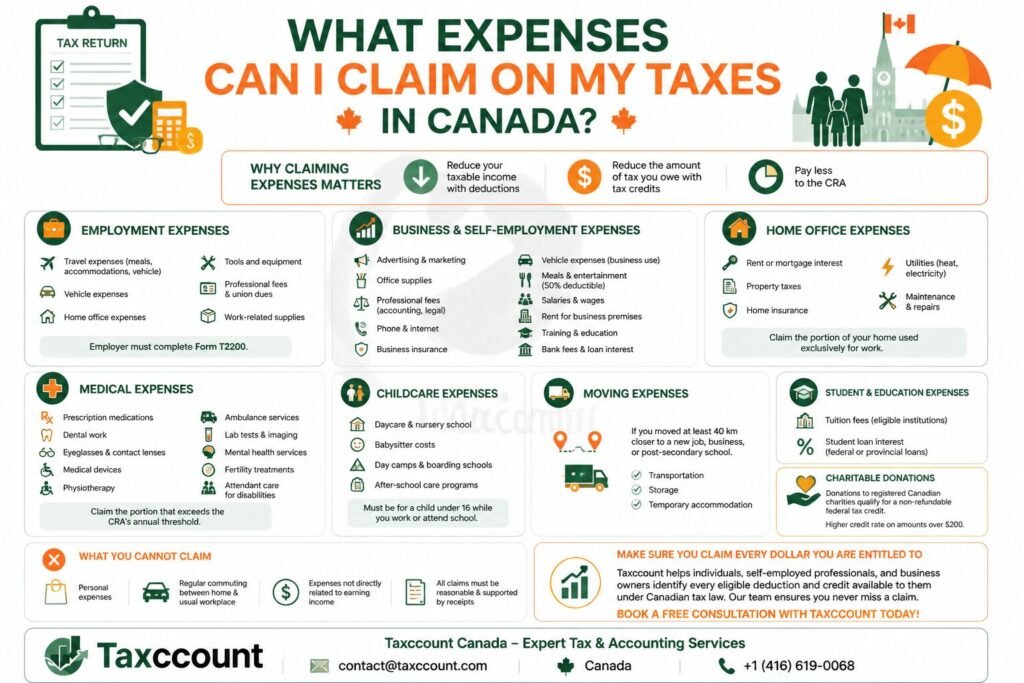
Why Claiming Expenses Matters
When you claim eligible expenses on your tax return, you can either reduce your taxable income through a deduction, which lowers how much you are taxed, or receive a tax credit, which directly reduces the amount of tax you owe. Both result in paying less to the CRA.
File Taxes With Confidence
☎️ Get HelpEmployment Expenses
If you are an employee, you can claim certain work-related expenses, but only if your employer required you to pay them as part of your job and has completed Form T2200 to confirm this. Eligible employment expenses can include:
- Travel expenses including meals, accommodations, and vehicle costs
- Vehicle expenses for work-related driving
- Home office expenses
- Tools and equipment required for the job
- Professional membership fees and union dues
- Work-related supplies
Business and Self-Employment Expenses
If you are self-employed or run your own business, you can deduct a wide range of expenses used to earn income. Common deductible business expenses include:
- Advertising and marketing costs
- Office supplies
- Professional fees such as accounting and legal costs
- Phone and internet costs used for business
- Business insurance
- Vehicle expenses for business travel, not personal use
- Meals and entertainment, generally fifty percent deductible
- Salaries paid to employees
- Rent paid for business premises
- Bank fees and interest on business loans
- Training and education directly related to your business
Home Office Expenses
If you work from home as a self-employed individual, you can claim a portion of your home expenses based on the percentage of your home used exclusively for work. Eligible home office expenses include:
- Rent or mortgage interest
- Property taxes
- Home insurance
- Utilities such as heat and electricity
- Maintenance and repairs
Medical Expenses
Canadians can claim eligible medical expenses that exceed a minimum threshold. Common eligible medical expenses include:
- Prescription medications
- Dental work
- Eyeglasses and contact lenses
- Medical devices
- Physiotherapy
- Ambulance services
- Lab tests and diagnostic imaging
- Mental health services from eligible practitioners
- Fertility treatments
- Attendant care for persons with disabilities
Childcare Expenses
If you paid someone to care for your child while you worked or attended school, you may be able to deduct those costs. Eligible childcare expenses include:
- Daycare and nursery school fees
- Babysitter costs
- Day camps and boarding schools
- After-school care programs
Moving Expenses
If you moved at least forty kilometres closer to a new job, business, or post-secondary school, you may be able to deduct eligible moving costs such as transportation, storage, and temporary accommodation.
Student and Education Expenses
Students may be able to claim tuition fees paid to eligible institutions. Interest paid on student loans from federal or provincial programs is also eligible for a federal tax credit.
Charitable Donations
Donations made to registered Canadian charities qualify for a non-refundable federal tax credit. The credit rate increases on amounts over $200, making larger donations more tax advantageous.
What You Cannot Claim
Not all expenses are deductible. Personal expenses, regular commuting between home and your usual workplace, and costs that are not directly connected to earning income are generally not eligible. All claims must be reasonable and supported by receipts.
Make Sure You Claim Every Dollar You Are Entitled To
Taxccount helps individuals, self-employed professionals, and business owners identify every eligible deduction and credit available to them under Canadian tax law. Our team ensures you never miss a claim. Book a free consultation with Taxccount today.
Table of Summary
Here is the blog information in 6 easy rows for quick understanding:
| Section | Easy Information |
|---|---|
| 1. Topic | The blog explains what expenses Canadians can claim on their taxes to reduce taxable income or receive credits. |
| 2. Employment Expenses | Employees may claim work-related expenses if required by employer and supported by Form T2200: travel, vehicle, home office, tools, professional dues, and supplies. |
| 3. Business/Self-Employment Expenses | Self-employed individuals can deduct advertising, office supplies, professional fees, phone/internet, insurance, vehicle costs, meals/entertainment (50%), salaries, rent, bank fees, and training. |
| 4. Home Office & Other Expenses | Proportional home office costs for self-employed include rent/mortgage interest, property taxes, insurance, utilities, maintenance. Other claimable expenses: medical, childcare, moving, student/education, charitable donations. |
| 5. Non-Deductible Expenses | Personal expenses, commuting, or costs not directly related to earning income are generally not deductible. All claims require receipts or documentation. |
| 6. Simple Summary | Claim all eligible expenses, deductions, and credits to maximize tax savings. Keep documentation for CRA audits and consult professionals to ensure no claims are missed. |
Frequently Asked Questions
Do I need receipts to claim expenses on my taxes?
Yes. The CRA requires that all claimed expenses be supported by receipts or documentation. Keep records for at least six years in case of an audit.
Can I claim vehicle expenses if I use my car for both work and personal driving?
Yes, but only the business-use portion. You will need to keep a mileage log that tracks work-related trips and total kilometres driven during the year.
Can I claim RRSP contributions as a deduction?
Yes. RRSP contributions made within your contribution limit are fully deductible from your income for the year, which can significantly lower your tax bill.
Are veterinary expenses tax deductible in Canada?
Generally, personal veterinary expenses for pets are not deductible. However, if you use an animal for business purposes, such as a guard dog for a business property, those veterinary expenses may be deductible as a business expense.
Ready to Maximize Your Tax Refund?
Understanding what you can and cannot claim is the first step to keeping more of your money. Taxccount’s Canadian tax experts are here to review your situation and ensure every eligible deduction and credit is captured. Book a free consultation with Taxccount today and file your taxes with confidence.
Get Expert Tax Help
☎️ Get HelpThis is general information only and not professional advice. Consult a professional before acting.
 Written and fact-checked by Udit Gupta
 Written and fact-checked by
 Ex Big4, Ernst & Young, Deloitte | International & Cross-Border Tax Specialist | CPA Canada In Depth Tax Training | Licensed Chartered Accountant from ICAI & MIA
Udit Gupta has over 15 years of experience helping corporations & business owners with corporate structuring, corporate tax filing, bookkeeping, payroll, GST/HST, cross-border tax and CRA representation. Big 4 trained at Ernst & Young and Deloitte, and qualified as a Chartered Accountant in India and Malaysia, he founded accounting firm in 2014 to serve entrepreneurs, startups and non-resident business owners across Canada. View Full Member Bio.
Indian Institute of Chartered Accountant Member No. (521458) | Malaysian Institute of Accountants Membership number (CA 44667) | Ex Big4,Ex Ernst & Young (EY), Ex-Deloitte | CPA Canada In-Depth Tax Training 19 Dec 2023, 12 Jul 2022, 5 Jul 2023
Editorial policy. Every article is researched against primary sources — the Income Tax Act, CRA publications and CPA Canada.