How the Tuition Tax Credit Works in Canada

Post-secondary education can be expensive, but eligible tuition fees may provide tax relief through Canada’s tuition tax credit. Students can use the credit to reduce income tax payable, carry forward unused amounts, or transfer certain current-year amounts to an eligible family member.
Understanding how the credit works can help students and families make better decisions when completing their Canadian tax filing.
What Is the Tuition Tax Credit?
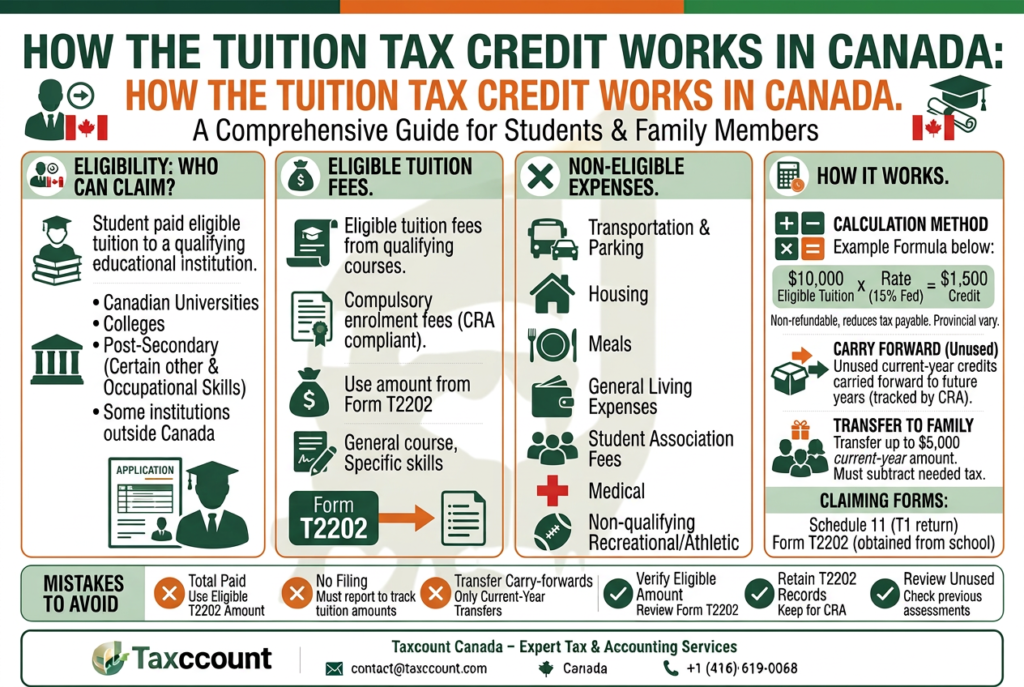
The tuition tax credit is a non-refundable tax credit available for eligible tuition fees paid to qualifying educational institutions.
Because it is non-refundable, the credit can reduce income tax payable but does not, by itself, generate a refund beyond the tax otherwise payable.
If a student cannot use the full eligible amount in the current year, unused amounts may generally be carried forward. A portion of the current-year amount may also be transferable to an eligible person.
Get Tuition Tax Help
☎️ Get HelpWho Can Claim the Tuition Tax Credit?
Students may qualify when they pay eligible tuition fees to a qualifying educational institution.
This can include students attending:
- Canadian universities
- Colleges
- Certain other post-secondary institutions
- Eligible educational institutions offering occupational skills courses
- Certain qualifying educational institutions outside Canada
Different requirements can apply depending on the institution, program and whether the school is located inside or outside Canada.
What Tuition Fees Qualify?
Eligible tuition fees generally include amounts paid for qualifying courses at eligible educational institutions.
Certain compulsory fees associated with enrolment may also qualify when they meet CRA requirements.
Your educational institution generally reports the eligible tuition amount on Form T2202, Tuition and Enrolment Certificate. You should use the eligible amount reported by the institution rather than simply using the total amount you paid to the school.
What Expenses Do Not Qualify?
Not every education-related cost qualifies for the tuition tax credit.
Costs that generally do not form part of eligible tuition can include:
- Transportation and parking
- Housing and accommodation
- Meals
- General living expenses
- Certain student association fees
- Medical expenses
- Non-qualifying recreational or athletic fees
- Other personal expenses associated with attending school
Rules can also apply when tuition has been reimbursed or paid by an employer or another organization.
How Much Is the Tuition Tax Credit Worth?
At the federal level, eligible tuition amounts are generally used to calculate a non-refundable tax credit at the lowest federal personal income tax rate applicable for the year.
For example, if the applicable credit rate were 15% and a student had $8,000 of eligible tuition:
$8,000 × 15% = $1,200
This would represent a potential federal tax reduction of up to $1,200, depending on the student’s circumstances.
Provincial and territorial tuition credits vary. Some jurisdictions have their own tuition amounts, while others have eliminated them.
What Happens to Unused Tuition Credits?
Students who cannot use all their available tuition amount in the current year may generally carry the unused amount forward to a future year.
This can be valuable for students who have little taxable income while studying but begin earning more after graduation.
Unused tuition amounts reported through previous tax returns are generally tracked by the CRA and can also appear on your Notice of Assessment or CRA account.
Once carried forward, the available amount generally must be used in a future year when it can reduce your tax payable before certain other options are considered.
Can You Transfer Tuition Credits to a Family Member?
A student may be able to transfer up to $5,000 of their current-year federal tuition amount, less the amount they need to reduce their own tax payable.
An eligible transfer can generally be made to a:
- Spouse or common-law partner
- Parent
- Grandparent
- Spouse’s or common-law partner’s parent or grandparent
An important distinction is that unused tuition amounts carried forward from previous years cannot later be transferred. The transfer rules generally apply to eligible current-year tuition amounts.
How to Claim the Tuition Tax Credit
Students generally calculate their federal tuition amount using Schedule 11 of their income tax return.
The basic process is:
- Obtain Form T2202 or other applicable tuition documentation.
- Report the eligible tuition amount.
- Calculate how much can be used on the current return.
- Determine whether an eligible current-year amount will be transferred.
- Carry forward any remaining eligible amount.
Tax return filing software will generally perform much of the calculation once the required information has been entered correctly.
What Is Form T2202?
Form T2202, Tuition and Enrolment Certificate, is issued by eligible Canadian educational institutions and provides information about qualifying tuition and enrolment.
Students should generally obtain the T2202 from their school’s online portal or other designated system.
You normally do not submit the certificate with an electronically filed tax return, but you should keep it with your supporting tax records in case the CRA requests it.
Common Tuition Tax Credit Mistakes
Students should avoid:
- Claiming the total amount paid instead of the eligible tuition amount
- Forgetting to report tuition because they had little or no income
- Trying to transfer tuition amounts carried forward from earlier years
- Claiming expenses such as rent, meals or transportation as tuition
- Failing to keep Form T2202
- Not reviewing unused tuition amounts from previous years
Even when a student has no tax payable, filing a tax return can be important for properly recording eligible tuition amounts for future use.
Table of Summary
| Section | Easy Information |
|---|---|
| 1. Topic | The article explains how the Tuition Tax Credit works in Canada, including eligible tuition fees, unused amounts, transfers and tax filing requirements. |
| 2. What Is the Tuition Tax Credit? | It is a non-refundable tax credit for eligible tuition fees. It can reduce income tax payable but does not, by itself, create a refund beyond tax otherwise payable. |
| 3. Who Can Claim? | Students attending qualifying universities, colleges, certain post-secondary institutions, occupational skills programs, and certain institutions outside Canada may qualify. |
| 4. Eligible Tuition Fees | Eligible tuition generally includes qualifying course fees and certain compulsory enrolment fees. The eligible amount is generally shown on Form T2202. |
| 5. Non-Eligible Expenses | Costs such as housing, meals, transportation, parking, general living expenses and other personal costs generally do not qualify as tuition expenses. |
| 6. Value of the Credit | Eligible tuition amounts are used to calculate a federal non-refundable tax credit. The actual tax savings depend on the applicable tax rate and the student’s circumstances. |
| 7. Unused Tuition Amounts | Tuition amounts that cannot be used in the current year may generally be carried forward to future years. CRA generally tracks reported unused amounts. |
| 8. Transfer to Family | Up to $5,000 of current-year federal tuition, less the amount required by the student, may generally be transferred to an eligible spouse, parent or grandparent. Prior-year carried-forward amounts cannot later be transferred. |
| 9. How to Claim | Students generally use Schedule 11 and information from Form T2202 to calculate the tuition amount used, transferred or carried forward. |
| 10. Key Takeaway | Students should file a tax return even when they have little or no income so eligible tuition amounts can be properly recorded and potentially carried forward for future use. |
Frequently Asked Questions
Is the tuition tax credit refundable?
No. It is a non-refundable tax credit, meaning it can reduce income tax payable but does not create a refund on its own when no tax is payable.
Can I carry unused tuition amounts forward?
Yes. Eligible unused tuition amounts can generally be carried forward and used in a future year.
Can I transfer my tuition credit to my parents?
You may be able to transfer an eligible portion of your current-year tuition amount to a parent or another qualifying person, subject to CRA rules.
Can I transfer tuition credits from previous years?
No. Tuition amounts already carried forward from previous years generally cannot later be transferred to another person.
Do international students qualify for the tuition tax credit?
International students may qualify if they meet the applicable Canadian tax and tuition-credit requirements.
Where can I find my tuition amount?
Eligible Canadian institutions generally provide students with Form T2202, often through the school’s student portal.
Should I file a tax return if I am a student with no income?
Filing can still be important because it allows eligible tuition amounts to be reported and carried forward and may also establish eligibility for other tax benefits.
Need Help With Student Tax Credits?
Taxccount Canada provides tax and accounting services and tax return filing services for students, graduates and families across Canada.
Our tax accountants can help review Form T2202, calculate available tuition amounts, identify unused carryforwards and determine whether a current-year tuition transfer is available.
Contact Taxccount Canada for professional assistance with your Canadian tax filing and student tax credits.
Claim Your Tuition Credit
☎️ Get HelpThis is general information only and not professional advice. Consult a professional before acting.
 Written and fact-checked by Udit Gupta
 Written and fact-checked by
 Ex Big4, Ernst & Young, Deloitte | International & Cross-Border Tax Specialist | CPA Canada In Depth Tax Training | Licensed Chartered Accountant from ICAI & MIA
Udit Gupta has over 15 years of experience helping corporations & business owners with corporate structuring, corporate tax filing, bookkeeping, payroll, GST/HST, cross-border tax and CRA representation. Big 4 trained at Ernst & Young and Deloitte, and qualified as a Chartered Accountant in India and Malaysia, he founded accounting firm in 2014 to serve entrepreneurs, startups and non-resident business owners across Canada. View Full Member Bio.
Indian Institute of Chartered Accountant Member No. (521458) | Malaysian Institute of Accountants Membership number (CA 44667) | Ex Big4,Ex Ernst & Young (EY), Ex-Deloitte | CPA Canada In-Depth Tax Training 19 Dec 2023, 12 Jul 2022, 5 Jul 2023
Editorial policy. Every article is researched against primary sources — the Income Tax Act, CRA publications and CPA Canada.