Tax on Severance Pay in Canada: How It Works and How to Minimize It

Being laid off or losing your job is already stressful. The last thing you want is to lose a large chunk of your severance pay to income taxes. But in Canada, severance pay and related amounts are generally taxable, and without proper planning, you could end up with a big tax bill.
The good news is there are legitimate strategies to reduce or defer the tax. Understanding how severance is taxed, and what options are available, can make a significant difference in how much you keep.
Is Severance Pay Taxable in Canada?
Yes. Severance pay is taxable income in Canada. When you receive a lump-sum payment from your employer on termination of employment, the Canada Revenue Agency (CRA) treats it as income.
The amount is reported on your T4 slip and is included in your total income for the year. It is taxed at your marginal tax rate, the same as employment income.
Let Taxccount help you reduce your tax bill
☎️ Get HelpRetiring Allowance vs. Severance Pay
For tax purposes, the CRA often refers to termination payments as a retiring allowance. A retiring allowance includes:
- Amounts received for loss of office or employment
- Damages received for wrongful dismissal
- Accumulated sick leave payouts in some cases
Not everything qualifies as a retiring allowance. Regular wages, vacation pay, or salary received up to the termination date are classified as regular employment income, not as a retiring allowance.
The distinction matters because of the RRSP transfer option (more below).
Withholding Tax on Severance
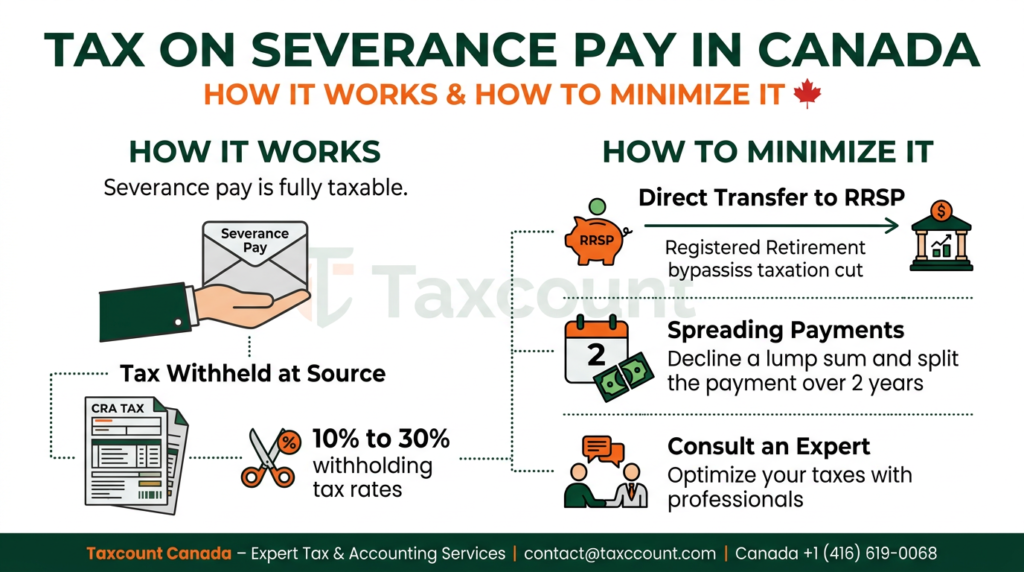
Your employer must withhold income tax from your severance payment before paying you. The withholding rate depends on the size of the payment:
- Lump-sum payments up to $5,000: 10% federal (5% in Quebec)
- Lump-sum payments from $5,001 to $15,000: 20% federal (10% in Quebec)
- Lump-sum payments over $15,000: 30% federal (15% in Quebec)
This is a withholding, not the final tax. When you file your tax return, your actual tax is calculated and the withholding is applied. If the withholding was more than you owe, you get a refund. If it was less, you will owe the difference.
Transferring Severance to Your RRSP
If you have available RRSP contribution room, you can contribute your severance (or any portion of it) directly to your RRSP. This shelters the money from tax in the year you receive it.
You can either:
1. Receive the full severance and then contribute to your RRSP by the RRSP deadline (60 days after December 31), or
2. Request a direct transfer from your employer to your RRSP to reduce or eliminate the withholding tax
By putting the severance into your RRSP, you defer the tax until you withdraw from the RRSP in retirement, when you may be in a lower tax bracket.
The key limit is your RRSP contribution room, which you can check on your most recent Notice of Assessment or in your CRA My Account.
The Pre-1996 Retiring Allowance Transfer
Before 1996, there was a special rule that allowed a portion of a retiring allowance to be transferred directly to an RRSP without counting against your regular contribution room. This was based on years of service before 1996.
This rule still exists for people who worked for the same employer before 1996. The formula is $2,000 per year of service before 1996 (and $1,500 per year before 1989 for which employer pension plan contributions were not made).
For example, if you worked for the same employer from 1990 to 2024, you have 6 years of pre-1996 service. This means you could transfer an additional $12,000 (6 years x $2,000) to your RRSP without affecting your regular contribution limit.
This is a valuable strategy for long-service employees who have pre-1996 service.
Strategies to Reduce Tax on Severance
1. Maximize your RRSP contribution
If you have available room, contribute as much of your severance as possible to your RRSP. This defers the tax and potentially moves the income to a lower-tax year.
2. Negotiate the payment timing
If you have some say in how the severance is structured, receiving part of it in one tax year and the rest in the next calendar year can spread the income across two tax years and potentially reduce your marginal rate.
3. Consider contributions to a spousal RRSP
If your spouse has RRSP room and you are making more than the minimum, contributing to a spousal RRSP can also help.
4. Claim applicable deductions
If you incurred legal fees to collect the severance or to establish a right to it, those legal fees may be deductible on your tax return.
Provincial Tax Considerations
In addition to federal tax, you will also pay provincial income tax on your severance. Combined federal and provincial rates can be quite high for large lump-sum amounts, especially if the severance pushes you into the top provincial bracket.
Properly planning when and how to receive the severance can reduce the provincial tax impact as well.
Table of Summary
| Topic | Key Information |
|---|---|
| Is Severance Pay Taxable in Canada? | Yes. Severance pay is generally taxable income in Canada. It is reported on the T4 slip and included in total income for the year, where it is taxed at the individual’s marginal tax rate. |
| Retiring Allowance vs. Severance Pay | The CRA often classifies termination payments as a retiring allowance for tax purposes. This can include compensation for loss of employment, wrongful dismissal damages, and certain accumulated sick leave payouts. |
| Regular Employment Income | Regular wages, vacation pay, and salary earned up to the termination date are generally treated as employment income rather than a retiring allowance. This distinction affects the available RRSP transfer options. |
| Withholding Tax on Severance up to $5,000 | The article lists a withholding rate of 10% federally, or 5% in Quebec, for lump-sum payments up to $5,000. |
| Withholding Tax on Severance from $5,001 to $15,000 | The article lists a withholding rate of 20% federally, or 10% in Quebec, for lump-sum payments from $5,001 to $15,000. |
| Withholding Tax on Severance over $15,000 | The article lists a withholding rate of 30% federally, or 15% in Quebec, for lump-sum payments over $15,000. |
| Withholding Tax vs. Final Tax | Withholding tax is an advance payment, not the final tax owed. When the income tax return is filed, the actual tax liability is calculated. Excess withholding may result in a refund, while insufficient withholding may mean additional tax is payable. |
| Transferring Severance to an RRSP | If you have available RRSP contribution room, you can contribute some or all of your severance to an RRSP. This may reduce taxable income for the year and defer tax until the funds are withdrawn. |
| Contributing After Receiving Severance | You can receive the severance payment and contribute it to your RRSP by the applicable contribution deadline, generally 60 days after December 31, subject to the rules for the relevant tax year. |
| Direct RRSP Transfer by Employer | You can ask your employer to transfer eligible retiring allowance amounts directly to your RRSP. This may reduce or eliminate withholding tax on the transferred portion, depending on eligibility and the applicable rules. |
| RRSP Contribution Room | The amount you can contribute depends on your available RRSP room. You can check your most recent Notice of Assessment or CRA My Account to confirm your limit. |
| Pre-1996 Retiring Allowance Transfer | Certain retiring allowances related to years of service before 1996 may qualify for an additional RRSP transfer that does not use regular contribution room. Eligibility depends on the employee’s service history and applicable conditions. |
| Pre-1996 Service Calculation | The article describes an additional transfer of $2,000 for each eligible year of service before 1996, plus $1,500 for certain years before 1989 when employer pension plan contributions were not made. |
| Example of Pre-1996 Service | An employee with six eligible years of service before 1996 could qualify for an additional transfer of $12,000, calculated as six years multiplied by $2,000, subject to the applicable requirements. |
| Maximize RRSP Contributions | Contributing eligible severance to an RRSP within available room may reduce current-year taxable income and defer tax until retirement, when the individual may be in a lower tax bracket. |
| Spread Severance Across Tax Years | Where the payment arrangement permits, receiving portions of severance in different calendar years may spread taxable income across two tax years and potentially reduce the marginal tax rate. |
| Spousal RRSP Contributions | A spousal RRSP may be worth considering as part of retirement and household tax planning. Contributions must comply with the contributor’s available RRSP room and applicable attribution rules. |
| Deducting Legal Fees | Legal fees incurred to collect severance or establish a right to it may be deductible in qualifying circumstances. The deduction depends on the nature of the legal costs and applicable tax rules. |
| Provincial Tax Considerations | Severance may be subject to both federal and provincial income tax. Large lump-sum payments can increase taxable income substantially, making payment timing and deduction planning important. |
| Wrongful Dismissal Settlements | Settlements paid in place of notice or as compensation for loss of employment are generally taxable. Amounts relating to personal injury, human rights violations, or other non-employment damages may receive different tax treatment depending on the circumstances. |
| Severance and EI Benefits | Severance can affect when Employment Insurance benefits begin. The timing depends on the payment and how it relates to the applicable notice period. Service Canada can provide guidance for individual circumstances. |
| Direct RRSP Transfer Request | Employees can ask their employer or HR department whether an eligible direct RRSP transfer can be arranged through payroll. Confirm the eligible amount and documentation requirements before proceeding. |
| Severance Received in a High-Income Year | Consider available RRSP contribution room, any eligible pre-1996 transfer allowance, and other applicable deductions. A tax professional can help evaluate options based on the payment and personal circumstances. |
| Key Severance Tax Planning Considerations | Review the classification of the payment, withholding tax, RRSP contribution room, eligible retiring allowance transfers, payment timing, legal fee deductions, and provincial tax implications before finalizing your tax return. |
Frequently Asked Questions
Is a wrongful dismissal settlement taxable?
Generally yes, if it is in lieu of notice or represents compensation for loss of employment. However, portions that compensate for personal injury, human rights violations, or other non-employment-related damages may not be taxable. Legal advice is recommended for complex settlements.
Does severance affect my EI benefits?
Yes. Severance pay can delay the start of your Employment Insurance benefits. The waiting period depends on the amount and how it relates to your weeks of notice. Contact Service Canada for specifics.
Can I ask my employer to put severance directly into my RRSP?
Yes. You can request a direct transfer to your RRSP. Ask your employer or their HR team to contact their payroll provider about facilitating this. The benefit is that withholding tax may be reduced or eliminated on the transferred portion.
I received severance in a high-income year. What should I do?
Contribute as much as you can to your RRSP to bring your income down. If you have pre-1996 service, use that additional transfer room. Consult a tax professional to explore all options.
Conclusion
Severance pay is taxable income in Canada, but there are legal strategies to reduce the impact. The most effective is contributing to your RRSP if you have room available. If you have pre-1996 years of service, you may also have an additional transfer allowance that lets you shelter even more.
Timing, RRSP contributions, and understanding the rules can make a meaningful difference in how much of your severance you actually keep.
How Taxccount Canada Can Help
A severance package can affect your income tax, retirement savings, and financial planning for the year. Understanding the payment breakdown and available tax deductions can help you make informed decisions before filing your return.
Taxccount Canada provides personal tax preparation and accounting services to individuals across Canada. Our team can help review your severance tax slips, identify potentially applicable deductions, and report your income accurately.
Contact Taxccount Canada to book a free consultation and discuss your tax filing needs.
Book a free consultation with Taxccount today
☎️ Get HelpThis is general information only and not professional advice. Consult a professional before acting.
 Written and fact-checked by Udit Gupta
 Written and fact-checked by
Ex Big4, Ernst & Young, Deloitte | International & Cross-Border Tax Specialist | CPA Canada In Depth Tax Training | Licensed Chartered Accountant from ICAI & MIA
Udit Gupta has over 15 years of experience helping corporations & business owners with corporate structuring, corporate tax filing, bookkeeping, payroll, GST/HST, cross-border tax and CRA representation. Big 4 trained at Ernst & Young and Deloitte, and qualified as a Chartered Accountant in India and Malaysia, he founded accounting firm in 2014 to serve entrepreneurs, startups and non-resident business owners across Canada. View Full Member Bio.
Indian Institute of Chartered Accountant Member No. (521458) | Malaysian Institute of Accountants Membership number (CA 44667) | Ex Big4,Ex Ernst & Young (EY), Ex-Deloitte | CPA Canada In-Depth Tax Training 19 Dec 2023, 12 Jul 2022, 5 Jul 2023
Editorial policy. Every article is researched against primary sources — the Income Tax Act, CRA publications and CPA Canada.