Filing Taxes for a Deceased Person in Canada: A Complete Guide

When someone passes away in Canada, their taxes do not disappear. As the legal representative of the deceased, you are responsible for filing their final tax return and settling any outstanding tax obligations with the CRA. This guide explains everything you need to know about filing taxes for a deceased person in Canada.
Who Is Responsible for Filing?
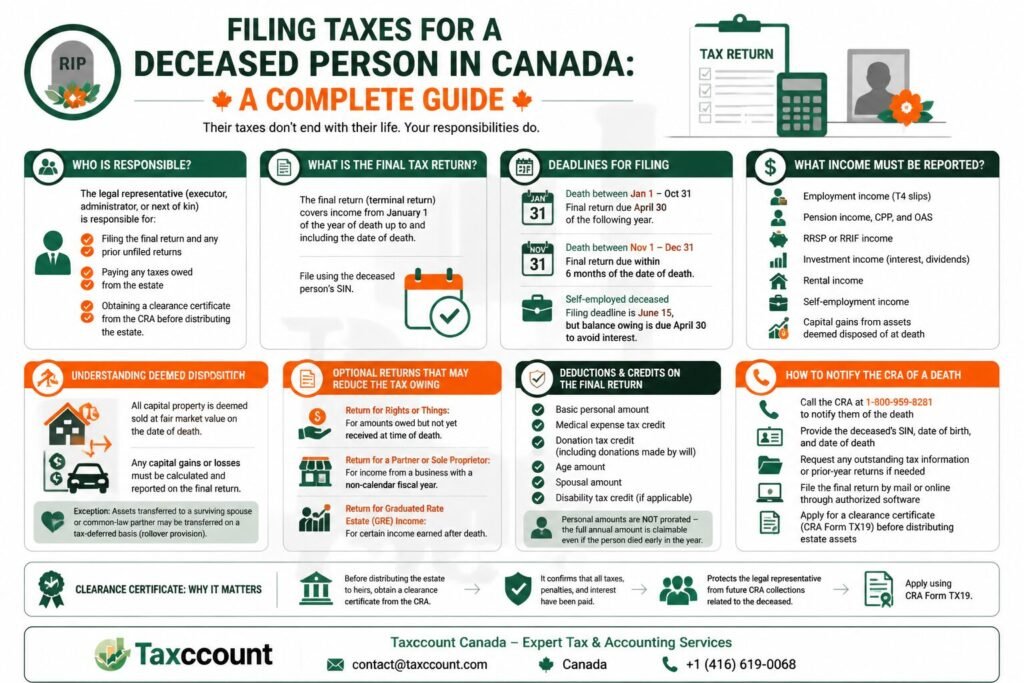
The person responsible for filing the tax return of a deceased individual is called the legal representative. This is typically:
- The executor or administrator named in the will
- A court-appointed administrator if there is no will
- A surviving spouse or next of kin in some provinces
As the legal representative, your responsibilities include:
- Filing the final return and any prior unfiled returns
- Paying any taxes owed from the estate
- Obtaining a clearance certificate from the CRA before distributing the estate to beneficiaries
Handle Estate Taxes Properly
☎️ Get HelpWhat Is the Final Tax Return?
The final return (also called the terminal return) covers income from January 1 of the year of death up to and including the date of death. It must be filed using the deceased person’s Social Insurance Number (SIN).
Deadlines for Filing a Deceased Person’s Tax Return
- Death between January 1 and October 31: Final return due April 30 of the following year
- Death between November 1 and December 31: Final return due within 6 months of the date of death
- Self-employed deceased: Filing deadline is June 15, but any balance owing is still due April 30 to avoid interest
What Income Must Be Reported?
The final return must include all income earned up to the date of death, including:
- Employment income (T4 slips)
- Pension income, CPP, and OAS
- RRSP or RRIF income
- Investment income (interest, dividends)
- Rental income
- Self-employment income
- Capital gains from assets deemed disposed of at death
Understanding Deemed Disposition at Death
When a person dies, the CRA treats all capital property as if it was sold at fair market value on the date of death. This is called deemed disposition. Any capital gains or losses from this deemed sale must be calculated and reported on the final return.
A notable exception applies when assets are transferred to a surviving spouse or common-law partner — in this case, the transfer can often be done on a tax-deferred basis (rollover provision).
Optional Returns That May Reduce the Tax Owing
Canadian tax law allows legal representatives to file up to three optional returns in addition to the final return. Each return uses separate personal amounts, potentially reducing the total tax bill:
- Return for Rights or Things: For amounts owed but not yet received at time of death (e.g., uncashed dividends)
- Return for a Partner or Sole Proprietor: For income from a business with a non-calendar fiscal year
- Return for Graduated Rate Estate (GRE) Income: For certain income earned after death
Deductions and Credits on the Final Return
The final return can claim most standard deductions and credits, and importantly, personal amounts are not prorated — the full annual amount is claimable even if the person died early in the year. Eligible credits include:
- Basic personal amount
- Medical expense tax credit
- Donation tax credit (including donations made by will)
- Age amount, spousal amount
- Disability tax credit (if applicable)
How to Notify the CRA of a Death
- Call the CRA at 1-800-959-8281 to notify them of the death
- Provide the deceased’s SIN, date of birth, and date of death
- Request any outstanding tax information or prior-year returns if needed
- File the final return by mail or online through authorized software
- Apply for a clearance certificate (CRA Form TX19) before distributing estate assets
Clearance Certificate: Why It Matters
Before distributing the estate to heirs, the legal representative should obtain a clearance certificate from the CRA. This document confirms that all taxes, penalties, and interest have been paid or secured. Without it, the legal representative can be held personally liable for any CRA amounts owed by the deceased.
Table of Summary
Here is the blog information in 6 easy rows for quick understanding:
| Section | Easy Information |
|---|---|
| 1. Topic | The blog explains how to check your tax return status in Canada after filing with the CRA. |
| 2. When Status Appears | NETFILE (online): ~2 weeks; paper return: up to 8 weeks; non-resident/complex returns: up to 16 weeks. |
| 3. Ways to Check | 1) CRA My Account (online), 2) MyCRA mobile app, 3) CRA TIPS automated phone line (1-800-267-6999). |
| 4. Online Step-by-Step | Sign in to CRA My Account → View Returns → Select tax year → See status (Received, Being Processed, Assessed). |
| 5. Reasons for Delays | Paper filing, review or audit, missing/inconsistent info, owing a balance applied to debts, or peak filing season. |
| 6. Tips to Speed Refund | File electronically, set up direct deposit, file early, double-check your return to avoid errors, and consult Taxccount for support. |
Frequently Asked Questions
Do I need to file a tax return for a deceased person?
Yes. A final tax return must be filed for the year of death. You may also need to file returns for prior years if they were never filed.
Can the estate get a tax refund?
Yes. If the deceased overpaid taxes through payroll deductions or instalments, the estate is entitled to a refund. It will be issued to the estate.
What happens to an RRSP when someone dies?
The full RRSP balance is generally included in the deceased’s income in the year of death, unless it is transferred to a qualifying surviving spouse or financially dependent child or grandchild.
How long does it take the CRA to process a deceased person’s return?
It can take several months, especially if the estate is complex. Applying for a clearance certificate can take up to 120 days or longer after all returns are filed and taxes paid.
Get Estate Tax Help
☎️ Get HelpThis is general information only and not professional advice. Consult a professional before acting.
 Written and fact-checked by Udit Gupta
 Written and fact-checked by
 Ex Big4, Ernst & Young, Deloitte | International & Cross-Border Tax Specialist | CPA Canada In Depth Tax Training | Licensed Chartered Accountant from ICAI & MIA
Udit Gupta has over 15 years of experience helping corporations & business owners with corporate structuring, corporate tax filing, bookkeeping, payroll, GST/HST, cross-border tax and CRA representation. Big 4 trained at Ernst & Young and Deloitte, and qualified as a Chartered Accountant in India and Malaysia, he founded accounting firm in 2014 to serve entrepreneurs, startups and non-resident business owners across Canada. View Full Member Bio.
Indian Institute of Chartered Accountant Member No. (521458) | Malaysian Institute of Accountants Membership number (CA 44667) | Ex Big4,Ex Ernst & Young (EY), Ex-Deloitte | CPA Canada In-Depth Tax Training 19 Dec 2023, 12 Jul 2022, 5 Jul 2023
Editorial policy. Every article is researched against primary sources — the Income Tax Act, CRA publications and CPA Canada.